Plecostachys serpyllifolia
Petite-licorice
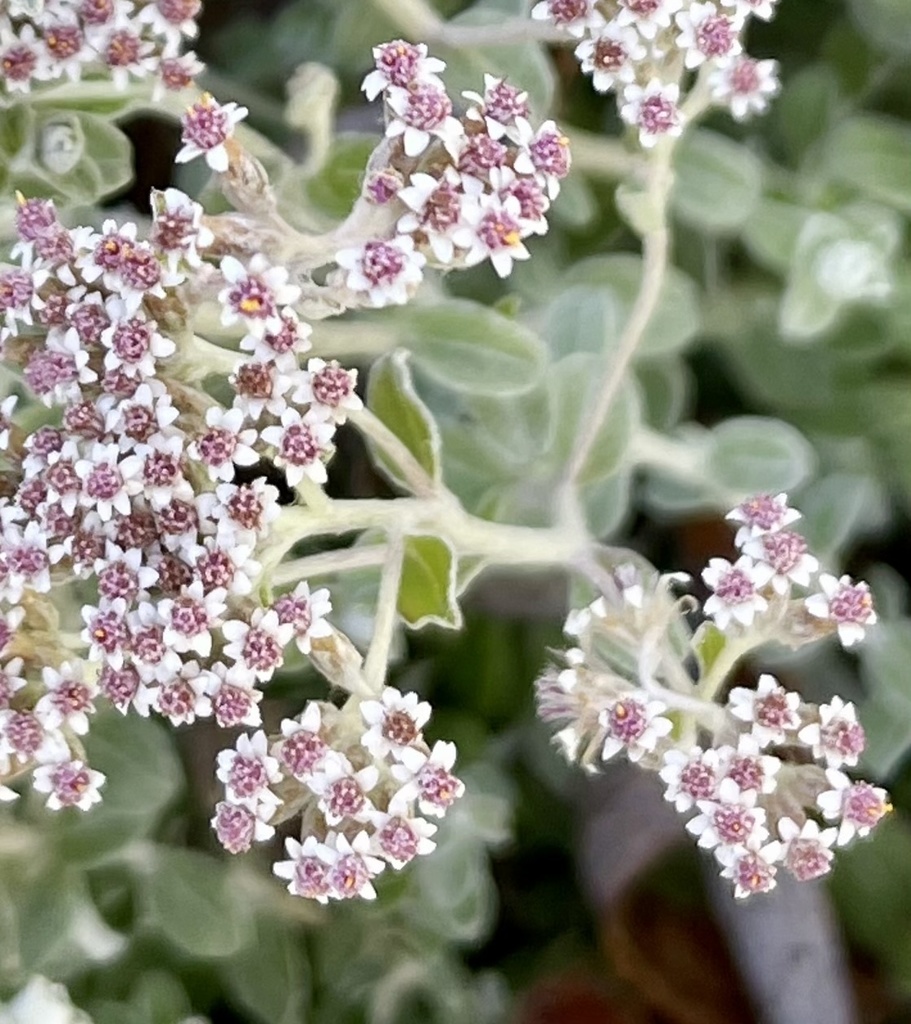
no rights reserved, uploaded by Irene · CC0
Family: Asteraceae · Type: Shrub · Not Native
Conservation status: Cal-IPC Yes
Plecostachys serpyllifolia (Petite-licorice) is a non-native California shrub in the Asteraceae family, recognized by South African ornamental now naturalized along coast - only member of this genus established outside native range.
Petite-licorice is a naturalized shrub found in the central and southern California Coast bioregions on sea bluffs, coastal wetlands, and saline soils at elevations below 350 meters. Flowering from February to June, this plant produces small white or cream-colored flowers in dense heads of 20 to 50 clusters. Growing with spreading, leafy stems 30 to 150 centimeters tall, it forms an open and expansive growth habit. Its leaves are relatively small, measuring 4 to 9 millimeters long, with an elliptical to rounded shape that becomes increasingly smooth on the upper surface with age. When mature, the plant produces tiny brown fruits approximately 0.7 to 0.8 millimeters long, accompanied by a delicate pappus 2 to 2.5 millimeters in length.
Identification and appearance
Key characters: South African ornamental now naturalized along coast - only member of this genus established outside native range
Habitat and range
Habitat: Sea bluffs, grassy areas, coastal wetlands, strand, saline or alkaline soils, escaped from cultivation
Elevation: < 350 m
Outside California: Portugal, native to southern Africa
Bloom period
Plecostachys serpyllifolia blooms Feb-Jun.
Conservation status
Cal-IPC Yes
How to tell it apart
vs Eriogonum: Plecostachys is in Asteraceae with composite heads; Eriogonum is in Polygonaceae with clusters of tiny simple flowers.; vs Eriophyllum: Plecostachys is a woody coastal shrub; Eriophyllum is herbaceous with showy yellow ray flowers.; vs Helichrysum: Plecostachys has slender much-branched stems; Helichrysum typically has larger, showier papery flower heads.; vs Artemisia: Plecostachys has woolly white leaves; Artemisia has aromatic, often silver-gray divided leaves.; vs Anaphalis: Plecostachys is a woody coastal shrub; Anaphalis is a rhizomatous herbaceous perennial.
Frequently asked questions
Is Plecostachys serpyllifolia native to California?
No. Plecostachys serpyllifolia is not native to California (recorded as not native).
When does Plecostachys serpyllifolia bloom?
Plecostachys serpyllifolia blooms Feb-Jun.
What plant family does Plecostachys serpyllifolia belong to?
Plecostachys serpyllifolia is in the Asteraceae family, genus Plecostachys.
Is Plecostachys serpyllifolia invasive in California?
Plecostachys serpyllifolia is listed by Cal-IPC with an invasiveness rating of Yes.
What habitat does Plecostachys serpyllifolia grow in?
Plecostachys serpyllifolia grows in Sea bluffs, grassy areas, coastal wetlands, strand, saline or alkaline soils, escaped from cultivation.
Related species
Other California species in the same genus, family, or bioregion.
Sources: Jepson eFlora · CalPhotos
Last updated 2026-10-07
Data from The California Species Project — 14,000+ California species with verified data from CNPS, CDFW, USFWS, Cal-IPC, and more.