Plectritis ciliosa
Long spurred plectritis
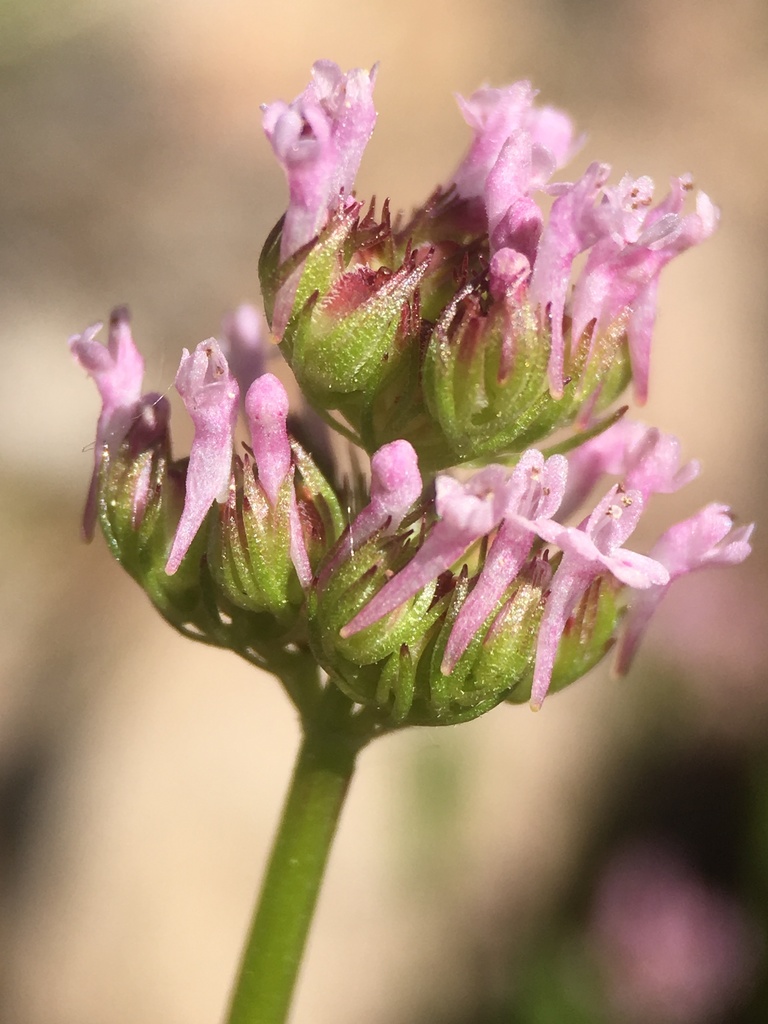
(c) Matt Berger, some rights reserved (CC BY) · licence
Family: Valerianaceae · Type: Herb · Native
Plectritis ciliosa (Long spurred plectritis) is a native California herb in the Valerianaceae family, recognized by spur length/shape and wing characteristics.
Long spurred plectritis is a California native annual found in the California Floristic Province on open, partly shaded slopes at elevations below 2,100 meters. Flowering from March to June, this delicate plant produces pink to dark pink flowers with distinctive two-lipped corollas featuring two red spots and a slender, pointed spur. Growing with thin, branching stems, it reaches modest heights typical of annual wildflowers. Its flowers have intriguing details, including bracts with reddish hues and a corolla measuring 1.5 to 8.5 millimeters long. When mature, its fruits develop pink to brown wings with vertical bands of hairs, with wing margins dramatically thickening as the fruit develops.
Identification and appearance
Key characters: 3 sympatric species; distinguished by spur length/shape and wing characteristics
Habitat and range
Habitat: Common. Open, partly shaded slopes
Elevation: < 2100 m
California counties: San Luis Obispo, Kern, Los Angeles, Tuolumne, Fresno, San Bernardino, Butte, Trinity, Amador, Madera, El Dorado, Tehama, Calaveras, Tulare, Orange, Riverside, Monterey, Yolo, Merced, Napa, Colusa, Sacramento, Sutter, Lake, Sonoma, Contra Costa, Glenn, Mendocino, Alameda, Santa Barbara, Marin, Santa Clara, Humboldt, Nevada, Placer, Siskiyou, Shasta, San Mateo, San Diego, Ventura, Solano, San Benito, Stanislaus, San Francisco, Mariposa, Yuba
Outside California: to Washington, Arizona, northern Baja California
Bloom period
Plectritis ciliosa blooms Mar-Jun.
How to tell it apart
vs Valerianella: Plectritis branches simply; Valerianella forks repeatedly in a symmetrical candelabra pattern.; vs Valeriana: Plectritis is annual with simple leaves; Valeriana is perennial with fern-like compound leaves.; vs Whipplea: Plectritis has tiny spurred flowers in dense clusters; Whipplea has 5-petaled white flowers with opposite leaves.; vs Centranthus: Plectritis is a delicate annual; Centranthus is a robust perennial with bright purple-red flowers.; vs Trifolium: Plectritis has tiny tubular flowers; Trifolium has pea-family flowers with three-part clover leaves.
Frequently asked questions
Is Plectritis ciliosa native to California?
Yes. Plectritis ciliosa is native to California (recorded as native).
When does Plectritis ciliosa bloom?
Plectritis ciliosa blooms Mar-Jun.
Where in California does Plectritis ciliosa grow?
Plectritis ciliosa occurs in San Luis Obispo, Kern, Los Angeles, Tuolumne, Fresno, San Bernardino, Butte, Trinity and other counties, at elevations of < 2100 m.
What plant family does Plectritis ciliosa belong to?
Plectritis ciliosa is in the Valerianaceae family, genus Plectritis.
What habitat does Plectritis ciliosa grow in?
Plectritis ciliosa grows in Common. Open, partly shaded slopes.
Related species
Other California species in the same genus, family, or bioregion.
Sources: Jepson eFlora · Index of California Plant Names · CalPhotos
Last updated 2026-10-07
Data from The California Species Project — 14,000+ California species with verified data from CNPS, CDFW, USFWS, Cal-IPC, and more.