Pleiacanthus spinosus
Thorny skeletonweed
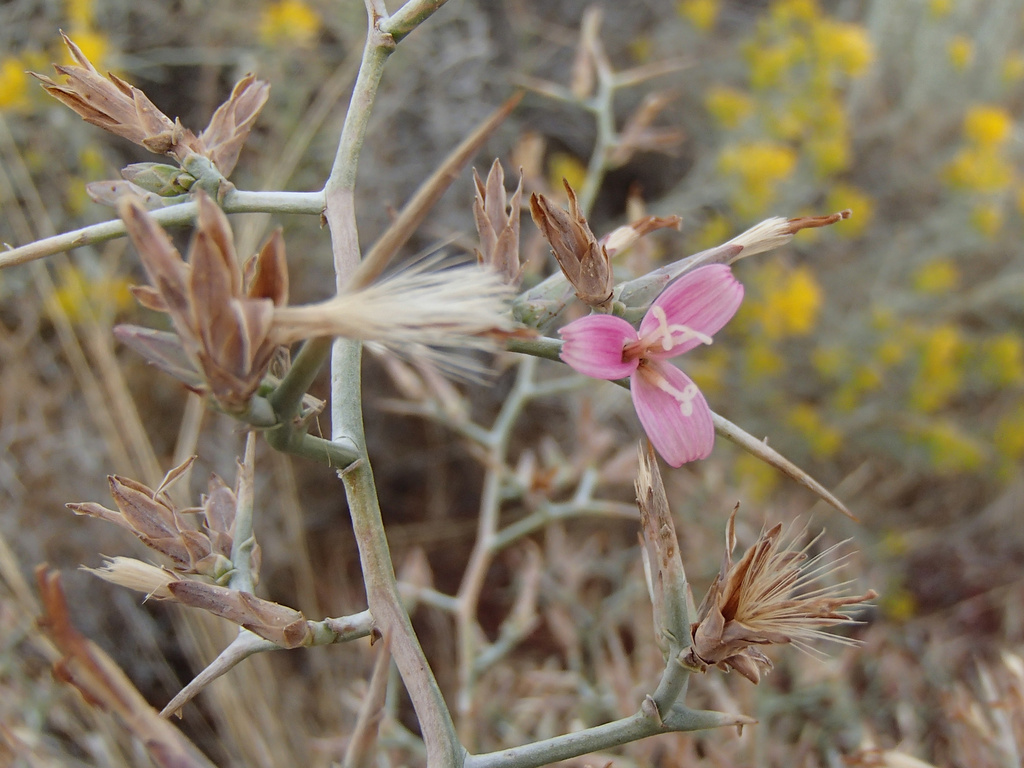
(c) Tom Wainwright, some rights reserved (CC BY), uploaded by Tom Wainwright · licence
Family: Asteraceae · Type: Subshrub · Native
Pleiacanthus spinosus (Thorny skeletonweed) is a native California subshrub in the Asteraceae family, recognized by Great Basin endemic - recently segregated from Stephanomeria based on woody habit and distinctive branching pattern.
Thorny skeletonweed is a California native shrub found in the Sierra Nevada, San Gabriel Mountains, San Bernardino Mountains, Great Basin, and Desert Mountains in gravelly washes, slopes, sagebrush scrub, and pinyon-juniper woodland at elevations of 425 to 2,900 meters. Flowering from June to September, this distinctive plant produces pink, lavender, or red-purple flowers (occasionally white) in solitary heads with delicate ligules. Growing with rigidly spreading branches 1 to 5 decimeters tall, it emerges from a woody caudex and features thorn-tipped branches with woolly-hairy axils. Its leaves are sparse, with proximal linear leaves and distal bract-like leaves, creating a skeletal, architectural form. The plant produces cylindric fruits with five faces, each with a long, narrow groove, and topped with a persistent pappus of light tan bristles.
Identification and appearance
Key characters: Great Basin endemic - recently segregated from Stephanomeria based on woody habit and distinctive branching pattern
Habitat and range
Habitat: Gravelly washes, slopes, sagebrush scrub, pinyon/juniper woodland
Elevation: 425-2900 m
California counties: Alpine, Inyo, Lassen, Mono, Los Angeles, Siskiyou, Tulare, Nevada, Sierra, Plumas, Modoc
Outside California: to Oregon, Montana, Utah, Arizona
Bloom period
Pleiacanthus spinosus blooms Jun-Sep.
How to tell it apart
vs Stephanomeria: Stephanomeria stems are smooth or slightly rough, never armed with sharp spines like Pleiacanthus.; vs Menodora: Menodora has tubular 4-lobed flowers (Oleaceae family), Pleiacanthus has composite ray flowers.; vs Chondrilla: Chondrilla has smooth stems and yellow flowers, Pleiacanthus has thorny stems and pink-purple flowers.; vs Hieracium: Hieracium has hairy but never thorny stems and always yellow flowers.; vs Prenanthella: Prenanthella has smooth stems and nodding buds, Pleiacanthus has thorny stems and erect buds.
Frequently asked questions
Is Pleiacanthus spinosus native to California?
Yes. Pleiacanthus spinosus is native to California (recorded as native).
When does Pleiacanthus spinosus bloom?
Pleiacanthus spinosus blooms Jun-Sep.
Where in California does Pleiacanthus spinosus grow?
Pleiacanthus spinosus occurs in Alpine, Inyo, Lassen, Mono, Los Angeles, Siskiyou, Tulare, Nevada and other counties, at elevations of 425-2900 m.
What plant family does Pleiacanthus spinosus belong to?
Pleiacanthus spinosus is in the Asteraceae family, genus Pleiacanthus.
What habitat does Pleiacanthus spinosus grow in?
Pleiacanthus spinosus grows in Gravelly washes, slopes, sagebrush scrub, pinyon/juniper woodland.
Related species
Other California species in the same genus, family, or bioregion.
Sources: Jepson eFlora · Index of California Plant Names · CalPhotos
Last updated 2026-10-07
Data from The California Species Project — 14,000+ California species with verified data from CNPS, CDFW, USFWS, Cal-IPC, and more.