Poa abbreviata
Dwarf blue grass, Dwarf Blue Grass
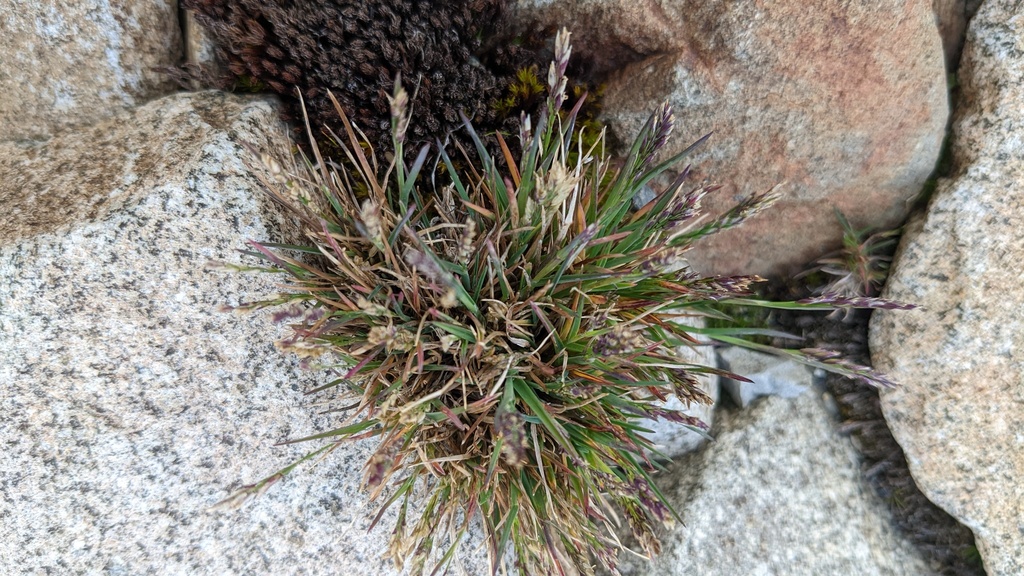
(c) Trevor Van Loon, some rights reserved (CC BY) · licence
Family: Poaceae · Type: Grass · Native
Poa abbreviata (Dwarf blue grass) is a native California grass in the Poaceae family.
Dwarf blue grass is a California native perennial found in alpine and subalpine habitats at elevations typically above 2,500 meters. Flowering from July to August, this delicate grass produces small blue-green flowers in dense, compact clusters about 2 to 6 centimeters long. Growing in tight, densely clustered tufts 5 to 15 centimeters tall, it forms multiple sterile shoots that create a compact ground-hugging form. Its narrow leaves are tightly folded, approximately 1.5 to 2 millimeters wide, with open sheaths that persist at the base of the plant. The grass has distinctive lemmas with hairy margins and keels, creating a soft, intricate texture in high-elevation mountain landscapes.
How to tell it apart
vs Festuca: Poa has boat-shaped, keeled leaf tips; Festuca leaves are flat or rolled but never keeled like a ship's prow.; vs Melica: Poa has fine, narrow leaves with boat-shaped tips; Melica has wider, flat leaves without the distinctive keel.; vs Nassella: Poa leaves have boat-shaped tips you can feel; Nassella leaves roll inward and lack the keel.; vs Koeleria: Poa has cobwebby hairs at seed base and keeled leaf tips; Koeleria lacks both features.; vs Holcus: Poa has boat-shaped leaf tips; Holcus leaves are flat and soft-hairy without any keel.
Frequently asked questions
Is Poa abbreviata native to California?
Yes. Poa abbreviata is native to California (recorded as native).
What plant family does Poa abbreviata belong to?
Poa abbreviata is in the Poaceae family, genus Poa.
Related species
Other California species in the same genus, family, or bioregion.
Sources: Jepson eFlora · CalPhotos
Last updated 2026-10-07
Data from The California Species Project — 14,000+ California species with verified data from CNPS, CDFW, USFWS, Cal-IPC, and more.