Poa diaboli
Diablo canyon blue grass, Diablo Canyon Blue Grass
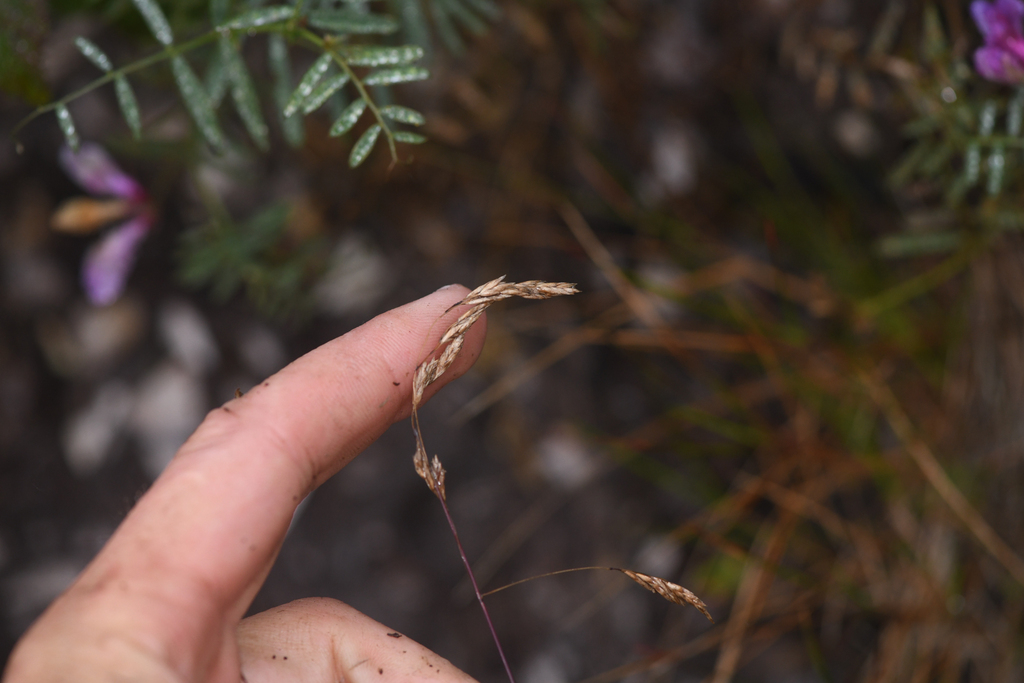
(c) Trevor Van Loon, some rights reserved (CC BY) · licence
Family: Poaceae · Type: Perennial · Native
Conservation status: CNPS 1B.2
Poa diaboli (Diablo canyon blue grass) is a native California perennial in the Poaceae family, recognized by distinctive habitat and large glabrous lemmas.
Diablo canyon blue grass is a rare (CNPS 1B.2) California native perennial found in southern Central Coast region of San Luis Obispo County in upper coastal scrub, live-oak woodland, and Bishop-pine forest at elevations of 120 to 400 meters. Flowering from March to April, this delicate grass produces pale green to green-white flowers in pyramidal inflorescences 4 to 8.5 centimeters long. Growing in loosely tufted mounds up to 30 centimeters across, it spreads through slender rhizomes or stolons with soft, flexible stems 25 to 50 centimeters tall. Its narrow leaves are 0.8 to 2 millimeters wide, soft and flat or slightly folded, with open leaf sheaths and small 1 to 3 millimeter ligules. The delicate grass forms compact, elegant clumps with fine, somewhat hairy leaf surfaces on sterile stems.
Identification and appearance
Key characters: 18 sympatric species; distinctive habitat and large glabrous lemmas
Habitat and range
Habitat: Thin soils on Edna shale slopes, upper coastal scrub, live-oak woodland, Bishop-pine forest, near coast
Elevation: 120-400 m
Bloom period
Poa diaboli blooms Mar-Apr.
Conservation status
CNPS 1B.2
How to tell it apart
vs Festuca: Poa has boat-shaped, keeled leaf tips; Festuca leaves are flat or rolled but never keeled like a ship's prow.; vs Melica: Poa has fine, narrow leaves with boat-shaped tips; Melica has wider, flat leaves without the distinctive keel.; vs Nassella: Poa leaves have boat-shaped tips you can feel; Nassella leaves roll inward and lack the keel.; vs Koeleria: Poa has cobwebby hairs at seed base and keeled leaf tips; Koeleria lacks both features.; vs Holcus: Poa has boat-shaped leaf tips; Holcus leaves are flat and soft-hairy without any keel.
Frequently asked questions
Is Poa diaboli native to California?
Yes. Poa diaboli is native to California (recorded as native).
When does Poa diaboli bloom?
Poa diaboli blooms Mar-Apr.
What plant family does Poa diaboli belong to?
Poa diaboli is in the Poaceae family, genus Poa.
Is Poa diaboli rare or endangered?
Poa diaboli carries California Rare Plant Rank 1B.2, state rank S2.
What habitat does Poa diaboli grow in?
Poa diaboli grows in Thin soils on Edna shale slopes, upper coastal scrub, live-oak woodland, Bishop-pine forest, near coast.
Related species
Other California species in the same genus, family, or bioregion.
Sources: Jepson eFlora · CalPhotos · CDFW CNDDB
Last updated 2026-09-30
Data from The California Species Project — 14,000+ California species with verified data from CNPS, CDFW, USFWS, Cal-IPC, and more.