Poa palustris
Fowl bluegrass
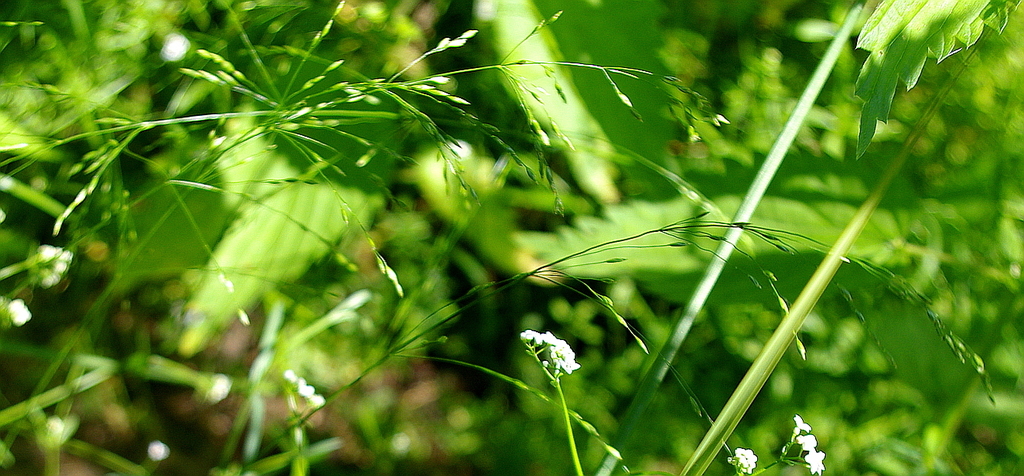
(c) Георгий Виноградов (Georgy Vinogradov), some rights reserved (CC BY) · licence
Family: Poaceae · Type: Grass · Not Native
Poa palustris (Fowl bluegrass) is a non-native California grass in the Poaceae family, recognized by non-native status and hairy stem nodes.
Fowl bluegrass is a naturalized perennial grass found in the Klamath Ranges, northern California High Sierra Nevada, San Gabriel Mountains, San Bernardino Mountains, and Great Basin in disturbed ground, moist forests, sagebrush scrub, meadows, and stream edges at elevations of 1,500 to 2,000 meters. Flowering from May to September, this grass produces small green to pale green spikelets in open, lanceolate inflorescences 10 to 30 centimeters long. Growing in dense tufts or with spreading stolons, it forms soft, flat stems 25 to 120 centimeters tall with occasional descending prickles below the nodes. Its leaves have soft, flat blades 1.5 to 6 millimeters wide, with open sheaths and short ligules 1 to 3 millimeters long. The plant produces delicate spikelets with lemmas 2 to 3 millimeters long, featuring hairy marginal veins and long cobwebby flower bases.
Identification and appearance
Key characters: 31 sympatric species; distinguished by non-native status and hairy stem nodes
Habitat and range
Habitat: Disturbed ground in moist forest or sagebrush scrub, meadows, along streams
Elevation: 1500-2000 m
California counties: San Bernardino, Butte, Modoc, Mono, Plumas, Tulare, Lassen, Sierra, Placer, San Diego, Los Angeles, Amador, El Dorado, Inyo, San Joaquin, Trinity, Ventura, Nevada, Siskiyou, Yuba, Mendocino, Tuolumne, Calaveras, Alpine, Humboldt, Santa Barbara, Lake, Shasta, Alameda, Tehama
Outside California: cool temperate, native to North America boreal forest, Eurasia
Bloom period
Poa palustris blooms May-Sep.
How to tell it apart
vs Festuca: Poa has boat-shaped, keeled leaf tips; Festuca leaves are flat or rolled but never keeled like a ship's prow.; vs Melica: Poa has fine, narrow leaves with boat-shaped tips; Melica has wider, flat leaves without the distinctive keel.; vs Nassella: Poa leaves have boat-shaped tips you can feel; Nassella leaves roll inward and lack the keel.; vs Koeleria: Poa has cobwebby hairs at seed base and keeled leaf tips; Koeleria lacks both features.; vs Holcus: Poa has boat-shaped leaf tips; Holcus leaves are flat and soft-hairy without any keel.
Frequently asked questions
Is Poa palustris native to California?
No. Poa palustris is not native to California (recorded as not native).
When does Poa palustris bloom?
Poa palustris blooms May-Sep.
Where in California does Poa palustris grow?
Poa palustris occurs in San Bernardino, Butte, Modoc, Mono, Plumas, Tulare, Lassen, Sierra and other counties, at elevations of 1500-2000 m.
What plant family does Poa palustris belong to?
Poa palustris is in the Poaceae family, genus Poa.
What habitat does Poa palustris grow in?
Poa palustris grows in Disturbed ground in moist forest or sagebrush scrub, meadows, along streams.
Related species
Other California species in the same genus, family, or bioregion.
Sources: Jepson eFlora · Index of California Plant Names · CalPhotos
Last updated 2026-10-07
Data from The California Species Project — 14,000+ California species with verified data from CNPS, CDFW, USFWS, Cal-IPC, and more.