Poa secunda var. secunda
Sandberg bluegrass, canby bluegrass
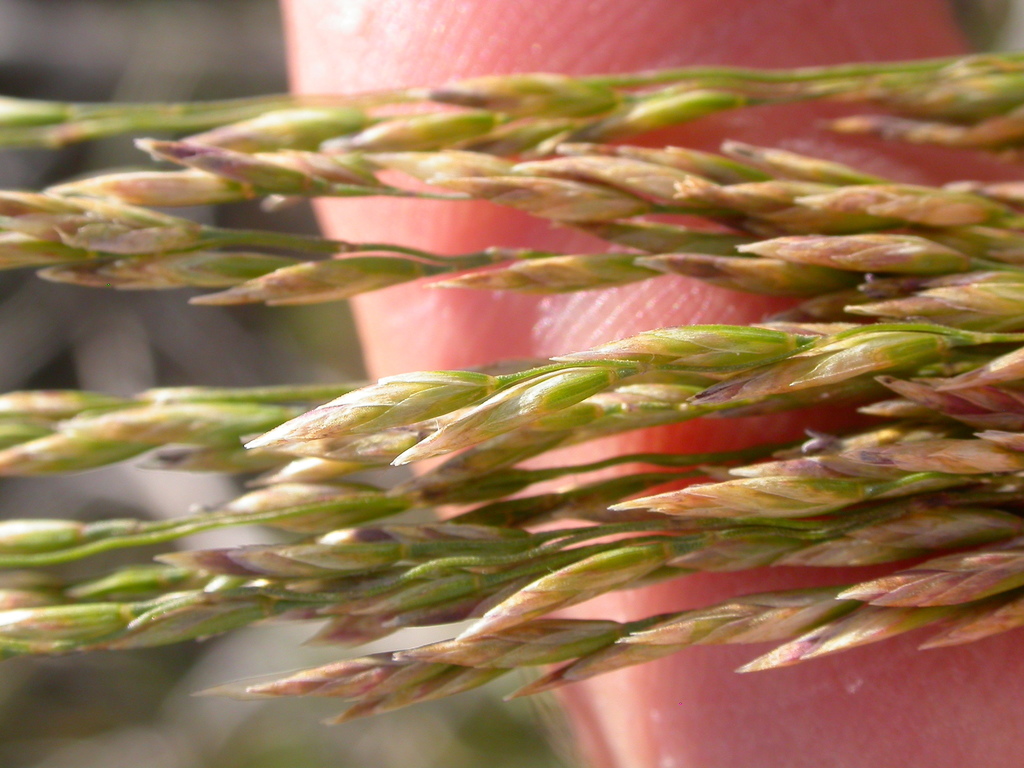
(c) Matt Lavin, some rights reserved (CC BY-SA) · licence
Family: Poaceae · Type: Perennial · Native
Poa secunda var. secunda (Sandberg bluegrass) is a native California perennial in the Poaceae family, recognized by soft leaves, temporarily open panicles, and lemma pubescence pattern.
Sandberg bluegrass is a native perennial grass found in sagebrush deserts, pinyon-juniper woodland, higher montane forests, and alpine regions across western North America at elevations of 900 to 3,900 meters. Flowering from May to August, this grass produces delicate, soft green to pale green flower clusters in contracted panicles 3 to 15 centimeters long. Growing with slender stems 15 to 120 centimeters tall, it forms soft, flexible clumps with smooth to slightly rough leaf sheaths. Its leaves are soft and narrow, with smooth or slightly scabrous ligules 2 to 5 millimeters long that add a subtle texture to its delicate appearance. Each spikelet contains 3 to 6 florets, with lemmas that are short-hairy over the lower body, creating a subtly textured and intricate grassland presence.
Identification and appearance
Key characters: 47 sympatric species; key features are soft leaves, temporarily open panicles, and lemma pubescence pattern
Habitat and range
Habitat: Sagebrush deserts, pinyon-juniper woodland, higher montane forests, to alpine
Elevation: 900-3900 m
Outside California: to Alaska, western Canada and Quebec, west-central United States, also Argentina, Chile
Bloom period
Poa secunda var. secunda blooms May-Aug.
How to tell it apart
vs Festuca: Poa has boat-shaped, keeled leaf tips; Festuca leaves are flat or rolled but never keeled like a ship's prow.; vs Melica: Poa has fine, narrow leaves with boat-shaped tips; Melica has wider, flat leaves without the distinctive keel.; vs Nassella: Poa leaves have boat-shaped tips you can feel; Nassella leaves roll inward and lack the keel.; vs Koeleria: Poa has cobwebby hairs at seed base and keeled leaf tips; Koeleria lacks both features.; vs Holcus: Poa has boat-shaped leaf tips; Holcus leaves are flat and soft-hairy without any keel.
Frequently asked questions
Is Poa secunda var. secunda native to California?
Yes. Poa secunda var. secunda is native to California (recorded as native).
When does Poa secunda var. secunda bloom?
Poa secunda var. secunda blooms May-Aug.
What plant family does Poa secunda var. secunda belong to?
Poa secunda var. secunda is in the Poaceae family, genus Poa.
What habitat does Poa secunda var. secunda grow in?
Poa secunda var. secunda grows in Sagebrush deserts, pinyon-juniper woodland, higher montane forests, to alpine.
Related species
Other California species in the same genus, family, or bioregion.
Sources: Jepson eFlora · CalPhotos
Last updated 2026-09-30
Data from The California Species Project — 14,000+ California species with verified data from CNPS, CDFW, USFWS, Cal-IPC, and more.