Poa wheeleri
Hooker's bluegrass
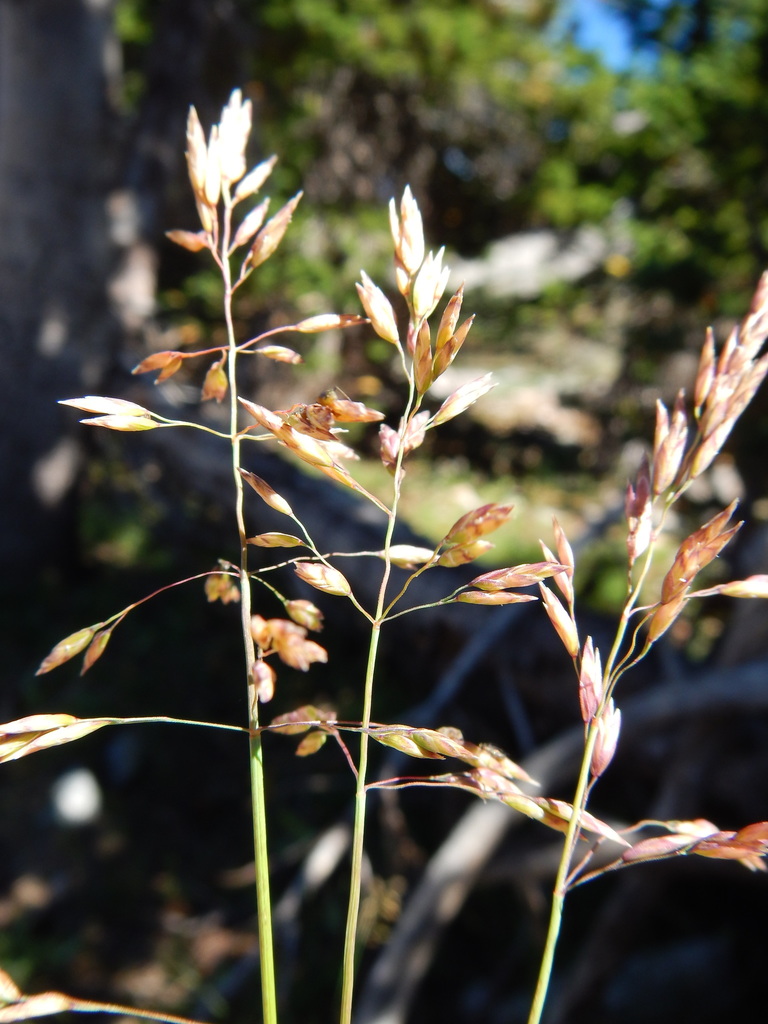
(c) Matt Lavin, some rights reserved (CC BY) · licence
Family: Poaceae · Type: Grass · Native
Poa wheeleri (Hooker's bluegrass) is a native California grass in the Poaceae family, recognized by pistillate flowers and asexual reproduction.
Hooker's bluegrass is a California native perennial grass found in the Klamath Ranges, northern Coast Ranges, California Ranges, Sierra Nevada, and Great Basin mountains in open forest with rich soil at elevations of 1,300 to 3,800 meters. Flowering from May to August, this grass produces pale green to whitish flowers in sparse, open panicles 5 to 12 centimeters long. Growing with tufted stems 35 to 80 centimeters tall, emerging from short rhizomes and forming distinctive grass clumps. Its leaf blades are 1.5 to 3.5 millimeters wide, soft to somewhat firm, often folded or inrolled, with upper surfaces finely hairy. The plant reproduces asexually, with lemmas 3 to 6 millimeters long and glabrous to sparsely hairy surfaces.
Identification and appearance
Key characters: 32 sympatric species; distinguished by pistillate flowers and asexual reproduction
Habitat and range
Habitat: Common (especially SN), mountains, open forest in rich soil
Elevation: 1300-3800 m
California counties: Mono, San Bernardino, Fresno, Plumas, Tulare, Tuolumne, Inyo, Modoc, Shasta, Placer, Amador, Alpine, Mariposa, Butte, Trinity, El Dorado, Madera, Nevada, Lassen, Siskiyou, Calaveras, Sierra, Lake, Del Norte, Riverside, Kern
Outside California: to British Columbia, Manitoba, Montana, New Mexico
Bloom period
Poa wheeleri blooms May-Aug.
How to tell it apart
vs Festuca: Poa has boat-shaped, keeled leaf tips; Festuca leaves are flat or rolled but never keeled like a ship's prow.; vs Melica: Poa has fine, narrow leaves with boat-shaped tips; Melica has wider, flat leaves without the distinctive keel.; vs Nassella: Poa leaves have boat-shaped tips you can feel; Nassella leaves roll inward and lack the keel.; vs Koeleria: Poa has cobwebby hairs at seed base and keeled leaf tips; Koeleria lacks both features.; vs Holcus: Poa has boat-shaped leaf tips; Holcus leaves are flat and soft-hairy without any keel.
Frequently asked questions
Is Poa wheeleri native to California?
Yes. Poa wheeleri is native to California (recorded as native).
When does Poa wheeleri bloom?
Poa wheeleri blooms May-Aug.
Where in California does Poa wheeleri grow?
Poa wheeleri occurs in Mono, San Bernardino, Fresno, Plumas, Tulare, Tuolumne, Inyo, Modoc and other counties, at elevations of 1300-3800 m.
What plant family does Poa wheeleri belong to?
Poa wheeleri is in the Poaceae family, genus Poa.
What habitat does Poa wheeleri grow in?
Poa wheeleri grows in Common (especially SN), mountains, open forest in rich soil.
Related species
Other California species in the same genus, family, or bioregion.
- Poa abbreviata — Dwarf blue grass
- Poa abbreviata subsp. marshii — Marsh's blue grass
- Poa abbreviata subsp. pattersonii — Patterson's blue grass
- Poa annua — Annual blue grass
- Poa atropurpurea — San bernardino bluegrass
- Poa bigelovii — Bigelow's blue grass
- Polypogon australis — Chilean beard grass
- Polypogon imberbis — Streambank rabbits foot grass
- Polypogon interruptus — Ditch beard grass
- Polypogon maritimus — Mediterranean beard grass
Sources: Jepson eFlora · Index of California Plant Names · CalPhotos
Last updated 2026-10-07
Data from The California Species Project — 14,000+ California species with verified data from CNPS, CDFW, USFWS, Cal-IPC, and more.