Polanisia dodecandra subsp. trachysperma
Western clammyweed, Western Clammyweed
no rights reserved · CC0
Family: Cleomaceae · Type: Herb · Native
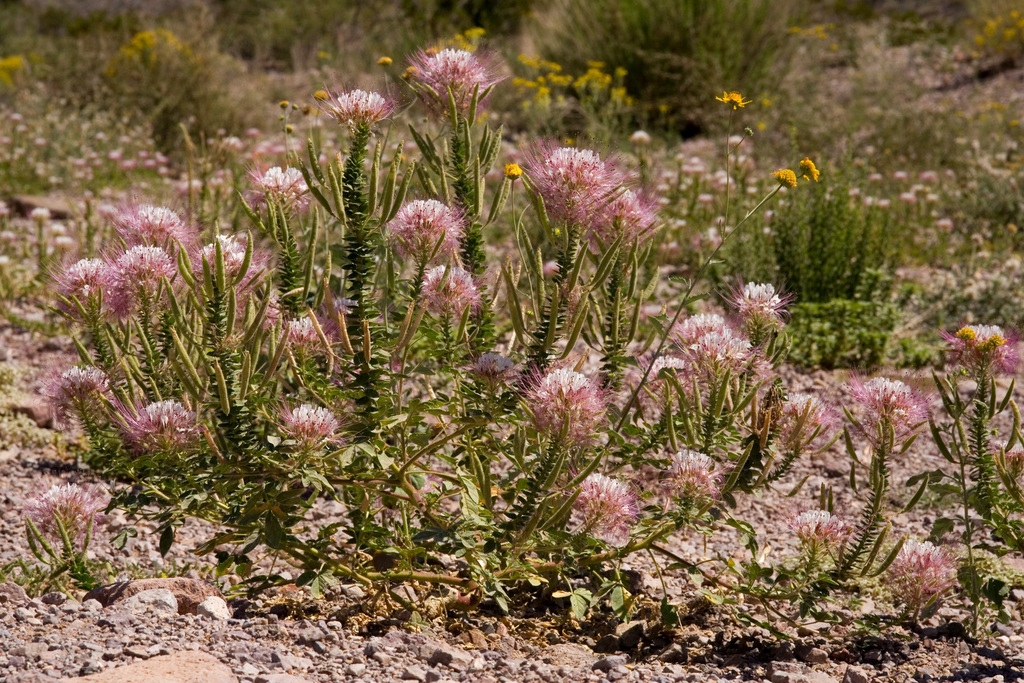
Polanisia dodecandra subsp. trachysperma (Western clammyweed) is a native California herb in the Cleomaceae family, recognized by Western North American subspecies of widespread species - only member of recently segregated spider flower family in California.
Western clammyweed is a California native annual found in northern California, including the Cascade Range, Sierra Nevada foothills, Sacramento Valley, and Modoc Plateau in gravel bars, roadsides, and disturbed areas at elevations of 30 to 1,680 meters. Flowering from June to September, this plant produces white petals with purple sepals and stamens, creating delicate flowers 6 to 13 millimeters long with a distinctive bright orange nectary. Growing with slender stems 5 to 30 centimeters tall, it develops green to purple-tinted flower clusters that emerge after the leaves. Its compound leaves have multiple leaflets 1.6 to 4.5 centimeters long, carried on petioles 1.5 to 4.5 centimeters in length. The mature fruit develops as a green pod 4 to 7 centimeters long and 5 to 9 millimeters wide.
Identification and appearance
Key characters: Western North American subspecies of widespread species - only member of recently segregated spider flower family in California
Habitat and range
Habitat: Gravel bars, roadsides, disturbed areas
Elevation: 30-1680 m
California counties: Mariposa, Colusa, Butte, Tehama, Glenn, Riverside, Modoc, Shasta, Sacramento
Outside California: to eastern Canada, southeastern United States
Bloom period
Polanisia dodecandra subsp. trachysperma blooms Jun-Sep.
How to tell it apart
vs Oxystylis: Polanisia has many stamens and unstalked capsules; Oxystylis has 6 stamens and spine-tipped nutlets.; vs Wislizenia: Wislizenia has 6 stamens and paired nutlets; Polanisia has 8-32 stamens and capsules.; vs Carsonia: Carsonia has 6 stamens and stalked capsules; Polanisia has 8-32 stamens and sessile capsules.; vs Peritoma: Peritoma has 6 stamens and long-stalked capsules; Polanisia has 8-32 stamens and unstalked capsules.; vs Cleomella: Cleomella has 6 stamens and tiny round capsules; Polanisia has 8-32 stamens creating bristly flowers.
Frequently asked questions
Is Polanisia dodecandra subsp. trachysperma native to California?
Yes. Polanisia dodecandra subsp. trachysperma is native to California (recorded as native).
When does Polanisia dodecandra subsp. trachysperma bloom?
Polanisia dodecandra subsp. trachysperma blooms Jun-Sep.
Where in California does Polanisia dodecandra subsp. trachysperma grow?
Polanisia dodecandra subsp. trachysperma occurs in Mariposa, Colusa, Butte, Tehama, Glenn, Riverside, Modoc, Shasta and other counties, at elevations of 30-1680 m.
What plant family does Polanisia dodecandra subsp. trachysperma belong to?
Polanisia dodecandra subsp. trachysperma is in the Cleomaceae family, genus Polanisia.
What habitat does Polanisia dodecandra subsp. trachysperma grow in?
Polanisia dodecandra subsp. trachysperma grows in Gravel bars, roadsides, disturbed areas.
Related species
Other California species in the same genus, family, or bioregion.
Sources: Jepson eFlora · Index of California Plant Names · CalPhotos
Last updated 2026-10-07
Data from The California Species Project — 14,000+ California species with verified data from CNPS, CDFW, USFWS, Cal-IPC, and more.