Polemonium chartaceum
Mason's sky pilot, Mason's Sky Pilot
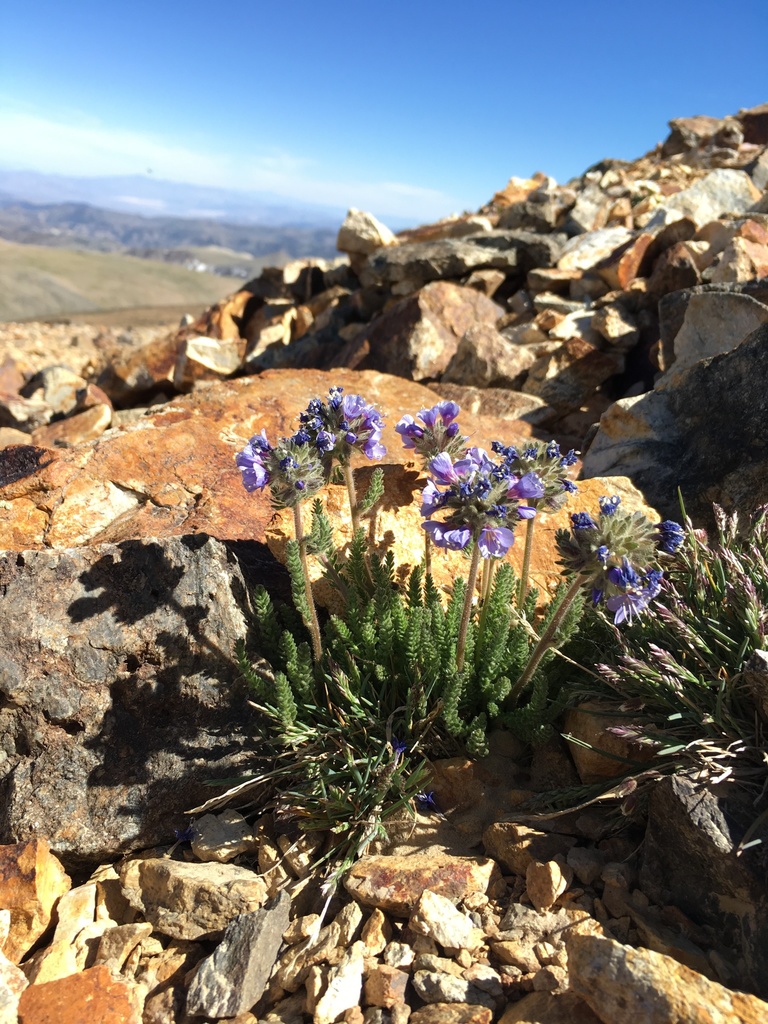
(c) Martin Purdy, some rights reserved (CC BY) · licence
Family: Polemoniaceae · Type: Herb · Native
Conservation status: CNPS 1B.3
Polemonium chartaceum (Mason's sky pilot) is a native California herb in the Polemoniaceae family, recognized by deeply lobed leaflets and geographic restriction.
Mason's sky pilot is a rare (CNPS 1B.3) California native perennial found in the eastern Sierra Nevada Mountains, specifically in the Sweetwater and White Mountains, on rocky slopes and talus at elevations of 2,600 to 4,200 meters. Flowering from July to August, this plant produces blue to purple flowers in heads with a funnel-shaped corolla and a limb 5 to 12 millimeters in diameter. Growing with erect, hairy stems less than 20 centimeters tall that are slightly purple, it forms a dense cespitose clump with a short rhizome. Its basal leaves have 15 to 25 small leaflets, each deeply 3 to 5-lobed and less than 4 millimeters long, with membranous sheathing leaf bases. The fruit is approximately 4 millimeters long and contains up to 6 brown seeds.
Identification and appearance
Key characters: 3 sympatric species; deeply lobed leaflets and geographic restriction are diagnostic
Habitat and range
Habitat: Rocky slopes, talus
Elevation: 2600-4200 m
California counties: Mono, Nevada, Siskiyou, Inyo, Trinity
Bloom period
Polemonium chartaceum blooms Jul-Aug.
Conservation status
CNPS 1B.3
How to tell it apart
vs Phlox: Polemonium (Jacob's ladder) has pinnately compound leaves with many discrete leaflets arranged ladder-like along the rachis; Phlox has simple, entire, usually opposite leaves.; vs Gilia: Polemonium bears true separate leaflets; Gilia leaves are pinnately dissected into narrow lobes rather than divided into distinct leaflets.; vs Ipomopsis: Polemonium leaflets are broad and entire; Ipomopsis leaves are finely cut into thread-like segments.; vs Collomia: Polemonium has compound leaves and open branched cymes; Collomia has entire to lobed leaves and flowers clustered among leafy bracts.; vs Vicia: Polemonium leaves lack tendrils and its flowers are radially symmetric bells or funnels; vetch leaves end in tendrils and bear bilateral pea flowers.
Frequently asked questions
Is Polemonium chartaceum native to California?
Yes. Polemonium chartaceum is native to California (recorded as native).
When does Polemonium chartaceum bloom?
Polemonium chartaceum blooms Jul-Aug.
Where in California does Polemonium chartaceum grow?
Polemonium chartaceum occurs in Mono, Nevada, Siskiyou, Inyo, Trinity, at elevations of 2600-4200 m.
What plant family does Polemonium chartaceum belong to?
Polemonium chartaceum is in the Polemoniaceae family, genus Polemonium.
Is Polemonium chartaceum rare or endangered?
Polemonium chartaceum carries California Rare Plant Rank 1B.3, state rank S2.
Related species
Other California species in the same genus, family, or bioregion.
Sources: Jepson eFlora · CNPS Rare Plant Inventory · Index of California Plant Names · CalPhotos · CDFW CNDDB
Last updated 2026-10-07
Data from The California Species Project — 14,000+ California species with verified data from CNPS, CDFW, USFWS, Cal-IPC, and more.