Poliomintha incana
Frosted mint
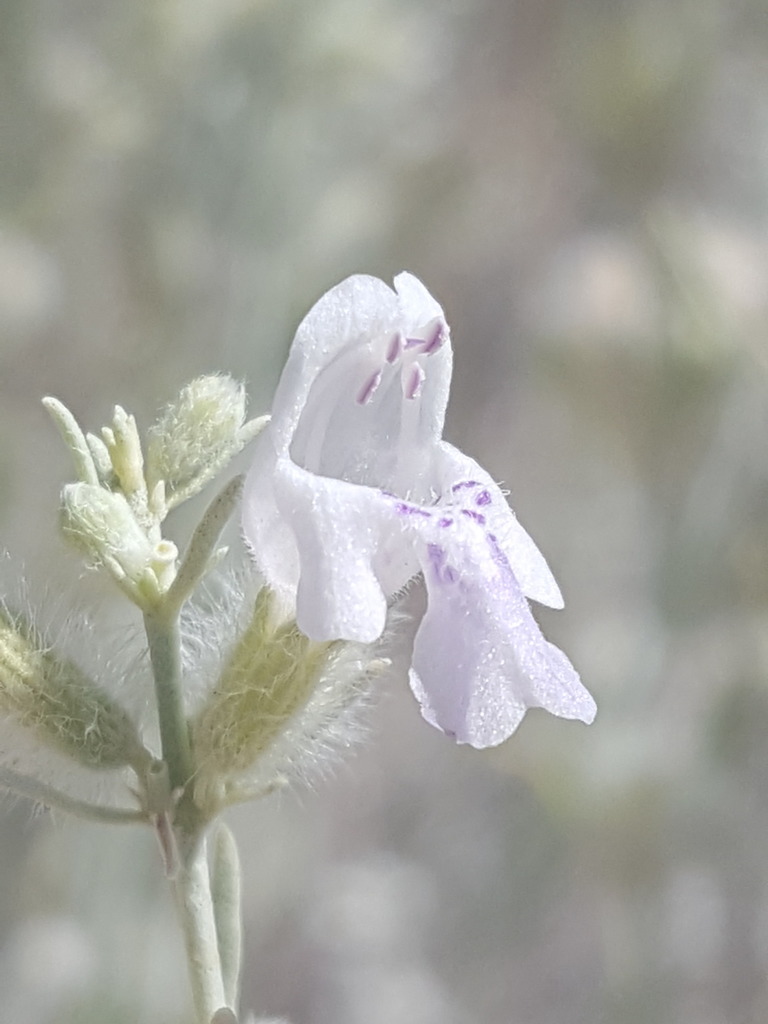
(c) Alex Abair, some rights reserved (CC BY), uploaded by Alex Abair · licence
Family: Lamiaceae · Type: Shrub · Native
Conservation status: CNPS 2A
Poliomintha incana (Frosted mint) is a native California shrub in the Lamiaceae family, recognized by 0 congeners - only Poliomintha in CA; aromatic mounded desert mint-shrub restricted to Cushenbury Springs.
Frosted mint is a rare (CNPS 2A) California native shrub found in the southern Mojave Desert at Cushenbury Springs in sandy soils and rocky slopes at elevations below 1,700 meters. Flowering from June to July, this plant produces light blue to lavender flowers 8 to 10 millimeters long with distinctive purple dots on the lower lip. Growing 50 to 100 centimeters tall with a rounded or mound-like form, it develops dense, compact branches. Its leaves are narrow and elongated, measuring 5 to 18 millimeters long and 2 to 4 millimeters wide, becoming smaller and more reduced toward the stem tips. The plant is characterized by densely short-hairy calyxes and a compact, rounded growth habit that helps it survive in harsh desert environments.
Identification and appearance
Key characters: 0 congeners - only Poliomintha in CA; aromatic mounded desert mint-shrub restricted to Cushenbury Springs
Habitat and range
Habitat: Sandy soils, rocky slopes
Elevation: < 1700 m
Outside California: to Colorado, Texas, northern Mexico
Bloom period
Poliomintha incana blooms Jun-Jul.
Conservation status
CNPS 2A
How to tell it apart
vs Lycopus: Poliomintha is a woody upland shrub, while Lycopus is a wetland herb.; vs Salvia: Poliomintha forms a compact rounded mound 5-10 feet tall, while most Salvia are smaller herbs or open-branched shrubs.; vs Monarda: Poliomintha is a rounded woody shrub, while Monarda is a small herb under 5 feet.; vs Acanthomintha: Poliomintha is a woody perennial shrub, while Acanthomintha is a tiny annual herb.; vs Hedeoma: Poliomintha is a mound-like shrub 5-10 feet tall, while Hedeoma is a small perennial herb.
Frequently asked questions
Is Poliomintha incana native to California?
Yes. Poliomintha incana is native to California (recorded as native).
When does Poliomintha incana bloom?
Poliomintha incana blooms Jun-Jul.
What plant family does Poliomintha incana belong to?
Poliomintha incana is in the Lamiaceae family, genus Poliomintha.
Is Poliomintha incana rare or endangered?
Poliomintha incana carries California Rare Plant Rank 2A, state rank SH.
What habitat does Poliomintha incana grow in?
Poliomintha incana grows in Sandy soils, rocky slopes.
Related species
Other California species in the same genus, family, or bioregion.
Sources: Jepson eFlora · CalPhotos · CDFW CNDDB
Last updated 2026-10-07
Data from The California Species Project — 14,000+ California species with verified data from CNPS, CDFW, USFWS, Cal-IPC, and more.