Polycarpon tetraphyllum subsp. depressum
California allseed
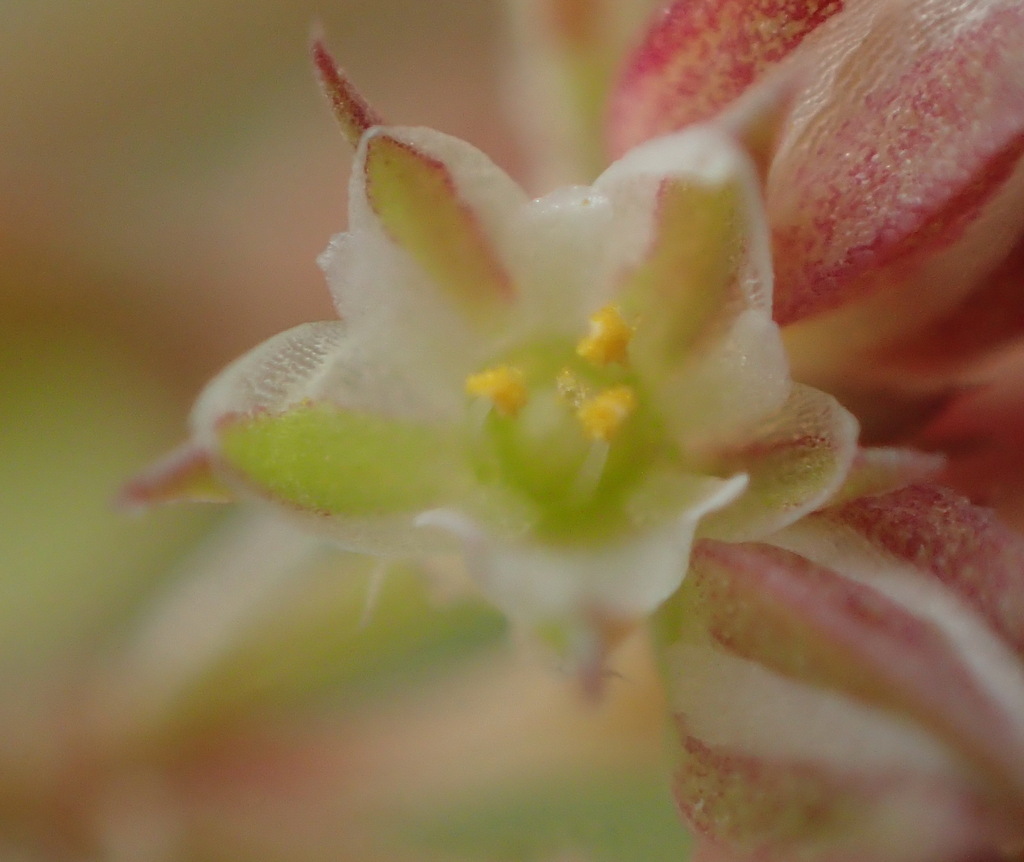
(c) Nicola van Berkel, some rights reserved (CC BY-SA), uploaded by Nicola van Berkel · licence
Family: Caryophyllaceae · Type: Annual · Native
Polycarpon tetraphyllum subsp. depressum (California allseed) is a native California annual in the Caryophyllaceae family, recognized by 2 sympatric subspecies; key differences in leaf succulence, size, and stipule shape.
California allseed is a California native annual found in southern California coastal regions, Santa Catalina Island, and surrounding areas in bluffs, gravelly or sandy soil, and chaparral at elevations below 500 meters. Flowering from spring to summer, this plant produces tiny, delicate white flowers that rarely open except after wet conditions. Growing with prostrate stems 1 to 6 centimeters long that mound together in moist environments, it forms low-spreading clusters across the landscape. Its leaves are small and somewhat succulent, measuring 3 to 7 millimeters long, with oblanceolate to obovate blades and delicate ovate stipules. The seeds are minutely granular, allowing the plant to persist in fragile coastal and disturbed habitats.
Identification and appearance
Key characters: 2 sympatric subspecies; key differences in leaf succulence, size, and stipule shape
Habitat and range
Habitat: Bluffs, gravelly or sandy soil, chaparral, fields, rarely low lying disturbed areas
Elevation: < 500 m
California counties: San Bernardino, Los Angeles, Lake, Monterey, Orange, Riverside, San Diego, Santa Barbara, Alameda, San Luis Obispo, Ventura, San Benito, Santa Cruz, Fresno
Outside California: Baja California
Bloom period
Polycarpon tetraphyllum subsp. depressum blooms Spring-summer.
How to tell it apart
vs Euphorbia: Polycarpon has separate tiny white flowers; Euphorbia has a cup-like cyathium with milky sap when broken.; vs Stellaria: Polycarpon has spoon-shaped leaves with stalks; Stellaria has stalkless, pointed oval leaves.; vs Portulaca: Polycarpon has thin, flat spoon-shaped leaves; Portulaca has succulent, cylindrical leaves.; vs Soleirolia: Polycarpon has white flowers with visible separate petals; Soleirolia has tiny flowers hidden in leaf axils.; vs Crassula: Polycarpon has thin, flat leaves; Crassula has thick, succulent leaves often in tight rosettes.
Frequently asked questions
Is Polycarpon tetraphyllum subsp. depressum native to California?
Yes. Polycarpon tetraphyllum subsp. depressum is native to California (recorded as native).
When does Polycarpon tetraphyllum subsp. depressum bloom?
Polycarpon tetraphyllum subsp. depressum blooms Spring-summer.
Where in California does Polycarpon tetraphyllum subsp. depressum grow?
Polycarpon tetraphyllum subsp. depressum occurs in San Bernardino, Los Angeles, Lake, Monterey, Orange, Riverside, San Diego, Santa Barbara and other counties, at elevations of < 500 m.
What plant family does Polycarpon tetraphyllum subsp. depressum belong to?
Polycarpon tetraphyllum subsp. depressum is in the Caryophyllaceae family, genus Polycarpon.
What habitat does Polycarpon tetraphyllum subsp. depressum grow in?
Polycarpon tetraphyllum subsp. depressum grows in Bluffs, gravelly or sandy soil, chaparral, fields, rarely low lying disturbed areas.
Related species
Other California species in the same genus, family, or bioregion.
Sources: Jepson eFlora · CalPhotos
Last updated 2026-09-30
Data from The California Species Project — 14,000+ California species with verified data from CNPS, CDFW, USFWS, Cal-IPC, and more.