Polyctenium fremontii
Desert combleaf
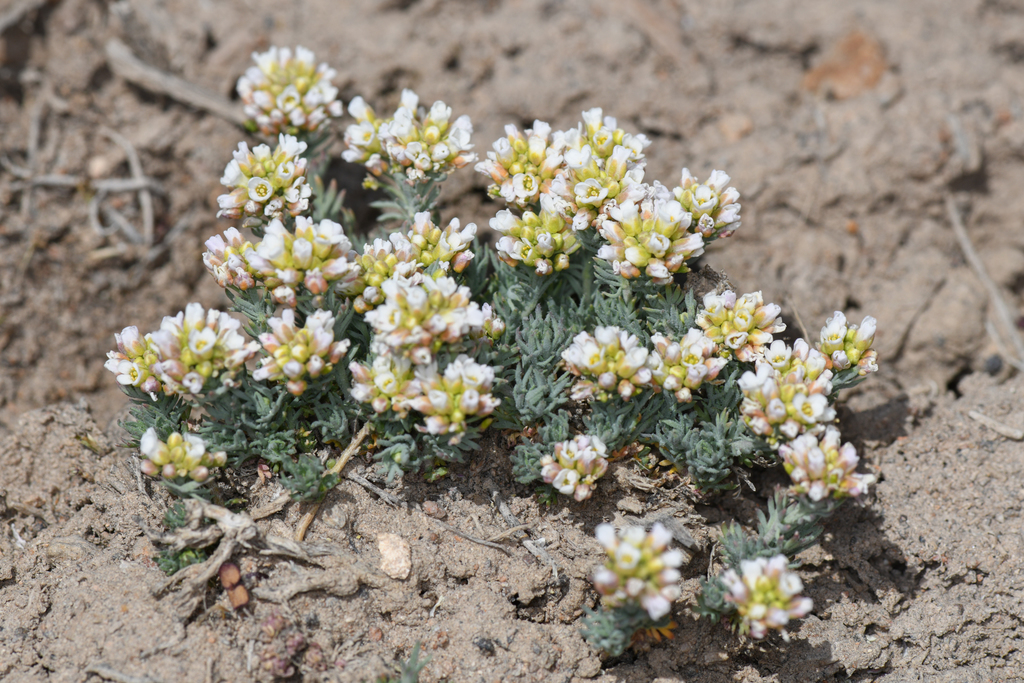
(c) Trevor Van Loon, some rights reserved (CC BY) · licence
Family: Brassicaceae · Type: Herb · Native
Conservation status: CNPS 1B.2
Polyctenium fremontii (Desert combleaf) is a native California herb in the Brassicaceae family.
Desert combleaf is a rare (CNPS 1B.2) California native perennial found in the Great Basin in saline soils, vernal pool edges, lake margins, meadows, and sagebrush scrub at elevations of 1,000 to 2,500 meters. Flowering from May to July, this plant produces white to pale purple flowers 5 to 6 millimeters long. Growing with woody-based stems 5 to 16 centimeters tall, it forms dense tufted clumps with many-branched hairs that give the plant a distinctive glaucous appearance. Its leaves are rigidly divided into 3 to 4 pairs of narrow linear lobes, with the terminal lobe 4 to 7 millimeters long and less than a millimeter wide. The plant produces linear siliques 4 to 13 millimeters long, developing from ascending flowers with erect sepals.
Identification and appearance
Key characters: 0 sympatric species; geographically isolated in Great Basin Province
Habitat and range
Habitat: Saline soils, vernal pool edges, lake margins, meadows, swales, mud flats, dry streambeds, gravel bars, sagebrush scrub
Elevation: 1000-2500 m
California counties: Lassen, Modoc, Mono, Siskiyou, Plumas, Sierra
Outside California: to Oregon, Idaho, Nevada
Bloom period
Polyctenium fremontii blooms May-Jul.
Conservation status
CNPS 1B.2
How to tell it apart
vs Sibara: Polyctenium leaves feel stiff and rigid like combs; Sibara leaves are soft and flexible.; vs Descurainia: Polyctenium has rigid prickly leaves and is perennial; Descurainia has soft fuzzy leaves and is annual.; vs Arabis: Polyctenium has deeply divided comb-like leaves; Arabis has simple undivided leaves with smooth or toothed edges.; vs Boechera: Polyctenium has rigid comb-divided leaves; Boechera has simple undivided leaves.; vs Arabidopsis: Polyctenium has rigid comb-like divided leaves; Arabidopsis has simple smooth-edged undivided leaves.
Frequently asked questions
Is Polyctenium fremontii native to California?
Yes. Polyctenium fremontii is native to California (recorded as native).
When does Polyctenium fremontii bloom?
Polyctenium fremontii blooms May-Jul.
Where in California does Polyctenium fremontii grow?
Polyctenium fremontii occurs in Lassen, Modoc, Mono, Siskiyou, Plumas, Sierra, at elevations of 1000-2500 m.
What plant family does Polyctenium fremontii belong to?
Polyctenium fremontii is in the Brassicaceae family, genus Polyctenium.
Is Polyctenium fremontii rare or endangered?
Polyctenium fremontii carries California Rare Plant Rank 1B.2, state rank S1.
Related species
Other California species in the same genus, family, or bioregion.
Sources: Jepson eFlora · CNPS Rare Plant Inventory · Index of California Plant Names · CalPhotos · CDFW CNDDB
Last updated 2026-10-07
Data from The California Species Project — 14,000+ California species with verified data from CNPS, CDFW, USFWS, Cal-IPC, and more.