Polygonum aviculare
Knotweed, knotgrass, Knotgrass
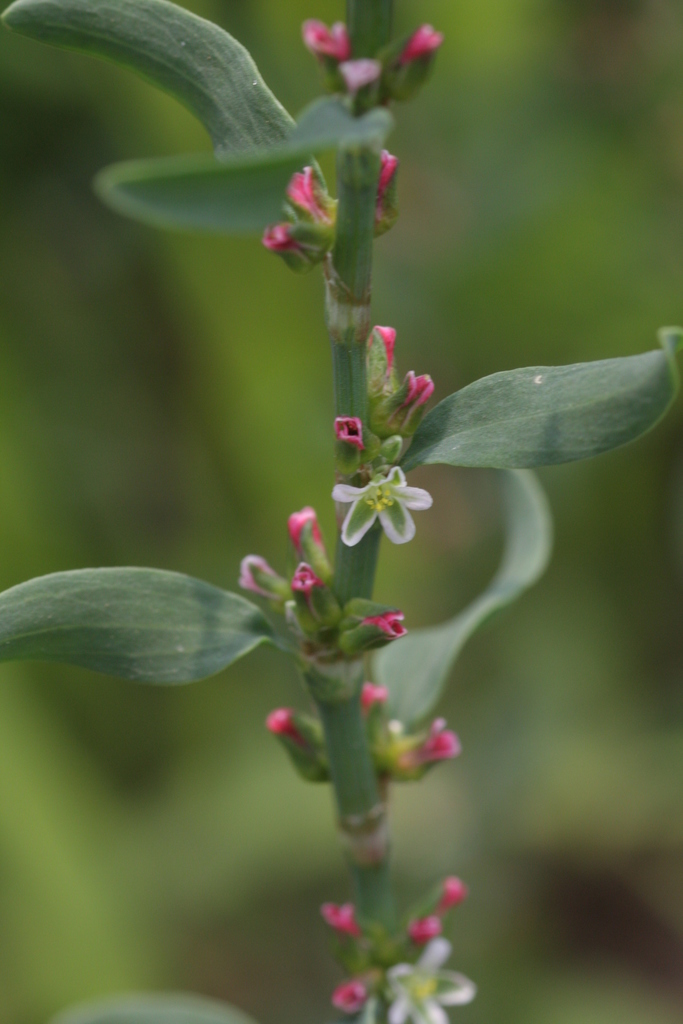
(c) Dalgial, some rights reserved (CC BY-SA) · licence
Family: Polygonaceae · Type: Herb · Not Native
Polygonum aviculare (Knotweed) is a non-native California herb in the Polygonaceae family, recognized by occurs in specific counties with no sympatric congeners.
Knotweed is a naturalized annual plant found in disturbed areas and open spaces across California. Flowering from June to September, this plant produces small white to red-margined flowers crowded in axillary clusters. Growing with prostrate to erect stems 10 to 60 centimeters long, it spreads across the ground in a sprawling, branched form. Its narrow elliptic to lanceolate leaves range from 6 to 50 millimeters long, varying from green to gray-green with flat margins. The plant produces small light to dark brown fruits with coarsely textured, angled surfaces that persist into late season.
Identification and appearance
Key characters: Geographically isolated; occurs in specific counties with no sympatric congeners
Habitat and range
California counties: Amador, Los Angeles, Orange, Ventura, San Bernardino, Santa Cruz, Mono, Santa Clara, Mariposa, San Francisco, Tulare, Butte, San Joaquin, Santa Barbara, San Diego, Fresno, Modoc, Contra Costa, Riverside, Marin, Lake, Sonoma, Stanislaus, San Luis Obispo, Alameda, San Mateo, Siskiyou, Sutter, El Dorado, Sacramento, Tuolumne, Colusa, Kern, Nevada, Yuba, Calaveras, Placer, Inyo, Alpine, Lassen, Monterey, Solano, Yolo, Plumas, Merced, Tehama, Shasta, Sierra, Madera, Trinity, Humboldt, Del Norte, Mendocino
How to tell it apart
vs Euphorbia: Polygonum has swollen stem joints with papery sheaths; Euphorbia has milky sap when broken.; vs Persicaria: Hold node sheaths to light—Polygonum's are translucent and split; Persicaria's are opaque and intact.; vs Eriogonum: Polygonum has papery sheaths at nodes; Eriogonum has flowers in cup-like involucres.; vs Acmispon: Polygonum has swollen stem nodes; Acmispon has compound leaves with 3-5 leaflets.; vs Atriplex: Polygonum has papery stem sheaths; Atriplex has mealy or scurfy coating on leaves.
Frequently asked questions
Is Polygonum aviculare native to California?
No. Polygonum aviculare is not native to California (recorded as not native).
Where in California does Polygonum aviculare grow?
Polygonum aviculare occurs in Amador, Los Angeles, Orange, Ventura, San Bernardino, Santa Cruz, Mono, Santa Clara and other counties.
What plant family does Polygonum aviculare belong to?
Polygonum aviculare is in the Polygonaceae family, genus Polygonum.
Related species
Other California species in the same genus, family, or bioregion.
Sources: Jepson eFlora · Index of California Plant Names · CalPhotos
Last updated 2026-10-07
Data from The California Species Project — 14,000+ California species with verified data from CNPS, CDFW, USFWS, Cal-IPC, and more.