Polypodium calirhiza
Acrid fern
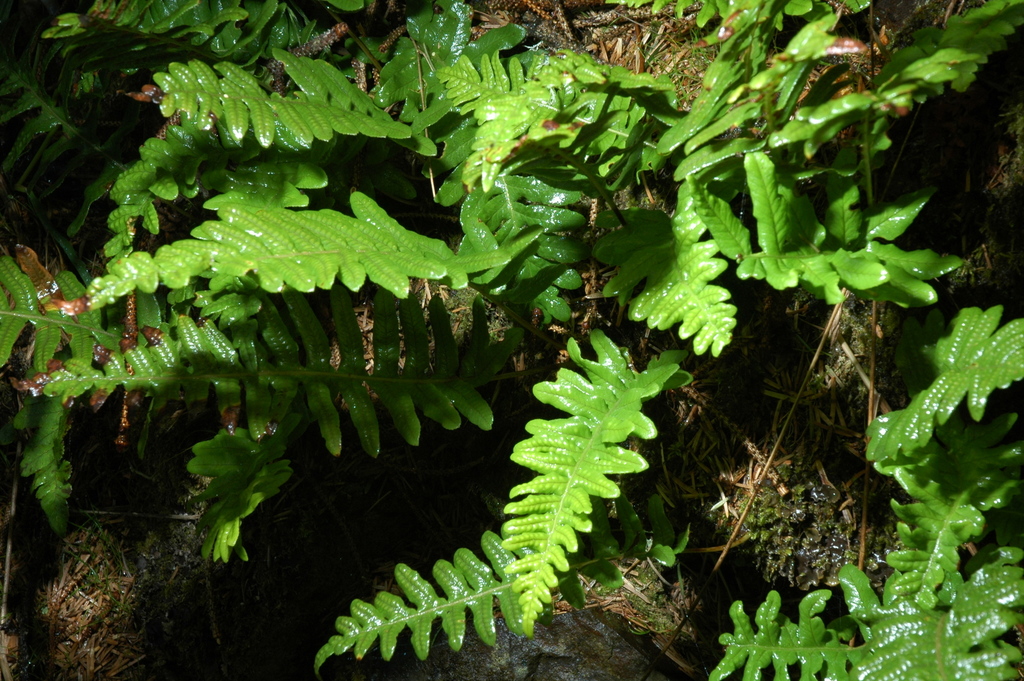
(c) Timothy McNitt, some rights reserved (CC BY) · licence
Family: Polypodiaceae · Type: Herb · Native
Polypodium calirhiza (Acrid fern) is a native California herb in the Polypodiaceae family, recognized by acrid rhizome taste and primarily rocky habitat rather than epiphytic.
Acrid fern is a California native perennial found in northwestern California, the Cascade Range foothills, Sierra Nevada, and central western California in rocky habitats on cliffs, outcrops, and roadcuts, often on granitic or volcanic terrain at elevations below 1,400 meters. Its summer-deciduous fronds grow 10 to 20 centimeters long, with oblong-ovate blades that are slightly membranous to firm. The fern features segments with serrated edges and acute to obtuse tips, with a distinctively hairy midrib on the upper surface. Its rhizome is 5 to 10 millimeters in diameter and produces a notably acrid taste when encountered. The plant produces sori (spore clusters) 1.5 to 4 millimeters long, often accompanied by short, branched glandular hairs.
Identification and appearance
Key characters: 4 sympatric species; distinguished by acrid rhizome taste and primarily rocky habitat rather than epiphytic
Habitat and range
Habitat: On pls, rocky cliffs or outcrops, roadcuts, often granitic or volcanic, rarely dunes
Elevation: < 1400 m
California counties: San Francisco, Amador, Butte, Calaveras, Contra Costa, Humboldt, Marin, Placer, Kern, Monterey, El Dorado, San Luis Obispo, Sonoma, Santa Clara, Mariposa, San Mateo, Plumas, Nevada, Fresno, Napa, Santa Cruz, Lake, Tulare, Tuolumne, Solano, Santa Barbara, Sacramento, Sutter, Shasta, Tehama, Mendocino, Alameda, Yuba, Siskiyou, San Benito, Stanislaus, San Bernardino, Los Angeles, Ventura, Yolo
Outside California: to Oregon
How to tell it apart
vs Polystichum: Polypodium sori are completely naked; Polystichum sori have umbrella-like covers attached at the center.; vs Dryopteris: Polypodium sori lack any covering; Dryopteris sori have kidney-shaped covers attached at the side.; vs Pentagramma: Polypodium sori are on the upper leaf surface; Pentagramma has powder on the lower leaf surface.; vs Pteridium: Polypodium sori are round and exposed; Pteridium sori are hidden under rolled-back leaf margins.; vs Woodwardia: Polypodium has round sori; Woodwardia has elongated chain-like sori in parallel rows.
Frequently asked questions
Is Polypodium calirhiza native to California?
Yes. Polypodium calirhiza is native to California (recorded as native).
Where in California does Polypodium calirhiza grow?
Polypodium calirhiza occurs in San Francisco, Amador, Butte, Calaveras, Contra Costa, Humboldt, Marin, Placer and other counties, at elevations of < 1400 m.
What plant family does Polypodium calirhiza belong to?
Polypodium calirhiza is in the Polypodiaceae family, genus Polypodium.
What habitat does Polypodium calirhiza grow in?
Polypodium calirhiza grows in On pls, rocky cliffs or outcrops, roadcuts, often granitic or volcanic, rarely dunes.
Related species
Other California species in the same genus, family, or bioregion.
Sources: Jepson eFlora · Index of California Plant Names · CalPhotos
Last updated 2026-10-07
Data from The California Species Project — 14,000+ California species with verified data from CNPS, CDFW, USFWS, Cal-IPC, and more.