Polypogon monspeliensis
Annual beard grass, rabbitfoot grass, Rabbitfoot Grass
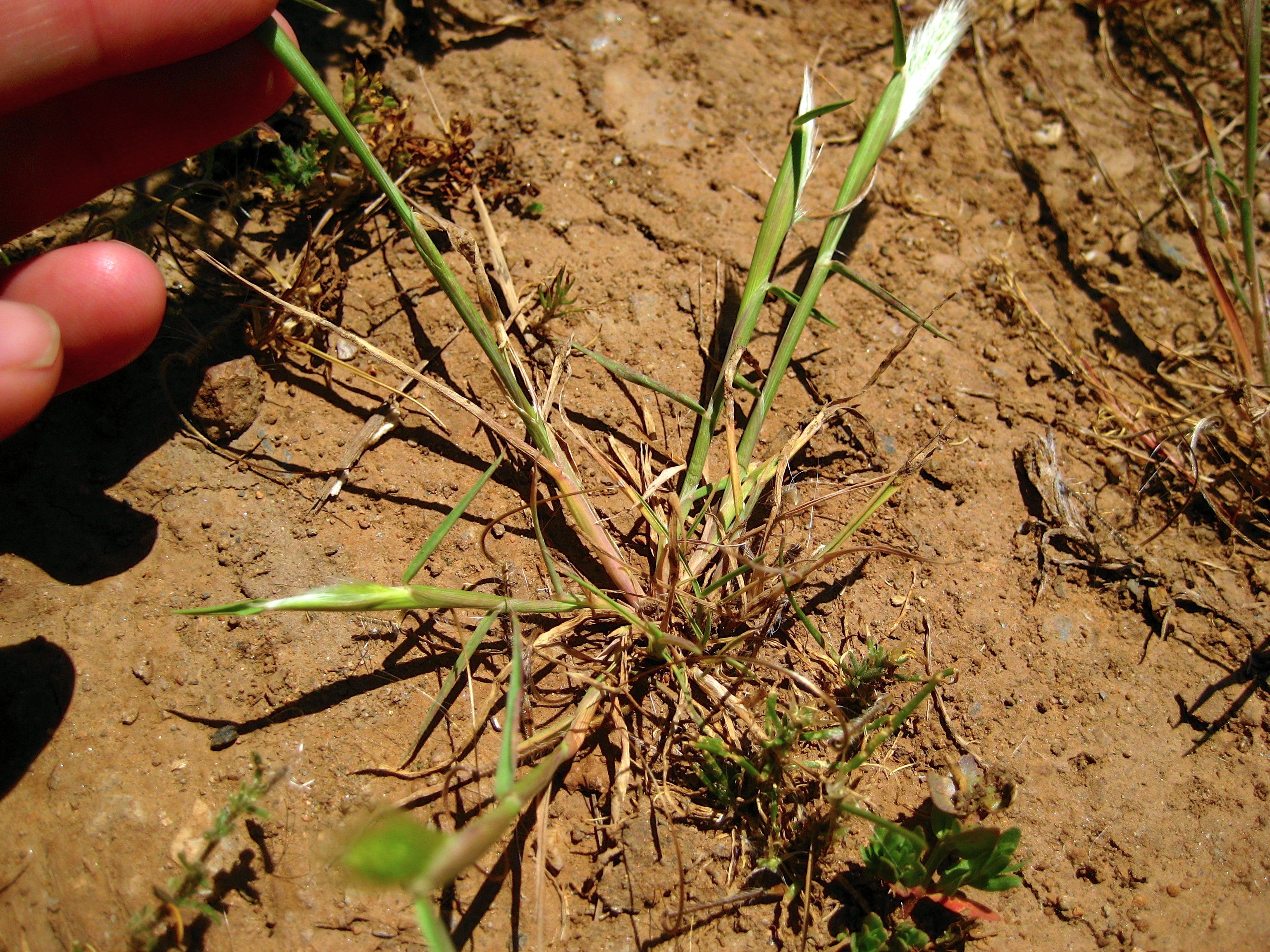
Photo by Chez Brungraber
Family: Poaceae · Type: Grass · Not Native
Conservation status: Cal-IPC Yes
Polypogon monspeliensis (Annual beard grass) is a non-native California grass in the Poaceae family, recognized by 2-lobed glumes and awned lemmas separate it from P. maritimus.
Annual beard grass is a naturalized annual grass found in California in moist places and along streams at elevations below 2,100 meters. Flowering from April to August, this grass produces pale green to pale yellow plume-like inflorescences 1 to 17 centimeters long with delicate bristly flower clusters. Growing with erect stems 20 to 100 centimeters tall, it forms dense, soft-textured grass patches. Its leaves have long ligules 2 to 12 millimeters long that are irregularly toothed and minutely hairy, with blade-like leaves 10 to 20 centimeters long and 4 to 6 millimeters wide. The grass produces small spikelets with short awns 2 to 10 millimeters long, giving it a soft, feathery appearance.
Identification and appearance
Key characters: 5 sympatric species; 2-lobed glumes and awned lemmas separate it from P. maritimus
Habitat and range
Habitat: Common. Moist places, along streams
Elevation: < 2100 m
California counties: Los Angeles, San Bernardino, San Diego, Kern, San Luis Obispo, Humboldt, Alameda, Yolo, Marin, Siskiyou, Lake, Santa Clara, Santa Cruz, Fresno, Sonoma, Tulare, Monterey, Riverside, Orange, Imperial, San Francisco, San Mateo, Lassen, San Joaquin, Colusa, Inyo, Ventura, Mono, Contra Costa, Mendocino, Santa Barbara, Del Norte, Glenn, Madera, Napa, Placer, San Benito, Yuba, El Dorado, Nevada, Modoc, Trinity, Mariposa, Alpine, Calaveras, Merced, Sacramento, Shasta, Solano, Tuolumne, Butte, Kings, Plumas, Sutter, Tehama, Amador, Stanislaus
Outside California: North America, native to southern and western Europe
Bloom period
Polypogon monspeliensis blooms Apr-Aug.
Conservation status
Cal-IPC Yes
How to tell it apart
vs Lagurus: Beard grass has loose fuzzy heads in wet areas; hare's tail has dense white-woolly oval heads in dry areas.; vs Cynosurus: Beard grass has soft fuzzy bristled heads; dogtail has hard one-sided spike-like heads.; vs Hordeum: Beard grass has soft fuzzy heads; barley has stiff, harsh-awned spike-like heads.; vs Setaria: Beard grass spikelets fall intact; foxtail bristles remain on stem after seeds fall.; vs Trifolium: Polypogon is a grass with fuzzy flower spikes; Trifolium is a legume with clover-leaf clusters.
Frequently asked questions
Is Polypogon monspeliensis native to California?
No. Polypogon monspeliensis is not native to California (recorded as not native).
When does Polypogon monspeliensis bloom?
Polypogon monspeliensis blooms Apr-Aug.
Where in California does Polypogon monspeliensis grow?
Polypogon monspeliensis occurs in Los Angeles, San Bernardino, San Diego, Kern, San Luis Obispo, Humboldt, Alameda, Yolo and other counties, at elevations of < 2100 m.
What plant family does Polypogon monspeliensis belong to?
Polypogon monspeliensis is in the Poaceae family, genus Polypogon.
Is Polypogon monspeliensis invasive in California?
Polypogon monspeliensis is listed by Cal-IPC with an invasiveness rating of Yes.
Related species
Other California species in the same genus, family, or bioregion.
- Polypogon sp. — Beard grass
- Polypogon viridis — Water beard grass
- Polypogon australis — Chilean beard grass
- Polypogon imberbis — Streambank rabbits foot grass
- Polypogon interruptus — Ditch beard grass
- Polypogon maritimus — Mediterranean beard grass
- Puccinellia distans — European alkali grass
- Puccinellia howellii — Howell's alkali grass
Sources: Jepson eFlora · Index of California Plant Names · CalPhotos
Last updated 2026-10-07
Data from The California Species Project — 14,000+ California species with verified data from CNPS, CDFW, USFWS, Cal-IPC, and more.