Polystichum kruckebergii
Kruckeberg's sword fern
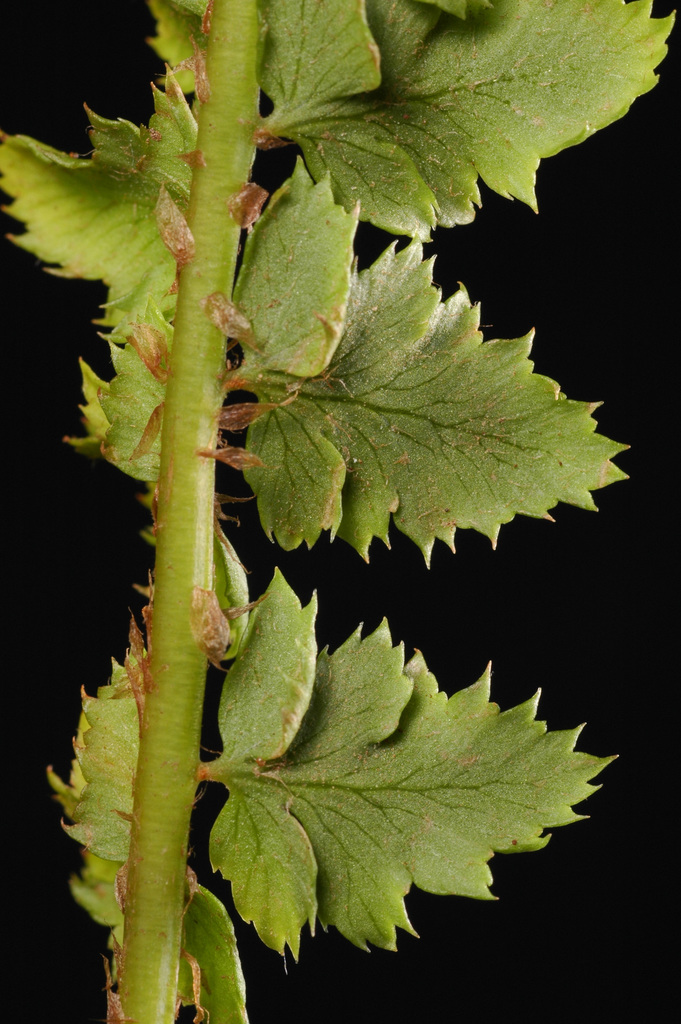
(c) Timothy McNitt, some rights reserved (CC BY), uploaded by Timothy McNitt · licence
Family: Dryopteridaceae · Type: Herb · Native
Conservation status: CNPS 4.3
Polystichum kruckebergii (Kruckeberg's sword fern) is a native California herb in the Dryopteridaceae family, recognized by very small size and high elevation habitat.
Kruckeberg's sword fern is a California native perennial found in the Klamath Ranges, northern California Cascades, and northern Sierra Nevada Mountains on rocky slopes and in crevices at elevations of 2,100 to 3,200 meters. This small fern has linear to narrow-elliptic blade structures that are 10 to 15 centimeters long, with pinnae generally 6 to 15 millimeters wide and proximal sections that are approximately deltate in shape. Growing with relatively short fronds, the fern has a delicate structure with stipe bases featuring 2 to 3 millimeter wide ovate to lanceolate scales. Its leaves are primarily 1-pinnate, with the longest pinnae less than 1 centimeter in length and characterized by a distinctive narrow growth pattern. The fern's sporangia feature an indusium that is either entire or minutely toothed, adding to its subtle botanical complexity.
Identification and appearance
Key characters: 7 sympatric species; distinguished by very small size and high elevation habitat
Habitat and range
Habitat: Rocky slopes, crevices
Elevation: 2100-3200 m
California counties: Alpine, Sierra, Shasta, Butte, Plumas, San Bernardino, Siskiyou, Tuolumne, Riverside
Outside California: to British Columbia, Montana, Utah
Conservation status
CNPS 4.3
How to tell it apart
vs Nephrolepis: Polystichum has bristle-tipped teeth and grows in wild habitats; Boston fern has smooth-edged leaflets and escapes from cultivation.; vs Dryopteris: Polystichum fronds feel prickly with bristle-tipped teeth; Dryopteris fronds feel smooth without bristles.; vs Polypodium: Polystichum has shield-shaped spore covers and bristly edges; polypody has naked round spore dots and smooth margins.; vs Struthiopteris: Polystichum has one frond type with bristly teeth; ostrich fern has separate narrow fertile fronds and smooth sterile ones.; vs Athyrium: Polystichum feels prickly and has shield-shaped spore covers; lady ferns feel soft with curved, elongated spore clusters.
Frequently asked questions
Is Polystichum kruckebergii native to California?
Yes. Polystichum kruckebergii is native to California (recorded as native).
Where in California does Polystichum kruckebergii grow?
Polystichum kruckebergii occurs in Alpine, Sierra, Shasta, Butte, Plumas, San Bernardino, Siskiyou, Tuolumne and other counties, at elevations of 2100-3200 m.
What plant family does Polystichum kruckebergii belong to?
Polystichum kruckebergii is in the Dryopteridaceae family, genus Polystichum.
Is Polystichum kruckebergii rare or endangered?
Polystichum kruckebergii carries California Rare Plant Rank 4.3, state rank S4.
What habitat does Polystichum kruckebergii grow in?
Polystichum kruckebergii grows in Rocky slopes, crevices.
Related species
Other California species in the same genus, family, or bioregion.
Sources: Jepson eFlora · CNPS Rare Plant Inventory · Index of California Plant Names · CalPhotos · CDFW CNDDB
Last updated 2026-10-07
Data from The California Species Project — 14,000+ California species with verified data from CNPS, CDFW, USFWS, Cal-IPC, and more.