Populus fremontii subsp. fremontii
Alamo or fremont cottonwood, Alamo Or Fremont Cottonwood
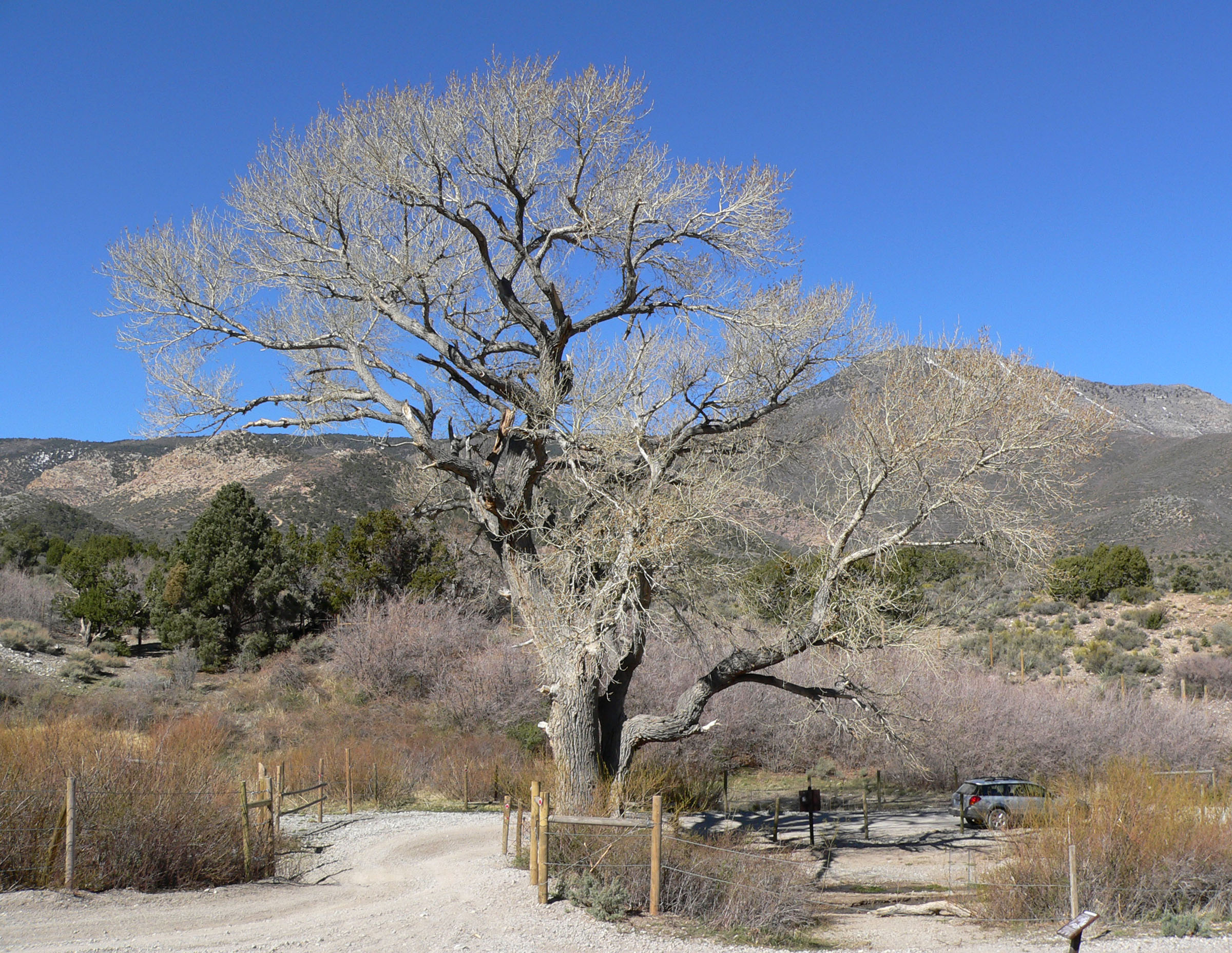
Stan Shebs (via Wikimedia Commons) · CC BY-SA
Family: Salicaceae · Type: Tree · Native
Populus fremontii subsp. fremontii (Alamo or fremont cottonwood) is a native California tree in the Salicaceae family, recognized by deltate leaves and resin staining help distinguish from similar species.
Alamo or fremont cottonwood is a California native tree found in alluvial bottomlands and streamsides throughout California (except the Modoc Plateau) at elevations below 2,000 meters. Flowering from March to April, this tree produces yellow-green flowers with distinctive deltate leaves. Growing to 20 meters tall with a wide crown, it features yellow to gray twigs that become more grayish with age and have resinous winter buds. Its leaves have laterally compressed petioles measuring half to equal the blade length, with 3 to 7 centimeter blades that are often stained with milky resin and have coarsely scalloped edges. The tree's base leaves are roughly heart-shaped to flat-bottomed, with leaf tips that taper gradually.
Identification and appearance
Key characters: 5 sympatric species; deltate leaves and resin staining help distinguish from similar species
Habitat and range
Habitat: Scattered. Alluvial bottomland, streamsides
Elevation: < 2000 m
California counties: Los Angeles, Kern, Inyo, San Diego, Ventura, San Bernardino, Tulare, Contra Costa, Monterey, San Luis Obispo, San Benito, Fresno, Orange, Lake, Riverside, Butte, Santa Clara, Yolo, Stanislaus, Sonoma, Santa Cruz, El Dorado, Solano, Nevada, Calaveras, Sacramento, Imperial, Tehama, Glenn, Mendocino, Santa Barbara, Alameda, Amador, Merced, Trinity, Sutter, Colusa, Mariposa, Napa, Mono, Siskiyou, Lassen, Madera, San Joaquin
Outside California: to central Rocky Mountains, northern Mexico
Bloom period
Populus fremontii subsp. fremontii blooms Mar-Apr.
How to tell it apart
vs Quercus: Poplar leaves flutter conspicuously on flat petioles; oaks have stiff leaves that don't flutter and produce acorns.; vs Salix: Poplar catkins hang downward like tassels; willow catkins stand upright or spread outward.; vs Pyrus: Poplars have catkins and cottony seeds; pears have showy white flowers and round pear-shaped fruits.; vs Platanus: Poplar bark is furrowed; sycamore bark peels in puzzle-piece patches revealing white inner bark.; vs Alnus: Poplar catkins are soft and pendulous; alder has woody cone-like structures that persist through winter.
Frequently asked questions
Is Populus fremontii subsp. fremontii native to California?
Yes. Populus fremontii subsp. fremontii is native to California (recorded as native).
When does Populus fremontii subsp. fremontii bloom?
Populus fremontii subsp. fremontii blooms Mar-Apr.
Where in California does Populus fremontii subsp. fremontii grow?
Populus fremontii subsp. fremontii occurs in Los Angeles, Kern, Inyo, San Diego, Ventura, San Bernardino, Tulare, Contra Costa and other counties, at elevations of < 2000 m.
What plant family does Populus fremontii subsp. fremontii belong to?
Populus fremontii subsp. fremontii is in the Salicaceae family, genus Populus.
What habitat does Populus fremontii subsp. fremontii grow in?
Populus fremontii subsp. fremontii grows in Scattered. Alluvial bottomland, streamsides.
Related species
Other California species in the same genus, family, or bioregion.
Sources: Jepson eFlora · Index of California Plant Names · CalPhotos
Last updated 2026-10-07
Data from The California Species Project — 14,000+ California species with verified data from CNPS, CDFW, USFWS, Cal-IPC, and more.