Porophyllum ruderale var. macrocephalum
Yerba porosa
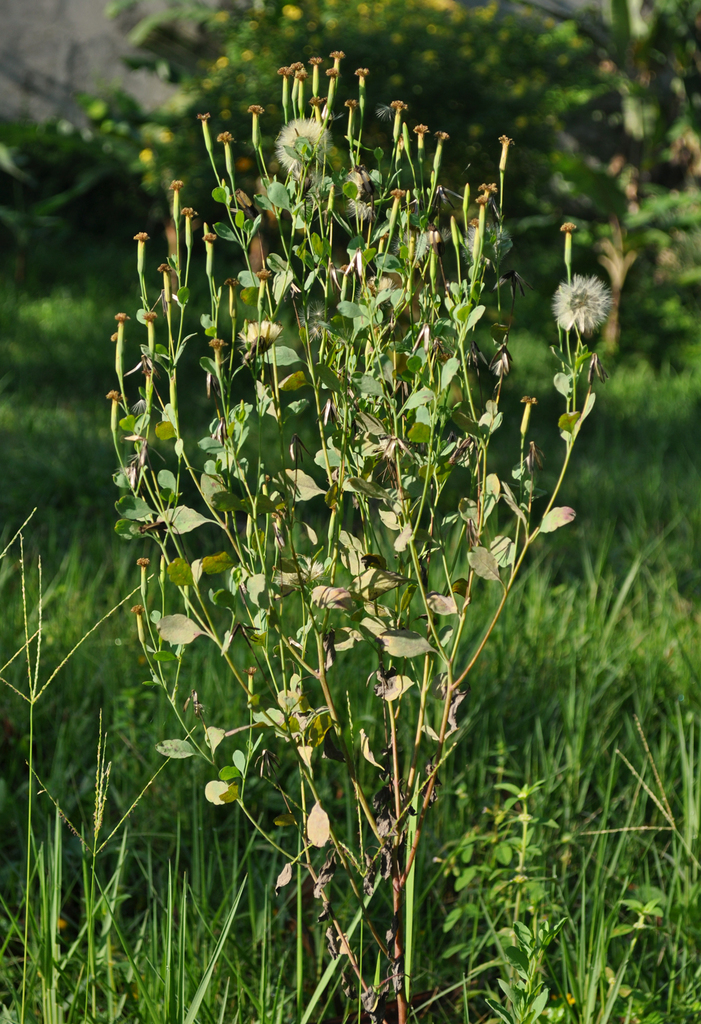
(c) Wie146, some rights reserved (CC BY-SA) · licence
Family: Asteraceae · Type: Herb · Not Native
Porophyllum ruderale var. macrocephalum (Yerba porosa) is a non-native California herb in the Asteraceae family, recognized by . Non-native agricultural weed with distinctive coastal distribution.
Yerba porosa is a naturalized annual herb found in southern California coastal areas, typically in agricultural settings at elevations below 10 meters. Flowering from September to November, this plant produces flowers that range from nearly white to purple, with distinctive linear phyllaries 15 to 25 millimeters long that are dotted or streaked with glands. Growing with a single stem reaching up to 50 centimeters tall, the plant has ascending branches and appears glabrous. Its leaves are 1 to 5 centimeters long, varying from narrowly elliptic to ovate or obovate, with entire or slightly crenate edges. The fruit is 8 to 10 millimeters long, accompanied by a pappus 6 to 7 millimeters long that ranges from green to dark purple.
Identification and appearance
Key characters: Geographically isolated with no sympatric species. Non-native agricultural weed with distinctive coastal distribution.
Habitat and range
Habitat: Agricultural weed
Elevation: < 10 m
Outside California: native Arizona to Texas, Mexico, western South America
Bloom period
Porophyllum ruderale var. macrocephalum blooms Sep-Nov.
How to tell it apart
vs Tagetes: Porophyllum (poreleaf) has a cylindric involucre of about five free phyllaries and rayless heads of purple to whitish disk florets; marigolds have fused involucres and usually showy ray flowers.; vs Adenophyllum: Porophyllum lacks ray flowers and has no bractlets below the involucre; Adenophyllum bears ray florets and a set of calyx-like bractlets.; vs Pectis: Porophyllum is an erect, oil-gland-streaked plant with purplish rayless heads; Pectis is low with linear gland-dotted leaves and yellow ray flowers.; vs Dyssodia: Porophyllum has few large discoid heads on peduncles swollen just below the head; Dyssodia is small with many gland-dotted involucres and often yellow rays.; vs Flaveria: Porophyllum heads are purplish and rayless with conspicuous oil glands on the phyllaries; Flaveria has tiny clustered yellow heads.
Frequently asked questions
Is Porophyllum ruderale var. macrocephalum native to California?
No. Porophyllum ruderale var. macrocephalum is not native to California (recorded as not native).
When does Porophyllum ruderale var. macrocephalum bloom?
Porophyllum ruderale var. macrocephalum blooms Sep-Nov.
What plant family does Porophyllum ruderale var. macrocephalum belong to?
Porophyllum ruderale var. macrocephalum is in the Asteraceae family, genus Porophyllum.
What habitat does Porophyllum ruderale var. macrocephalum grow in?
Porophyllum ruderale var. macrocephalum grows in Agricultural weed.
Related species
Other California species in the same genus, family, or bioregion.
Sources: Jepson eFlora · CalPhotos
Last updated 2026-10-07
Data from The California Species Project — 14,000+ California species with verified data from CNPS, CDFW, USFWS, Cal-IPC, and more.