Portulaca halimoides
Desert portulaca
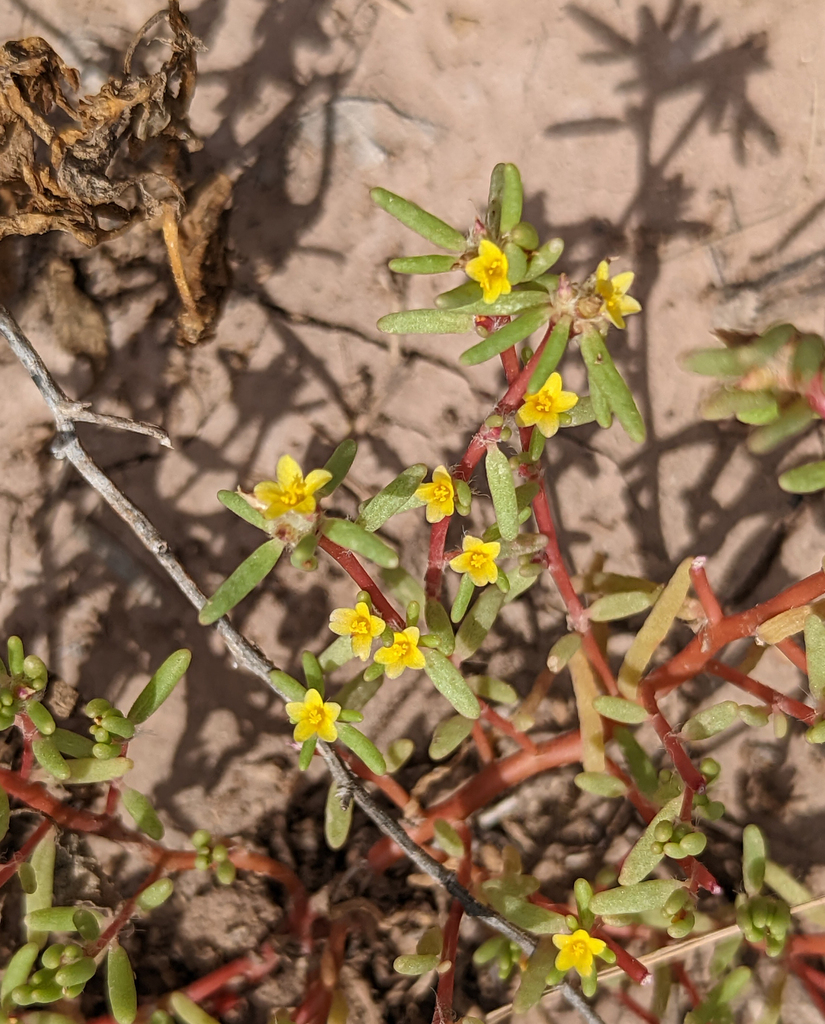
(c) Dominic Gentilcore, some rights reserved (CC BY), uploaded by Dominic Gentilcore · licence
Family: Portulacaceae · Type: Herb · Native
Conservation status: CNPS 4.2
Portulaca halimoides (Desert portulaca) is a native California herb in the Portulacaceae family.
Desert portulaca is a California native annual found in the Peninsular Ranges, southern desert, and Mojave Desert in sandy washes and flats at elevations of 1,000 to 1,200 meters. Flowering in September, this plant produces bright yellow flowers with 1.5 to 3.5 millimeter petals in clusters of 2 to 8 blooms. Growing with spreading to ascending stems 2 to 15 centimeters tall, it forms low, compact growth with delicate branching. Its small leaves range from 3 to 15 millimeters long, creating a compact ground-hugging form. The fruit is tiny, measuring 1.5 to 2 millimeters wide, with black or metallic silver seeds.
Identification and appearance
Key characters: 1 sympatric species (P. oleracea). Key differentiators: size, habitat specialization, seed size
Habitat and range
Habitat: Sandy washes, flats
Elevation: 1000-1200 m
California counties: San Bernardino, Riverside, San Diego
Outside California: to Colorado, Oklahoma, Texas, Mexico, Central America, South America
Bloom period
Portulaca halimoides blooms Sep.
Conservation status
CNPS 4.2
How to tell it apart
vs Rosa: Portulaca has fleshy succulent leaves and 2 sepals; rose has thin leaves and 5 sepals.; vs Euphorbia: Portulaca has true petals and thick succulent leaves; spurge has petal-like bracts and milky sap.; vs Cistanthe: Portulaca has only 2 sepals; Cistanthe has 2-8 sepals that vary by species.; vs Crassula: Portulaca has 5 separate petals; Crassula has 5 petals often fused at base into a tube.; vs Dianthus: Portulaca has 2 sepals and succulent leaves; pinks have 5 sepals in a tubular calyx and thin leaves.
Frequently asked questions
Is Portulaca halimoides native to California?
Yes. Portulaca halimoides is native to California (recorded as native).
When does Portulaca halimoides bloom?
Portulaca halimoides blooms Sep.
Where in California does Portulaca halimoides grow?
Portulaca halimoides occurs in San Bernardino, Riverside, San Diego, at elevations of 1000-1200 m.
What plant family does Portulaca halimoides belong to?
Portulaca halimoides is in the Portulacaceae family, genus Portulaca.
Is Portulaca halimoides rare or endangered?
Portulaca halimoides carries California Rare Plant Rank 4.2, state rank S3.
Related species
Other California species in the same genus, family, or bioregion.
Sources: Jepson eFlora · CNPS Rare Plant Inventory · Index of California Plant Names · CalPhotos · CDFW CNDDB
Last updated 2026-10-07
Data from The California Species Project — 14,000+ California species with verified data from CNPS, CDFW, USFWS, Cal-IPC, and more.