Portulaca oleracea
Purslane
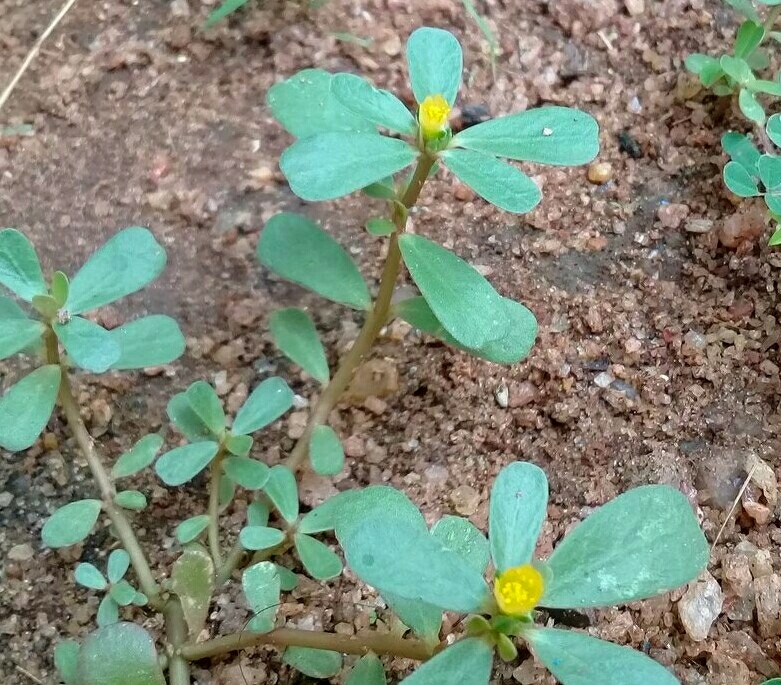
(c) Vihansith Kulatunga, some rights reserved (CC BY-SA), uploaded by Vihansith Kulatunga · licence
Family: Portulacaceae · Type: Herb · Not Native
Portulaca oleracea (Purslane) is a non-native California herb in the Portulacaceae family.
Purslane is a naturalized annual or somewhat perennial herb found in California's disturbed soil areas at elevations below 2,100 meters. Flowering from April to October, this plant produces small, bright yellow flowers 3 to 5 millimeters long with green or reddish sepals. Growing with spreading stems 3 to 40 centimeters long, it forms low, sprawling mats across the ground. Its small, fleshy leaves are 3 to 30 millimeters long, creating a dense, ground-hugging habit. Individual flowers appear singularly or in clusters of up to 8, with 5 to 12 stamens supporting each bloom.
Identification and appearance
Key characters: 1 sympatric species (P. halimoides). Key differentiators: non-native status, disturbed habitat preference, larger size and seeds
Habitat and range
Habitat: Disturbed soil
Elevation: < 2100 m
California counties: San Bernardino, Orange, Imperial, San Diego, Riverside, Los Angeles, Inyo, Plumas, Kern, Lake, Mono, Santa Barbara, Santa Clara, Santa Cruz, Siskiyou, Sonoma, Tuolumne, Ventura, Stanislaus, San Luis Obispo, El Dorado, Butte, Calaveras, Fresno, Marin, Monterey, Napa, Nevada, San Mateo, Sutter, Trinity, Yolo, San Francisco, Sacramento, Solano, Lassen, Tehama, Colusa, Yuba, Modoc, Alameda, Merced, San Joaquin, Humboldt, Contra Costa, Mariposa
Outside California: probably native to eastern hemisphere, widely naturalized elsewhere
Bloom period
Portulaca oleracea blooms Apr-Oct.
How to tell it apart
vs Rosa: Portulaca has fleshy succulent leaves and 2 sepals; rose has thin leaves and 5 sepals.; vs Euphorbia: Portulaca has true petals and thick succulent leaves; spurge has petal-like bracts and milky sap.; vs Cistanthe: Portulaca has only 2 sepals; Cistanthe has 2-8 sepals that vary by species.; vs Crassula: Portulaca has 5 separate petals; Crassula has 5 petals often fused at base into a tube.; vs Dianthus: Portulaca has 2 sepals and succulent leaves; pinks have 5 sepals in a tubular calyx and thin leaves.
Frequently asked questions
Is Portulaca oleracea native to California?
No. Portulaca oleracea is not native to California (recorded as not native).
When does Portulaca oleracea bloom?
Portulaca oleracea blooms Apr-Oct.
Where in California does Portulaca oleracea grow?
Portulaca oleracea occurs in San Bernardino, Orange, Imperial, San Diego, Riverside, Los Angeles, Inyo, Plumas and other counties, at elevations of < 2100 m.
What plant family does Portulaca oleracea belong to?
Portulaca oleracea is in the Portulacaceae family, genus Portulaca.
What habitat does Portulaca oleracea grow in?
Portulaca oleracea grows in Disturbed soil.
Related species
Other California species in the same genus, family, or bioregion.
Sources: Jepson eFlora · Index of California Plant Names · CalPhotos
Last updated 2026-10-07
Data from The California Species Project — 14,000+ California species with verified data from CNPS, CDFW, USFWS, Cal-IPC, and more.