Potamogeton crispus
Crisp-leaved pondweed
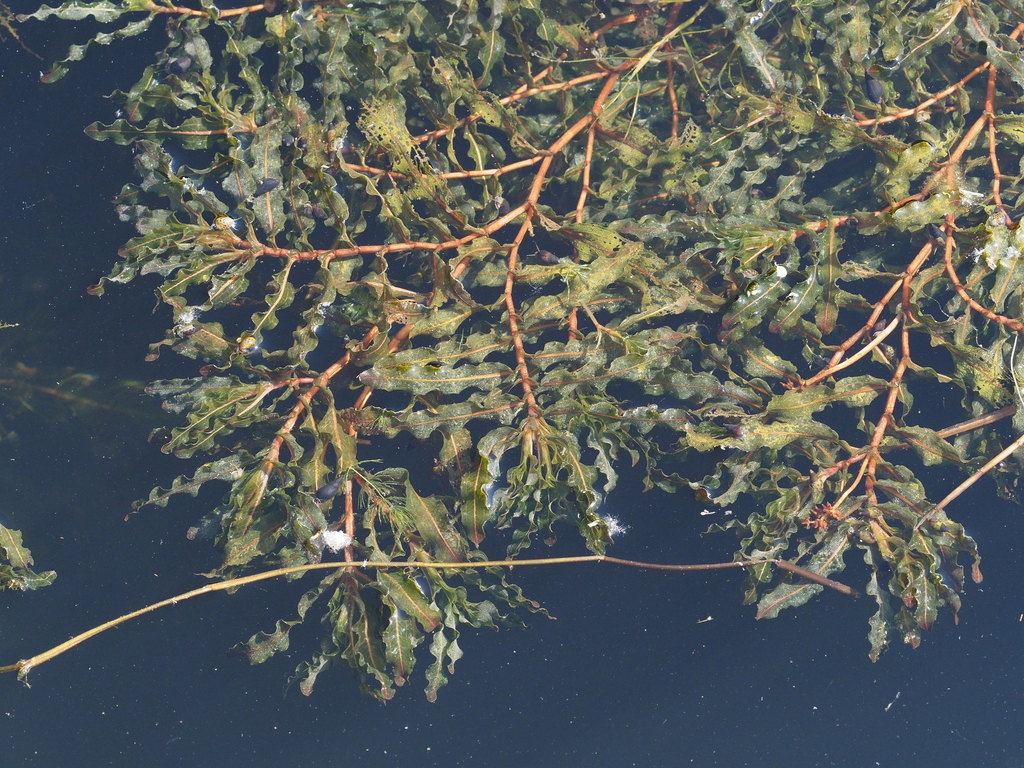
(c) gwynmwilliams, some rights reserved (CC BY), uploaded by gwynmwilliams · licence
Family: Potamogetonaceae · Type: Herb · Not Native
Conservation status: Cal-IPC Yes
Potamogeton crispus (Crisp-leaved pondweed) is a non-native California herb in the Potamogetonaceae family, recognized by wavy serrated leaves absolutely distinctive.
Crisp-leaved pondweed is a naturalized aquatic annual found in shallow water ecosystems across California, including the Klamath Ranges, North Coast Ranges, Central California Valley, coastal areas, Channel Islands, and desert regions at elevations up to 2,100 meters. Flowering from July to September, this plant produces small, inconspicuous greenish flowers in compact underwater inflorescences. Growing with slender, branching stems up to 90 centimeters long that are slightly compressed, it spreads through hard winter buds in aquatic environments. Its submersed leaves are distinctively wavy and serrated, measuring 4 to 8 centimeters long and 0.5 to 0.8 centimeters wide, with rounded tips and 3 to 5 subtle veins. The fruit is 4 to 6 millimeters long with slightly concave to convex sides and a short 2 to 3 millimeter beak.
Identification and appearance
Key characters: 15 sympatric species; wavy serrated leaves absolutely distinctive
Habitat and range
Habitat: Uncommon. Shallow water, ponds, streams
Elevation: < 2100 m
California counties: Riverside, Orange, Los Angeles, Fresno, San Bernardino, Stanislaus, Kern, Merced, San Joaquin, Alameda, Butte, Tehama, Inyo, Shasta, Sonoma, Imperial, Contra Costa, Madera, Marin, Mendocino, San Francisco, Santa Barbara, Siskiyou, Tuolumne, Solano, Lake, Sutter, Glenn, Napa, Mariposa, Plumas, Humboldt, San Mateo, San Diego, Santa Clara, El Dorado, Sacramento, Monterey, Lassen, Mono
Outside California: +- worldwide; native to Eurasia, Australia.
Bloom period
Potamogeton crispus blooms Jul-Sep.
Conservation status
Cal-IPC Yes
How to tell it apart
vs Persicaria: Potamogeton flowers float on water; Persicaria has terrestrial pink/white flower spikes above solid ground.; vs Stuckenia: Potamogeton flowers emerge above water on stiff stalks; Stuckenia flowers stay underwater on flexible stalks.; vs Alisma: Potamogeton has inconspicuous spike flowers; Alisma has showy white three-petaled flowers in branched clusters.; vs Ranunculus: Potamogeton has tiny greenish spike flowers; Ranunculus has bright yellow buttercup flowers with visible petals.; vs Myriophyllum: Potamogeton has broad or ribbon-like leaves; Myriophyllum has feathery, finely divided leaves like a bottlebrush.
Frequently asked questions
Is Potamogeton crispus native to California?
No. Potamogeton crispus is not native to California (recorded as not native).
When does Potamogeton crispus bloom?
Potamogeton crispus blooms Jul-Sep.
Where in California does Potamogeton crispus grow?
Potamogeton crispus occurs in Riverside, Orange, Los Angeles, Fresno, San Bernardino, Stanislaus, Kern, Merced and other counties, at elevations of < 2100 m.
What plant family does Potamogeton crispus belong to?
Potamogeton crispus is in the Potamogetonaceae family, genus Potamogeton.
Is Potamogeton crispus invasive in California?
Potamogeton crispus is listed by Cal-IPC with an invasiveness rating of Yes.
Related species
Other California species in the same genus, family, or bioregion.
Sources: Jepson eFlora · Index of California Plant Names · CalPhotos
Last updated 2026-10-07
Data from The California Species Project — 14,000+ California species with verified data from CNPS, CDFW, USFWS, Cal-IPC, and more.