Potamogeton epihydrus
Nuttall's ribbon-leaved pondweed, Nuttall's Ribbon-Leaved Pondweed
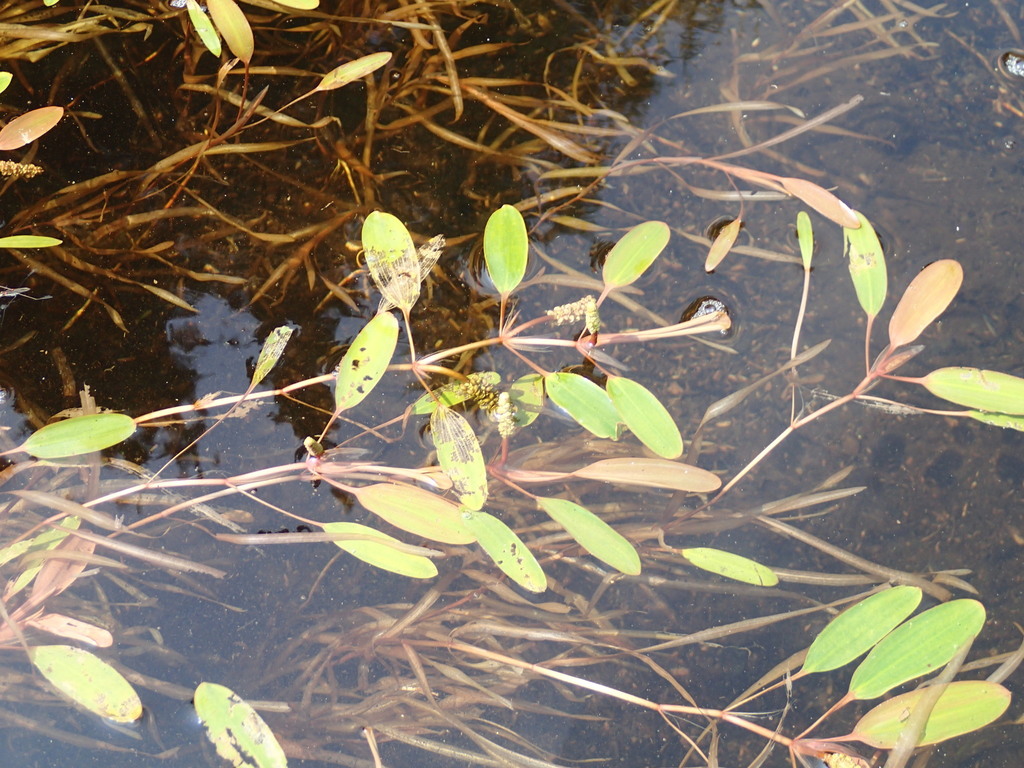
(c) Rob Foster, some rights reserved (CC BY), uploaded by Rob Foster · licence
Family: Potamogetonaceae · Type: Herb · Native
Conservation status: CNPS 2B.2
Potamogeton epihydrus (Nuttall's ribbon-leaved pondweed) is a native California herb in the Potamogetonaceae family, recognized by net-like midrib pattern and opposite floating leaves distinctive.
Nuttall's ribbon-leaved pondweed is a native perennial found in the northern Coast Ranges, Sierra Nevada, and Mountain Provinces in shallow water environments including ponds, lakes, and streams at elevations of 400 to 1,900 meters. Flowering from July to August, this aquatic plant produces small, inconspicuous flowers along slender underwater stems. Growing with ribbon-like submersed leaves 5 to 25 centimeters long and 2 to 10 millimeters wide, it forms matted patches with compressed stems less than 170 centimeters tall. Its distinctive leaves feature a unique net-like band along the midrib, with submersed leaves linear and acute-tipped, while floating leaves are generally opposite and oblong to elliptic. The fruits are small, spherical to obovate, measuring 2.5 to 4.5 millimeters long with three distinct keels and concave sides.
Identification and appearance
Key characters: 14 sympatric species; net-like midrib pattern and opposite floating leaves distinctive
Habitat and range
Habitat: Shallow water, ponds, lakes, streams
Elevation: 400-1900 m
California counties: Placer, Mendocino, Modoc, El Dorado, Merced, Mariposa, Tuolumne, Nevada
Outside California: to Alaska, eastern North America, Colorado
Bloom period
Potamogeton epihydrus blooms Jul-Aug.
Conservation status
CNPS 2B.2
How to tell it apart
vs Persicaria: Potamogeton flowers float on water; Persicaria has terrestrial pink/white flower spikes above solid ground.; vs Stuckenia: Potamogeton flowers emerge above water on stiff stalks; Stuckenia flowers stay underwater on flexible stalks.; vs Alisma: Potamogeton has inconspicuous spike flowers; Alisma has showy white three-petaled flowers in branched clusters.; vs Ranunculus: Potamogeton has tiny greenish spike flowers; Ranunculus has bright yellow buttercup flowers with visible petals.; vs Myriophyllum: Potamogeton has broad or ribbon-like leaves; Myriophyllum has feathery, finely divided leaves like a bottlebrush.
Frequently asked questions
Is Potamogeton epihydrus native to California?
Yes. Potamogeton epihydrus is native to California (recorded as native).
When does Potamogeton epihydrus bloom?
Potamogeton epihydrus blooms Jul-Aug.
Where in California does Potamogeton epihydrus grow?
Potamogeton epihydrus occurs in Placer, Mendocino, Modoc, El Dorado, Merced, Mariposa, Tuolumne, Nevada, at elevations of 400-1900 m.
What plant family does Potamogeton epihydrus belong to?
Potamogeton epihydrus is in the Potamogetonaceae family, genus Potamogeton.
Is Potamogeton epihydrus rare or endangered?
Potamogeton epihydrus carries California Rare Plant Rank 2B.2, state rank S2S3.
Related species
Other California species in the same genus, family, or bioregion.
Sources: Jepson eFlora · CNPS Rare Plant Inventory · Index of California Plant Names · CalPhotos · CDFW CNDDB
Last updated 2026-10-07
Data from The California Species Project — 14,000+ California species with verified data from CNPS, CDFW, USFWS, Cal-IPC, and more.