Proboscidea althaeifolia
Desert unicorn-plant, Desert Unicorn-Plant
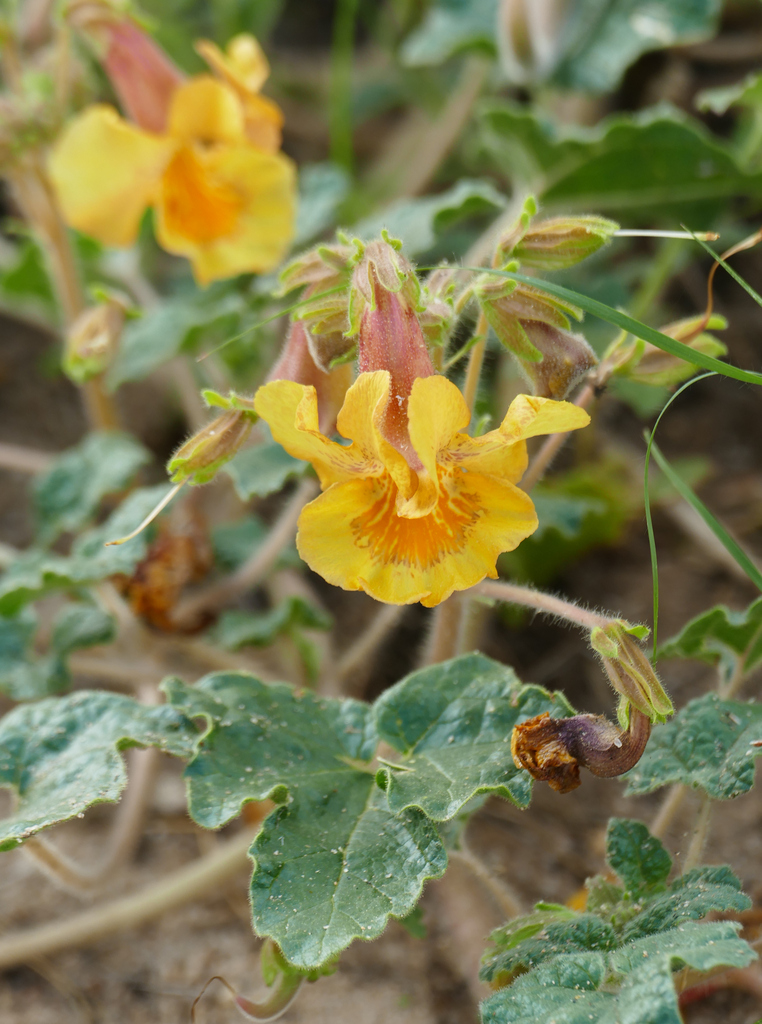
(c) Wendy McCrady, some rights reserved (CC BY) · licence
Family: Martyniaceae · Type: Herb · Native
Conservation status: CNPS 4.3
Proboscidea althaeifolia (Desert unicorn-plant) is a native California herb in the Martyniaceae family, recognized by . Key features: perennial, yellow tuber-like taproot, desert habitat.
Desert unicorn-plant is a California native perennial found in southeastern Mojave Desert and southeastern Sonoran Desert in sandy places at elevations below 1,000 meters. Flowering from May to August, this plant produces yellow to orange flowers with darker markings, blooming in clusters that generally exceed the leaf height. Growing with decumbent stems and a distinctive fusiform, tuber-like yellow taproot, it develops broad-ovate leaves 3 to 7 centimeters wide with palmately 3 to 5 lobes and crenate edges. Its leaves are distinctively shaped, broadly rounded or deltate, with soft scalloped margins that create an intricate leaf profile. The fruit develops approximately 1 centimeter wide with a lanceolate body and contains seeds 6 to 7 millimeters long.
Identification and appearance
Key characters: 0 sympatric species - geographically isolated. Key features: perennial, yellow tuber-like taproot, desert habitat
Habitat and range
Habitat: Sandy places
Elevation: < 1000 m
Outside California: to Texas, northern Mexico, Peru
Bloom period
Proboscidea althaeifolia blooms May-Aug.
Conservation status
CNPS 4.3
How to tell it apart
vs Ibicella: Ibicella's beak splits into two curved claws; Proboscidea's beak remains a single curved hook.; vs Streptocarpus: Streptocarpus has straight, unhooked capsules; Proboscidea's capsules curve into a dramatic hook.; vs Harpagophytum: Harpagophytum has multiple radiating hooks; Proboscidea has a single curved beak.; vs Mimulus: Mimulus has tiny capsules under 2 cm; Proboscidea's massive capsules are 5-35 cm long.; vs Limosella: Limosella has tiny capsules under 5 mm; Proboscidea's are massively larger at 5+ cm.
Frequently asked questions
Is Proboscidea althaeifolia native to California?
Yes. Proboscidea althaeifolia is native to California (recorded as native).
When does Proboscidea althaeifolia bloom?
Proboscidea althaeifolia blooms May-Aug.
What plant family does Proboscidea althaeifolia belong to?
Proboscidea althaeifolia is in the Martyniaceae family, genus Proboscidea.
Is Proboscidea althaeifolia rare or endangered?
Proboscidea althaeifolia carries California Rare Plant Rank 4.3, state rank S4.
What habitat does Proboscidea althaeifolia grow in?
Proboscidea althaeifolia grows in Sandy places.
Related species
Other California species in the same genus, family, or bioregion.
Sources: Jepson eFlora · CNPS Rare Plant Inventory · Index of California Plant Names · CalPhotos · CDFW CNDDB
Last updated 2026-10-07
Data from The California Species Project — 14,000+ California species with verified data from CNPS, CDFW, USFWS, Cal-IPC, and more.