Prosartes hookeri
Drops of gold
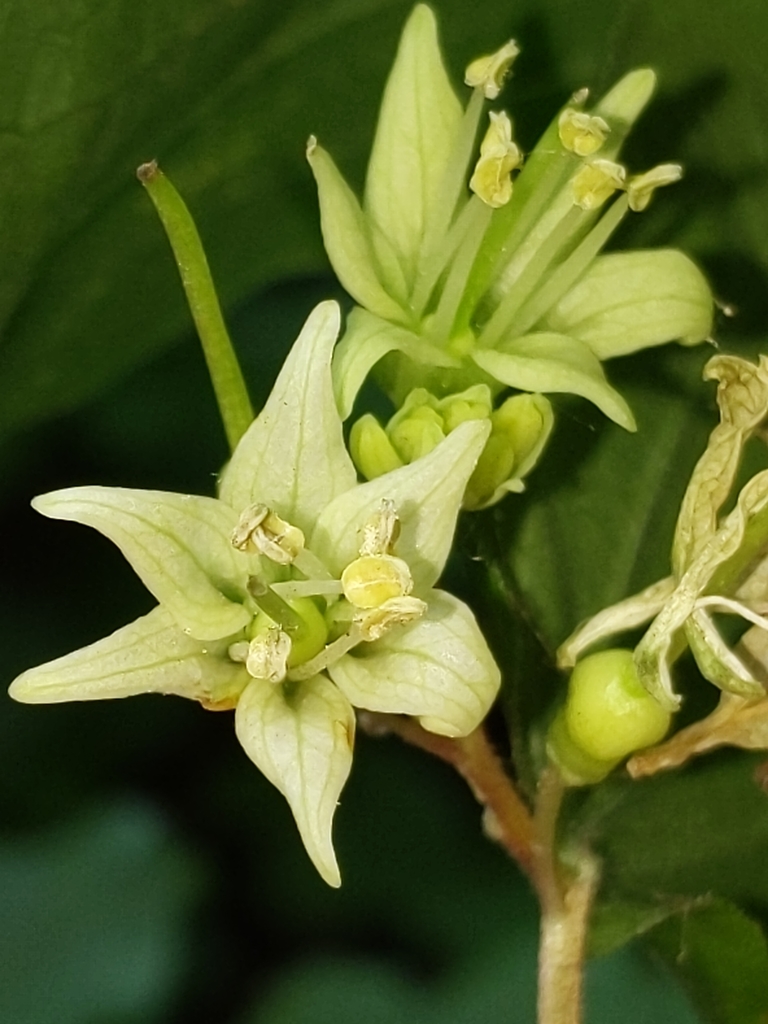
no rights reserved, uploaded by Alex Heyman · CC0
Family: Liliaceae · Type: Herb · Native
Prosartes hookeri (Drops of gold) is a native California herb in the Liliaceae family, recognized by flower shape, exserted anthers, and fruit characteristics.
Drops of gold is a California native perennial found in northwestern California, high Cascade Range, Sierra Nevada, and central western California in montane conifer and mixed-evergreen forests at elevations below 1,600 meters. Flowering from March to June, this plant produces yellow flowers in small clusters of 1 to 3 blooms, with perianth parts 8 to 18 millimeters long that spread open at the middle. Growing 30 to 80 centimeters tall with stems that may be hairy or smooth, it develops an upright and somewhat delicate form. Its leaves range 3 to 15 centimeters long, with leaf margins featuring many short, sharp, ascending hairs and minute rough surfaces, particularly along the leaf veins. The fruit is a red, nearly spherical structure 7 to 12 millimeters long, typically containing more than three seeds.
Identification and appearance
Key characters: 2 sympatric species; key features are flower shape, exserted anthers, and fruit characteristics
Habitat and range
Habitat: Montane conifer, mixed-evergreen forest, exposed roadsides
Elevation: < 1600 m
California counties: Del Norte, Monterey, Tulare, Marin, Amador, Butte, Calaveras, Contra Costa, El Dorado, Fresno, Humboldt, Napa, Placer, San Luis Obispo, Shasta, Alameda, Glenn, Lake, Mariposa, Mendocino, Nevada, San Francisco, Santa Cruz, San Mateo, Santa Clara, Siskiyou, Sonoma, Trinity, Tuolumne, Tehama, Sierra, Plumas
Outside California: to western Canada, Montana
Bloom period
Prosartes hookeri blooms Mar-Jun.
How to tell it apart
vs Maianthemum: Prosartes has large bell-shaped flowers in small clusters; Maianthemum has many tiny 4-parted flowers in dense clusters.; vs Streptopus: Prosartes has terminal flower clusters on straight stalks; Streptopus has single axillary flowers on kinked stalks.; vs Polygonatum: Prosartes flowers hang in terminal clusters; Polygonatum flowers hang individually from leaf axils along the stem.; vs Disporum: Prosartes and Disporum are extremely similar - check technical floral characters or rely on range.; vs Cornus: Prosartes has bell flowers and parallel-veined leaves; Cornus has small flowers in clusters and net-veined leaves.
Frequently asked questions
Is Prosartes hookeri native to California?
Yes. Prosartes hookeri is native to California (recorded as native).
When does Prosartes hookeri bloom?
Prosartes hookeri blooms Mar-Jun.
Where in California does Prosartes hookeri grow?
Prosartes hookeri occurs in Del Norte, Monterey, Tulare, Marin, Amador, Butte, Calaveras, Contra Costa and other counties, at elevations of < 1600 m.
What plant family does Prosartes hookeri belong to?
Prosartes hookeri is in the Liliaceae family, genus Prosartes.
What habitat does Prosartes hookeri grow in?
Prosartes hookeri grows in Montane conifer, mixed-evergreen forest, exposed roadsides.
Related species
Other California species in the same genus, family, or bioregion.
Sources: Jepson eFlora · Index of California Plant Names · CalPhotos
Last updated 2026-10-07
Data from The California Species Project — 14,000+ California species with verified data from CNPS, CDFW, USFWS, Cal-IPC, and more.