Prunella vulgaris var. lanceolata
Lance leaf self heal
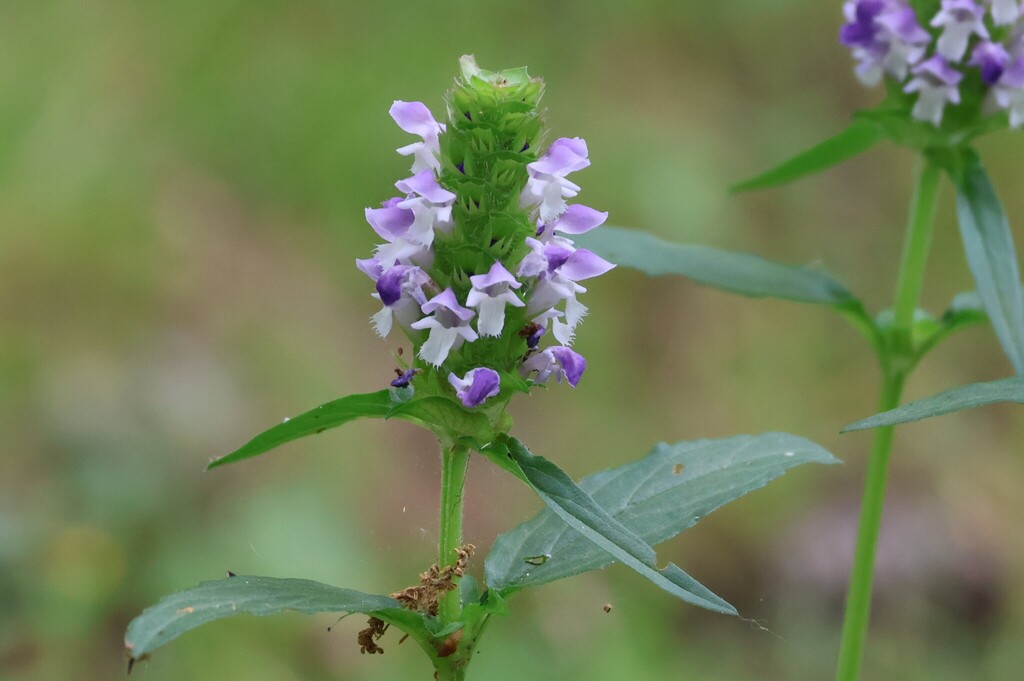
Photo: parent species Prunella vulgaris · (c) Millie Basden, some rights reserved (CC BY) · licence
Family: Lamiaceae · Type: Herb · Native
Prunella vulgaris var. lanceolata (Lance leaf self heal) is a native California herb in the Lamiaceae family, recognized by One sympatric species; distinguished primarily by native status and natural habitat preference.
Lance leaf self heal is a California native perennial found in northwestern California, the Cascade Range, Sierra Nevada, central western California, western Transverse Ranges, Peninsular Ranges, and Modoc Plateau in moist areas of conifer forest and woodland at elevations below 2,500 meters. Flowering from May to September, this plant produces small purple to blue flowers in compact terminal clusters. Growing with erect stems 10 to 30 centimeters tall, it forms dense clumps with multiple branching stems. Its leaves are lance-shaped, opposite, with entire or slightly toothed margins measuring 2 to 6 centimeters long. The dense flower clusters are characteristic of this widespread North American and eastern Asian species.
Identification and appearance
Key characters: One sympatric species; distinguished primarily by native status and natural habitat preference
Habitat and range
Habitat: Moist areas, generally conifer forest, woodland
Elevation: < 2500 m
California counties: San Bernardino, Tuolumne, Shasta, Placer, Riverside, Marin, Siskiyou, San Mateo, Del Norte, Humboldt, Orange, Plumas, Sonoma, Fresno, Butte, Modoc, Lassen, Santa Cruz, Madera, Mendocino, Santa Clara, Mariposa, Lake, Los Angeles, Tulare, Nevada, Trinity, Tehama, El Dorado, Calaveras, Sacramento, Yuba, Colusa, San Francisco, San Diego, Sierra, Glenn, Napa, Monterey
Outside California: North America, eastern Asia
Bloom period
Prunella vulgaris var. lanceolata blooms May-Sep.
How to tell it apart
vs Salvia: Prunella has dense cylindrical spikes; Salvia has loosely arranged flowers along the stem.; vs Stachys: Prunella flowers are tightly packed into one terminal spike; Stachys flowers are in separated whorls.; vs Ajuga: Prunella forms dense cylindrical spikes; Ajuga has flowers in loose whorls along stem.; vs Mentha: Prunella has one terminal spike; Mentha has multiple rounded clusters stacked up the stem.; vs Penstemon: Prunella has square stems and opposite leaves; Penstemon has round stems and opposite leaves.
Frequently asked questions
Is Prunella vulgaris var. lanceolata native to California?
Yes. Prunella vulgaris var. lanceolata is native to California (recorded as native).
When does Prunella vulgaris var. lanceolata bloom?
Prunella vulgaris var. lanceolata blooms May-Sep.
Where in California does Prunella vulgaris var. lanceolata grow?
Prunella vulgaris var. lanceolata occurs in San Bernardino, Tuolumne, Shasta, Placer, Riverside, Marin, Siskiyou, San Mateo and other counties, at elevations of < 2500 m.
What plant family does Prunella vulgaris var. lanceolata belong to?
Prunella vulgaris var. lanceolata is in the Lamiaceae family, genus Prunella.
What habitat does Prunella vulgaris var. lanceolata grow in?
Prunella vulgaris var. lanceolata grows in Moist areas, generally conifer forest, woodland.
Related species
Other California species in the same genus, family, or bioregion.
Sources: Jepson eFlora · Index of California Plant Names · CalPhotos
Last updated 2026-10-07
Data from The California Species Project — 14,000+ California species with verified data from CNPS, CDFW, USFWS, Cal-IPC, and more.