Prunus virginiana var. demissa
Western choke cherry, Western Choke Cherry
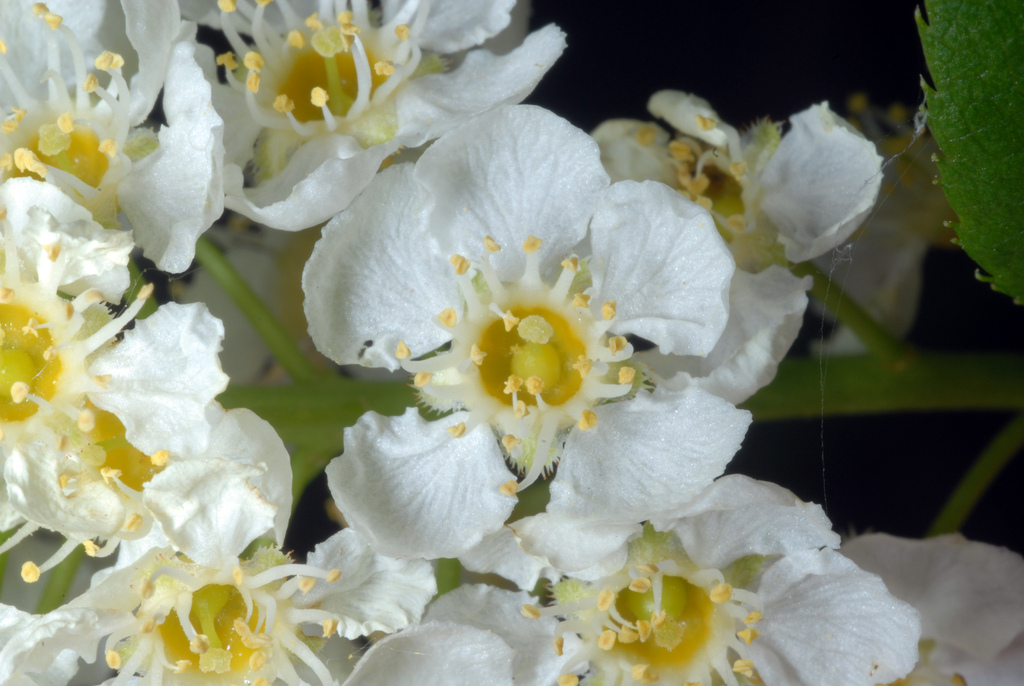
(c) Douglas Goldman, some rights reserved (CC BY-SA), uploaded by Douglas Goldman · licence
Family: Rosaceae · Type: Shrub / Tree · Native
Prunus virginiana var. demissa (Western choke cherry) is a native California shrub / tree in the Rosaceae family, recognized by long racemes with many flowers, acuminate leaves, and small astringent fruits.
Western choke cherry is a California native shrub found in the California Floristic Province (excluding the coast and Central Valley) and Great Basin in rocky slopes, canyons, scrubland, oak and pine woodlands, and conifer forests at elevations below 3,000 meters. Flowering from May to June, this plant produces white flowers 4 to 7 millimeters long in clustered racemes. Growing as a small shrub or tree up to 6 meters tall, often forming dense thickets with multiple stems. Its deciduous leaves are elliptic to oblanceolate, 30 to 100 millimeters long with finely serrated edges and an obtuse to slightly heart-shaped base. The fruit develops as a fleshy, glabrous drupe 6 to 14 millimeters long, ranging in color from red to black when mature.
Identification and appearance
Key characters: 13 sympatric species; key features are long racemes with many flowers, acuminate leaves, and small astringent fruits
Habitat and range
Habitat: Rocky slopes, canyons, scrubland, oak/pine woodland, conifer forest
Elevation: < 3000 m
California counties: Los Angeles, Sonoma, Tuolumne, Siskiyou, San Bernardino, San Diego, Tulare, Mendocino, Kern, Fresno, Ventura, Madera, Riverside, Humboldt, Plumas, Modoc, Trinity, Lake, San Mateo, Santa Clara, San Luis Obispo, Contra Costa, Mono, San Francisco, Alpine, Butte, Lassen, Napa, Santa Barbara, Shasta, Colusa, Mariposa, El Dorado, Nevada, Calaveras, Del Norte, Placer, San Benito, Santa Cruz, Alameda, Amador, Glenn, Sacramento, Marin, Monterey, Sierra, Sutter, Tehama, Solano, Stanislaus
Outside California: to British Columbia, Montana, Texas, northern Mexico
Bloom period
Prunus virginiana var. demissa blooms May-Jun.
How to tell it apart
vs Quercus: Prunus has simple leaves with fine teeth; oak leaves are lobed or have coarse rounded teeth.; vs Rhamnus: Prunus has fleshy fruits with single hard pits; buckthorn has berry-like fruits with multiple seeds.; vs Malus: Prunus fruits have a single hard pit; apple fruits have a papery core with multiple seeds.; vs Frangula: Prunus has cup-shaped flower base that falls off; alder buckthorn has persistent berry-like fruit base.; vs Pyrus: Prunus produces single-pitted drupes; pear produces pome fruits with papery seed chambers.
Frequently asked questions
Is Prunus virginiana var. demissa native to California?
Yes. Prunus virginiana var. demissa is native to California (recorded as native).
When does Prunus virginiana var. demissa bloom?
Prunus virginiana var. demissa blooms May-Jun.
Where in California does Prunus virginiana var. demissa grow?
Prunus virginiana var. demissa occurs in Los Angeles, Sonoma, Tuolumne, Siskiyou, San Bernardino, San Diego, Tulare, Mendocino and other counties, at elevations of < 3000 m.
What plant family does Prunus virginiana var. demissa belong to?
Prunus virginiana var. demissa is in the Rosaceae family, genus Prunus.
What habitat does Prunus virginiana var. demissa grow in?
Prunus virginiana var. demissa grows in Rocky slopes, canyons, scrubland, oak/pine woodland, conifer forest.
Related species
Other California species in the same genus, family, or bioregion.
- Prunus andersonii — Desert peach
- Prunus cerasifera — Cherry plum
- Prunus dulcis — Almond
- Prunus emarginata — Bitter cherry
- Prunus eremophila — Mojave desert plum
- Prunus fasciculata — Desert almond
- Purshia sp.
- Purshia stansburyana — Cliffrose
- Purshia tridentata — Bitterbrush
- Purshia tridentata var. glandulosa — Antelope brush
Sources: Jepson eFlora · Index of California Plant Names · CalPhotos
Last updated 2026-10-07
Data from The California Species Project — 14,000+ California species with verified data from CNPS, CDFW, USFWS, Cal-IPC, and more.