Pseudognaphalium luteoalbum
Jersey cudweed
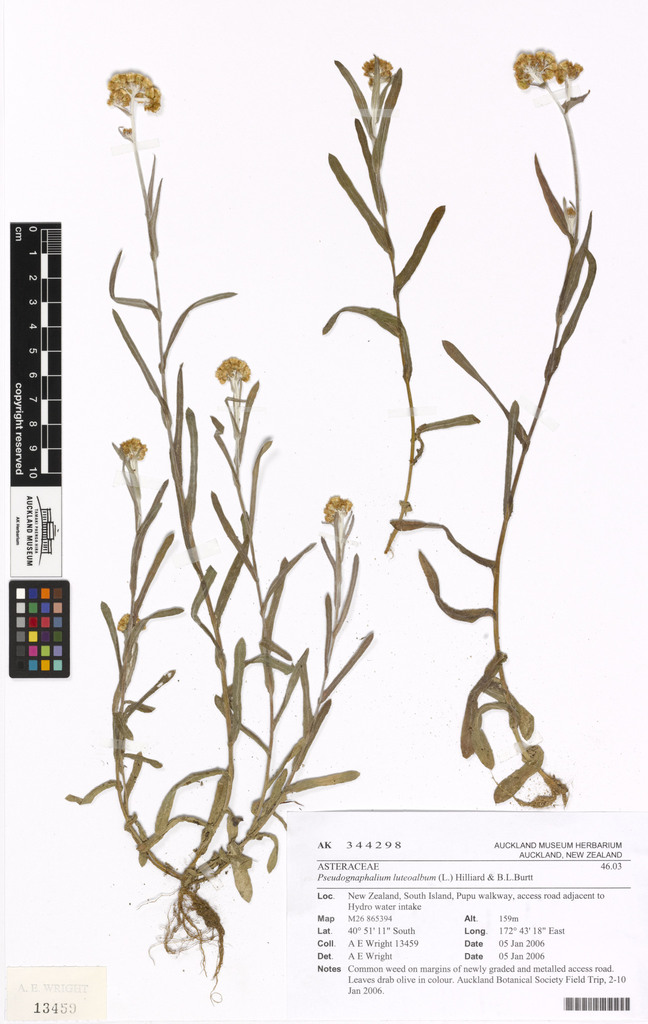
(c) A. E. Wright, some rights reserved (CC BY) · licence
Family: Asteraceae · Type: Herb · Not Native
Pseudognaphalium luteoalbum (Jersey cudweed) is a non-native California herb in the Asteraceae family, recognized by non-native status, small heads with many female flowers, and disturbed habitat.
Jersey cudweed is a naturalized annual found in northern California Coast, Sierra Nevada foothills, Central Valley, central western California, and southwestern California regions in disturbed sites, fields, streambeds, and drying mud areas at elevations below 850 meters. Flowering from April to August, this plant produces white to yellowish flowers with yellow or red-tipped disk florets in dense, long-peduncled clusters. Growing with loosely tomentose stems 10 to 60 centimeters tall, it spreads with linear to narrowly obovate leaves that are grayish and somewhat spoon-shaped. Its leaves range from 1 to 6 centimeters long, with margins generally curled under and distal leaves smaller and clasping the stem. The fruit is characterized by papillate surfaces with pappus bristles that shed in easily fragmented clusters.
Identification and appearance
Key characters: 11 sympatric species; key features are non-native status, small heads with many female flowers, and disturbed habitat
Habitat and range
Habitat: Disturbed sites, fields, streambeds, drying mud
Elevation: < 850 m
Outside California: widely scattered worldwide, native to Eurasia
Bloom period
Pseudognaphalium luteoalbum blooms Apr-Aug.
How to tell it apart
vs Anaphalis: Pseudognaphalium has branched, open flower clusters; Anaphalis has dense, flat-topped clusters and noticeably papery white bracts.; vs Helichrysum: Pseudognaphalium has small, clustered woolly heads; Helichrysum has larger, more colorful papery flower heads often used in dried arrangements.; vs Artemisia: Pseudognaphalium has woolly white leaves and papery flower heads; Artemisia has aromatic gray-green leaves and tiny greenish flowers.; vs Salvia: Pseudognaphalium has papery flower heads in the Asteraceae; Salvia has tubular lipped flowers typical of mints with square stems.; vs Erigeron: Pseudognaphalium has papery heads without obvious petals; Erigeron has clear white or colored ray petals around each flower head.
Frequently asked questions
Is Pseudognaphalium luteoalbum native to California?
No. Pseudognaphalium luteoalbum is not native to California (recorded as not native).
When does Pseudognaphalium luteoalbum bloom?
Pseudognaphalium luteoalbum blooms Apr-Aug.
What plant family does Pseudognaphalium luteoalbum belong to?
Pseudognaphalium luteoalbum is in the Asteraceae family, genus Pseudognaphalium.
What habitat does Pseudognaphalium luteoalbum grow in?
Pseudognaphalium luteoalbum grows in Disturbed sites, fields, streambeds, drying mud.
Related species
Other California species in the same genus, family, or bioregion.
Sources: Jepson eFlora · Index of California Plant Names · CalPhotos
Last updated 2026-10-07
Data from The California Species Project — 14,000+ California species with verified data from CNPS, CDFW, USFWS, Cal-IPC, and more.