Pseudotsuga macrocarpa
Bigcone douglas-fir, bigcone spruce, Bigcone Spruce
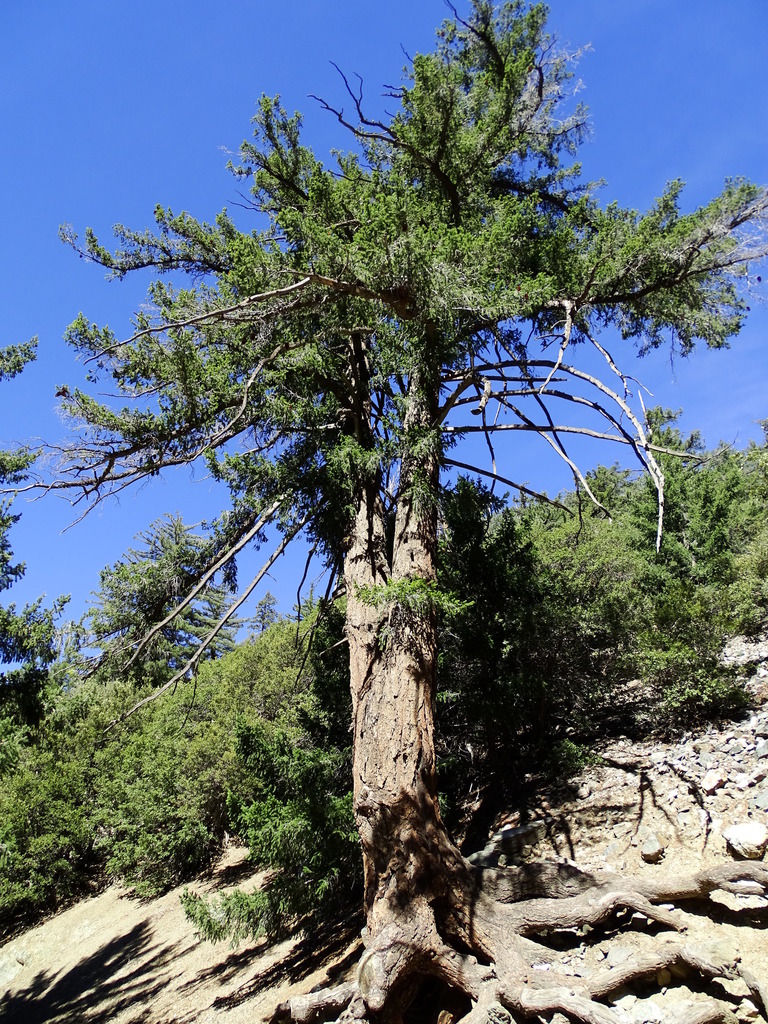
(c) Jesse Rorabaugh, some rights reserved (CC BY), uploaded by Jesse Rorabaugh · licence
Family: Pinaceae · Type: Tree · Native
Pseudotsuga macrocarpa (Bigcone douglas-fir) is a native California tree in the Pinaceae family, recognized by . Key distinguishing features are persistent cones vs. deciduous cones and bract exsertion differences.
Bigcone douglas-fir is a California native tree found in the southern Sierra Madre Mountains, Transverse Ranges, and Peninsular Ranges on fire-resistant slopes in mixed-evergreen forest at elevations of 200 to 2,400 meters. Although no flowering time is specified, this distinctive conifer features a trunk up to 44 meters tall and less than 2.1 meters wide with a strong taper and a mature crown that is rounded to flat. Growing with numerous large lower branches, it develops a robust and expansive form that can dominate its forest environment. Its needles measure 2 to 4.5 centimeters in length, creating a dense green canopy characteristic of douglas-fir trees. The seed cones are notable for their persistence, remaining on the tree for several years and distinguished by a central tooth or lobe that partially protrudes from the cone structure.
Identification and appearance
Key characters: 1 sympatric species. Key distinguishing features are persistent cones vs. deciduous cones and bract exsertion differences.
Habitat and range
Habitat: Scattered on fire-resistant slopes, mixed-evergreen forest
Elevation: 200-2400 m
California counties: Los Angeles, San Bernardino, Riverside, Kern, Orange, Ventura, San Diego, Santa Barbara, Santa Cruz, Monterey
How to tell it apart
vs Abies: Douglas-fir cones hang down with pitchfork bracts; fir cones stand upright and disintegrate on the tree.; vs Pinus: Douglas-fir needles attach individually to smooth twigs; pine needles come bundled in groups with papery sheaths.; vs Sequoia: Douglas-fir has individual needles and hanging cones; redwood has flat sprays of scale-like leaves and small round cones.; vs Picea: Douglas-fir twigs are smooth after needle drop; spruce twigs have rough, peg-like bumps.; vs Torreya: Douglas-fir has soft needles and hanging cones; California-nutmeg has sharp-tipped needles and plum-like fruits.
Frequently asked questions
Is Pseudotsuga macrocarpa native to California?
Yes. Pseudotsuga macrocarpa is native to California (recorded as native).
Where in California does Pseudotsuga macrocarpa grow?
Pseudotsuga macrocarpa occurs in Los Angeles, San Bernardino, Riverside, Kern, Orange, Ventura, San Diego, Santa Barbara and other counties, at elevations of 200-2400 m.
What plant family does Pseudotsuga macrocarpa belong to?
Pseudotsuga macrocarpa is in the Pinaceae family, genus Pseudotsuga.
What habitat does Pseudotsuga macrocarpa grow in?
Pseudotsuga macrocarpa grows in Scattered on fire-resistant slopes, mixed-evergreen forest.
Related species
Other California species in the same genus, family, or bioregion.
Sources: Jepson eFlora · Index of California Plant Names · CalPhotos
Last updated 2026-10-07
Data from The California Species Project — 14,000+ California species with verified data from CNPS, CDFW, USFWS, Cal-IPC, and more.