Psilocarphus chilensis
Round woolly-marbles
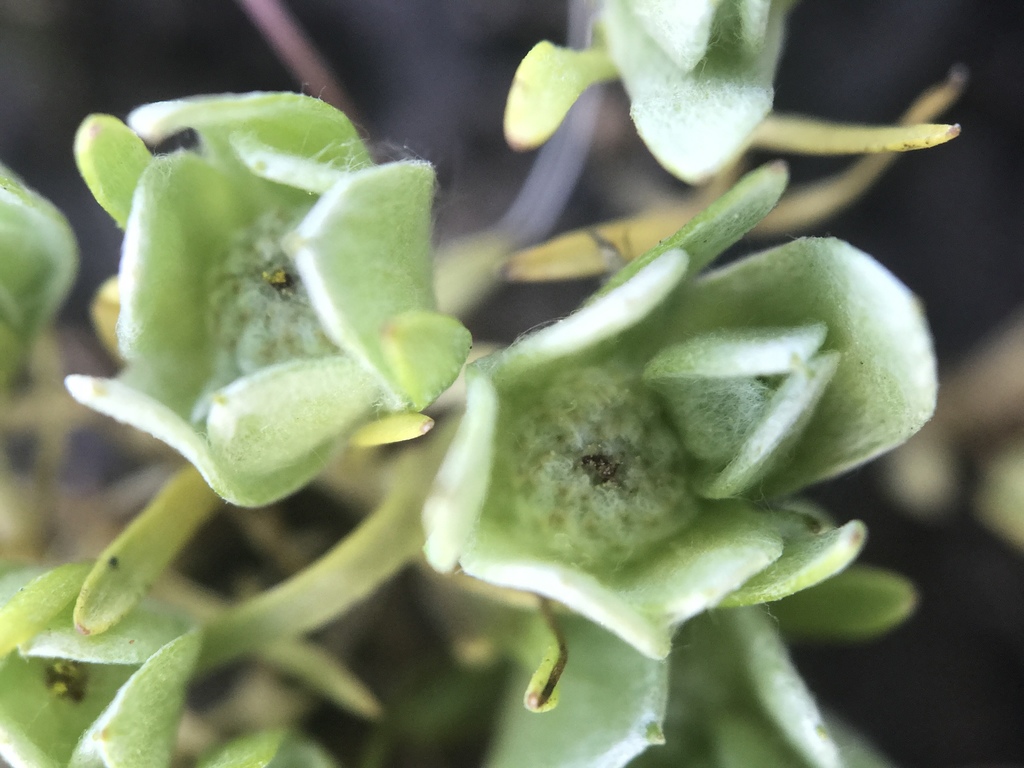
no rights reserved · CC0
Family: Asteraceae · Type: Annual · Native
Psilocarphus chilensis (Round woolly-marbles) is a native California annual in the Asteraceae family, recognized by smallest heads and distinctive stem/leaf proportions.
Round woolly-marbles is a California native annual found in the Central Valley, San Francisco Bay Area, Sierra Nevada foothills, Coast Ranges, and southern California coastal regions in vernal pools and coastal interdune habitats at elevations below 700 meters. Flowering from March to July, this plant produces delicate white to green flowers in small heads 3 to 5.5 millimeters in diameter. Growing with multiple slender stems 2 to 7 in number, it develops a silky-cobwebby texture that becomes more pronounced in coastal populations. Its leaves are ovate to widely elliptic, typically 5 to 12 millimeters long and approximately 1.2 to 1.8 times wider than their length, with distal leaves appressed close to the flower heads. The plant's distinctive woolly appearance ranges from green to gray or white, with a delicate, soft texture that helps it blend into its ephemeral vernal pool environments.
Identification and appearance
Key characters: 4 sympatric species; smallest heads and distinctive stem/leaf proportions
Habitat and range
Habitat: Uncommon. Vernal pools, coastal interdunes
Elevation: < 700 m
California counties: Riverside, Monterey, Kern, Fresno, Tulare, Solano, Merced, Calaveras, Marin, Tehama, Madera, Stanislaus, San Luis Obispo, Contra Costa, Shasta, Santa Barbara, Ventura, Butte, Yolo, Sonoma, Sutter, Santa Cruz
Outside California: central Chile
Bloom period
Psilocarphus chilensis blooms Mar-Jul.
How to tell it apart
vs Stylocline: Psilocarphus has opposite leaves; Stylocline has alternate leaves (may appear whorled).; vs Gnaphalium: Psilocarphus has opposite leaves and no pappus; Gnaphalium has alternate leaves and pappus present.; vs Pseudognaphalium: Psilocarphus has opposite leaves; Pseudognaphalium has alternate leaves.; vs Logfia: Psilocarphus has opposite leaves; Logfia has alternate leaves.; vs Micropus: Psilocarphus lacks prominent petal-like bracts; Micropus has 4-6 conspicuous spoon-shaped outer bracts.
Frequently asked questions
Is Psilocarphus chilensis native to California?
Yes. Psilocarphus chilensis is native to California (recorded as native).
When does Psilocarphus chilensis bloom?
Psilocarphus chilensis blooms Mar-Jul.
Where in California does Psilocarphus chilensis grow?
Psilocarphus chilensis occurs in Riverside, Monterey, Kern, Fresno, Tulare, Solano, Merced, Calaveras and other counties, at elevations of < 700 m.
What plant family does Psilocarphus chilensis belong to?
Psilocarphus chilensis is in the Asteraceae family, genus Psilocarphus.
What habitat does Psilocarphus chilensis grow in?
Psilocarphus chilensis grows in Uncommon. Vernal pools, coastal interdunes.
Related species
Other California species in the same genus, family, or bioregion.
Sources: Jepson eFlora · Index of California Plant Names · CalPhotos
Last updated 2026-10-06
Data from The California Species Project — 14,000+ California species with verified data from CNPS, CDFW, USFWS, Cal-IPC, and more.