Psilocarphus oregonus
Oregon woollyheads
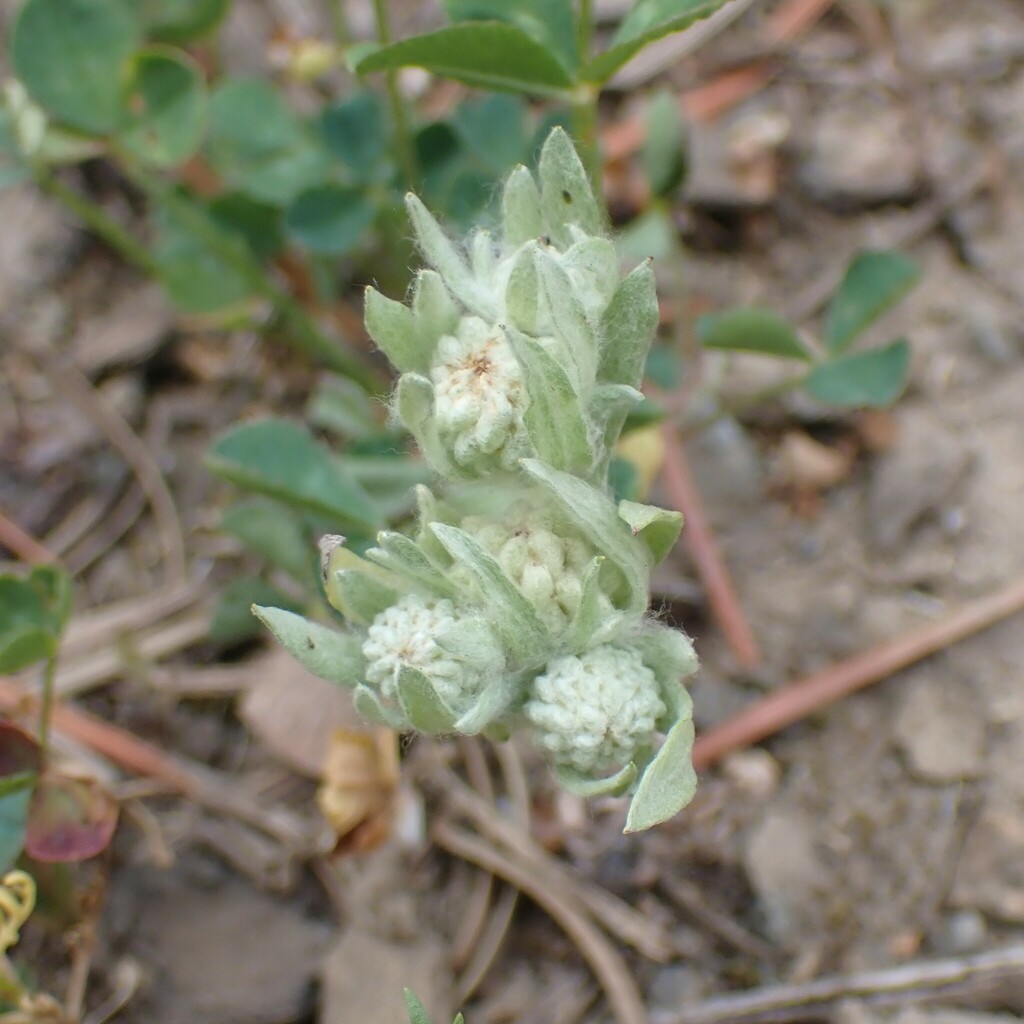
(c) giantcicada, some rights reserved (CC BY) · licence
Family: Asteraceae · Type: Herb · Native
Psilocarphus oregonus (Oregon woollyheads) is a native California herb in the Asteraceae family, recognized by silvery appearance and narrow leaf proportions diagnostic.
Oregon woollyheads is a California native annual found in the Klamath Ranges, northern Coast Ranges, Cascade Range, northern Sierra Nevada, central High Sierra Nevada, Great Valley, Central Western California, and Modoc Plateau in drying clay of vernal pools, drainages, and moist rocky slopes at elevations of 10 to 1,800 meters. Flowering from March to July, this plant produces silvery-white flowers in compact heads 4 to 6 millimeters in diameter, densely covered in silky hairs. Growing with slender stems 2 to 10 centimeters tall, it forms low-growing clusters with a distinctive silvery-white appearance. Its leaves are narrow and linear to oblanceolate, appressed to the flower heads, with the longest leaves 12 to 20 millimeters long and typically 6 to 12 times longer than their width. The tiny fruits are cylindrical and measure 0.6 to 1.2 millimeters long, nestled within the dense, woolly flower clusters.
Identification and appearance
Key characters: 5 sympatric species; silvery appearance and narrow leaf proportions diagnostic
Habitat and range
Habitat: Drying clay of vernal pools, drainages, moist rocky slopes
Elevation: 10-1800 m
Outside California: to southeastern Washington, western Idaho, northern Nevada
Bloom period
Psilocarphus oregonus blooms Mar-Jul.
How to tell it apart
vs Stylocline: Psilocarphus has opposite leaves; Stylocline has alternate leaves (may appear whorled).; vs Gnaphalium: Psilocarphus has opposite leaves and no pappus; Gnaphalium has alternate leaves and pappus present.; vs Pseudognaphalium: Psilocarphus has opposite leaves; Pseudognaphalium has alternate leaves.; vs Logfia: Psilocarphus has opposite leaves; Logfia has alternate leaves.; vs Micropus: Psilocarphus lacks prominent petal-like bracts; Micropus has 4-6 conspicuous spoon-shaped outer bracts.
Frequently asked questions
Is Psilocarphus oregonus native to California?
Yes. Psilocarphus oregonus is native to California (recorded as native).
When does Psilocarphus oregonus bloom?
Psilocarphus oregonus blooms Mar-Jul.
What plant family does Psilocarphus oregonus belong to?
Psilocarphus oregonus is in the Asteraceae family, genus Psilocarphus.
What habitat does Psilocarphus oregonus grow in?
Psilocarphus oregonus grows in Drying clay of vernal pools, drainages, moist rocky slopes.
Related species
Other California species in the same genus, family, or bioregion.
- Psilocarphus sp. — Woolly-marbles
- Psilocarphus tenellus — Slender woolly-marbles
- Psilocarphus brevissimus — Short woollyheads
- Psilocarphus brevissimus var. brevissimus — Dwarf woollyheads
- Psilocarphus brevissimus var. multiflorus — Delta woolly-marbles
- Psilocarphus chilensis — Round woolly-marbles
- Psilostrophe cooperi — Cooper's paper daisy
- Psilostrophe sp. — Paper-daisy
Sources: Jepson eFlora · Index of California Plant Names · CalPhotos
Last updated 2026-10-07
Data from The California Species Project — 14,000+ California species with verified data from CNPS, CDFW, USFWS, Cal-IPC, and more.