Pterospora andromedea
Pine drops
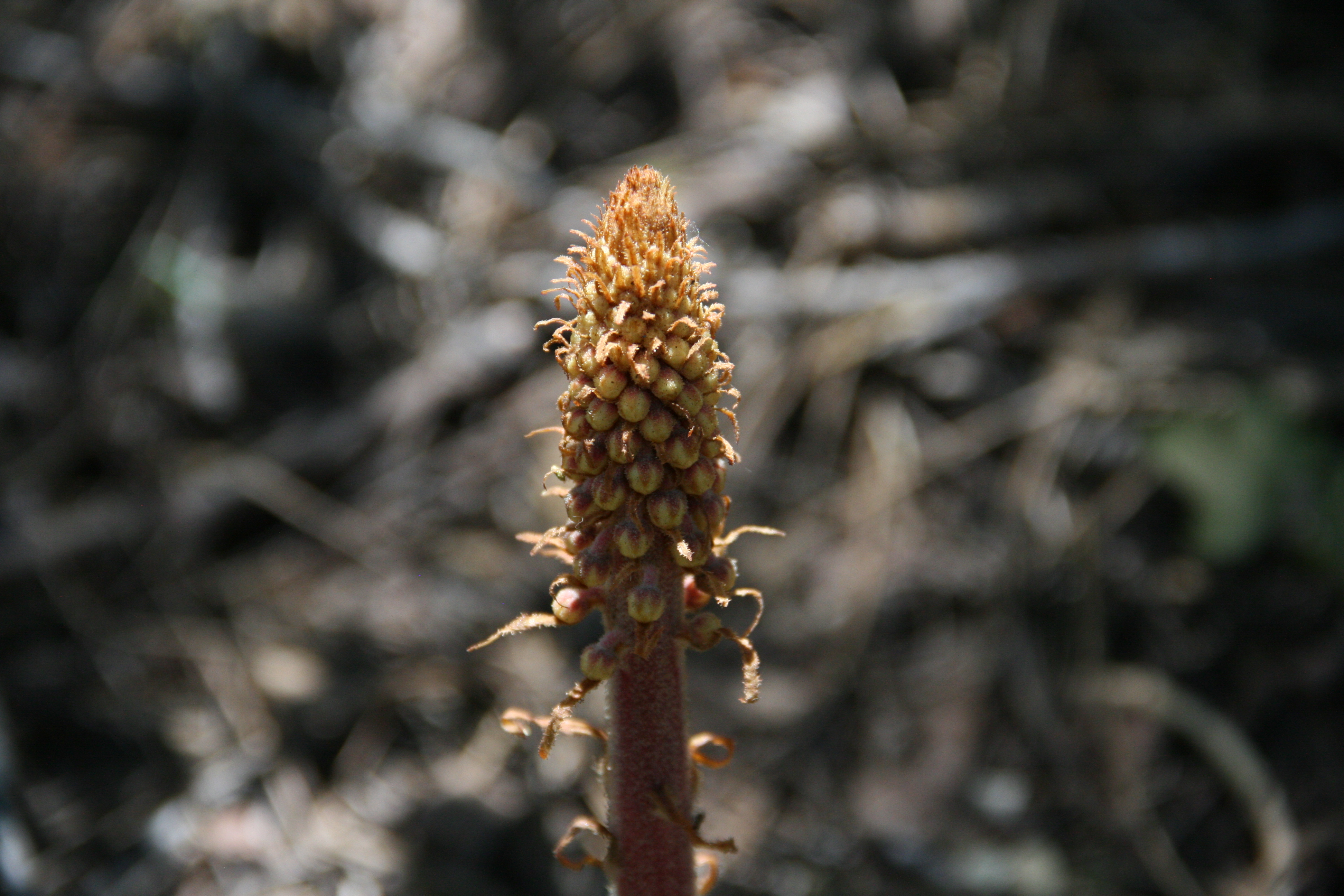
Photo by Chez Brungraber
Family: Ericaceae · Type: Herb · Native
Pterospora andromedea (Pine drops) is a native California herb in the Ericaceae family, recognized by Only Pterospora species in CA, distinctive parasitic member of Ericaceae found in coniferous forests.
Pine drops is a California native perennial found in the Klamath Ranges, northern Coast Ranges, California Ranges, Sierra Nevada, Tehachapi Mountains, Transverse Ranges, Peninsular Ranges, Modoc Plateau, and eastern Sierra Nevada in mixed or conifer forest at elevations of 60 to 3,700 meters. Flowering from June to August, this unusual non-green parasitic plant produces cream to yellow flowers in pendulous, glandular racemes 1.5 to 17 decimeters tall, emerging directly from the ground. Growing without leaves or stems, it appears as a distinctive pink to brown plant with a brittle root system. Its urn-shaped flowers have 5 petals approximately 6 to 9 millimeters long with recurved lobes, emerging from a dense, sticky-glandular inflorescence. The plant produces small capsules less than 1.3 centimeters wide that disperse numerous tiny seeds with minute membranous wings.
Identification and appearance
Key characters: Only Pterospora species in CA, distinctive parasitic member of Ericaceae found in coniferous forests
Habitat and range
Habitat: Mixed or conifer forest
Elevation: 60-3700 m
California counties: San Bernardino, Lassen, Tulare, Siskiyou, El Dorado, Kern, Fresno, Riverside, Tuolumne, Trinity, Plumas, Butte, Mendocino, Calaveras, Mariposa, Modoc, Humboldt, Los Angeles, Madera, Mono, Sierra, Placer, Alpine, Stanislaus, Nevada, Shasta, Amador, Glenn, Inyo, San Diego, Tehama, Ventura, Yuba, Lake, Colusa, Del Norte
Outside California: to British Columbia, Mexico, also eastern North America
Bloom period
Pterospora andromedea blooms Jun-Aug.
How to tell it apart
vs Sarcodes: Pterospora is tall, thin, and brownish; Sarcodes is short, thick, and bright red.; vs Pyrola: Pterospora lacks green leaves entirely; Pyrola has a basal rosette of green wintergreen leaves.; vs Pleuricospora: Pterospora has dry capsules that split open; Pleuricospora produces soft fleshy berries.; vs Allotropa: Pterospora is uniformly brownish-pink; Allotropa has bold red-and-white candy-cane stripes.; vs Corallorhiza: Pterospora has dense urn-shaped flowers; Corallorhiza has scattered bilateral orchid flowers.
Frequently asked questions
Is Pterospora andromedea native to California?
Yes. Pterospora andromedea is native to California (recorded as native).
When does Pterospora andromedea bloom?
Pterospora andromedea blooms Jun-Aug.
Where in California does Pterospora andromedea grow?
Pterospora andromedea occurs in San Bernardino, Lassen, Tulare, Siskiyou, El Dorado, Kern, Fresno, Riverside and other counties, at elevations of 60-3700 m.
What plant family does Pterospora andromedea belong to?
Pterospora andromedea is in the Ericaceae family, genus Pterospora.
What habitat does Pterospora andromedea grow in?
Pterospora andromedea grows in Mixed or conifer forest.
Related species
Other California species in the same genus, family, or bioregion.
Sources: Jepson eFlora · Index of California Plant Names · CalPhotos
Last updated 2026-10-07
Data from The California Species Project — 14,000+ California species with verified data from CNPS, CDFW, USFWS, Cal-IPC, and more.