Pterostegia drymarioides
Fairy mist
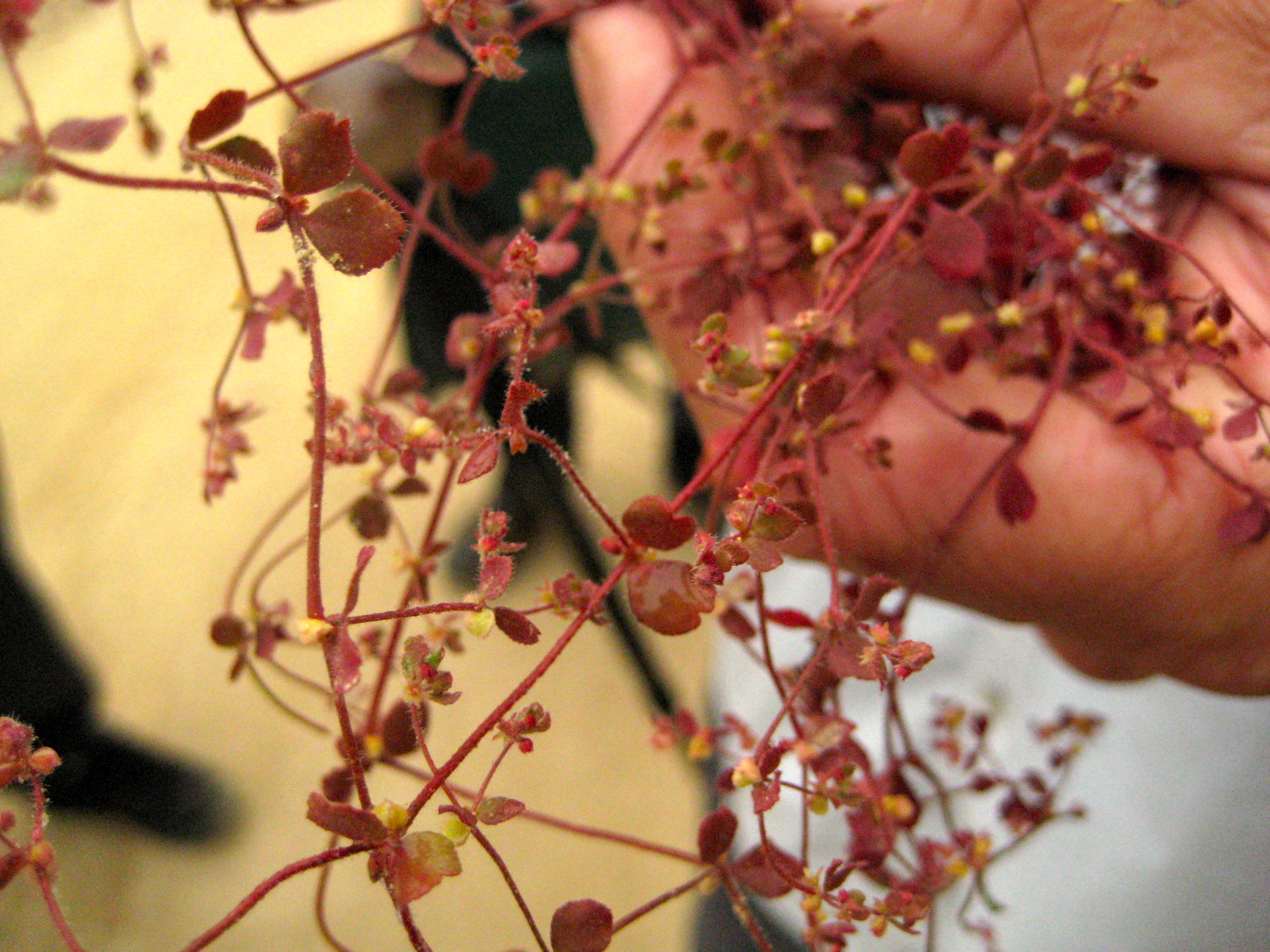
Photo by Chez Brungraber
Family: Polygonaceae · Type: Herb · Native
Pterostegia drymarioides (Fairy mist) is a native California herb in the Polygonaceae family, recognized by Only Pterostegia species in CA, distinctive among Polygonaceae for its winged involucres and sprawling habit.
Fairy mist is a California native annual herb found in sandy or gravelly habitats at elevations below 1,600 meters. Flowering from March to July, this delicate plant produces pale yellow to pink or rose flowers tiny and clustered in small terminal cymes. Growing as a sprawling herb with hairy stems spreading up to one meter in diameter, it forms intricate low-growing networks across its habitat. Its opposite cauline leaves are wide and entire or slightly lobed, measuring 0.3 to 2 centimeters long with distinctive wing-like bracts surrounding its tiny flowers. The fruits are small obconic structures, generally brown and winged, containing straight embryos.
Identification and appearance
Key characters: Only Pterostegia species in CA, distinctive among Polygonaceae for its winged involucres and sprawling habit
Habitat and range
Habitat: Common. Sand or gravel
Elevation: < 1600 m
California counties: Los Angeles, Santa Barbara, San Bernardino, Inyo, Kern, Contra Costa, Sonoma, Ventura, Tulare, Riverside, Yuba, San Luis Obispo, Tehama, Madera, Monterey, Orange, San Diego, Santa Cruz, Butte, Stanislaus, Fresno, Mariposa, Santa Clara, San Mateo, San Francisco, Shasta, Sacramento, Marin, Imperial, Napa, El Dorado, San Benito, Alameda, Glenn, Humboldt, Lake, Mendocino, Nevada, San Joaquin, Solano, Sutter, Amador, Calaveras, Tuolumne, Merced, Colusa, Yolo, Alpine
Outside California: to southern Oregon, southwestern Utah, western Arizona, northwestern Mexico
Bloom period
Pterostegia drymarioides blooms Mar-Jul.
How to tell it apart
vs Chorizanthe: Pterostegia has paired, often fan-shaped or 2-lobed stem leaves and smooth 2-winged involucres; Chorizanthe grows from a basal leaf rosette and its involucres end in hooked awns or teeth.; vs Eriogonum: Pterostegia is a delicate sprawling annual with opposite lobed leaves; Eriogonum has basal leaves and cup-shaped involucres holding several flowers.; vs Drymaria: Both are tiny opposite-leaved sprawlers, but Pterostegia lacks stipules and encloses its fruit in a winged, one-sided saclike bract; Drymaria has membranous stipules and 5 distinct white petals.; vs Nemacaulis: Nemacaulis is densely woolly with leaves in basal clusters; Pterostegia is only thinly hairy with leaves paired along the stem.; vs Stellaria: Chickweeds have deeply notched white petals and a dry capsule; Pterostegia has no petals, only a minute pale yellow-to-pink perianth, and its fruit sits in a winged bract.
Frequently asked questions
Is Pterostegia drymarioides native to California?
Yes. Pterostegia drymarioides is native to California (recorded as native).
When does Pterostegia drymarioides bloom?
Pterostegia drymarioides blooms Mar-Jul.
Where in California does Pterostegia drymarioides grow?
Pterostegia drymarioides occurs in Los Angeles, Santa Barbara, San Bernardino, Inyo, Kern, Contra Costa, Sonoma, Ventura and other counties, at elevations of < 1600 m.
What plant family does Pterostegia drymarioides belong to?
Pterostegia drymarioides is in the Polygonaceae family, genus Pterostegia.
What habitat does Pterostegia drymarioides grow in?
Pterostegia drymarioides grows in Common. Sand or gravel.
Related species
Other California species in the same genus, family, or bioregion.
Sources: Jepson eFlora · Index of California Plant Names · CalPhotos
Last updated 2026-10-07
Data from The California Species Project — 14,000+ California species with verified data from CNPS, CDFW, USFWS, Cal-IPC, and more.