Puccinellia simplex
California alkaligrass
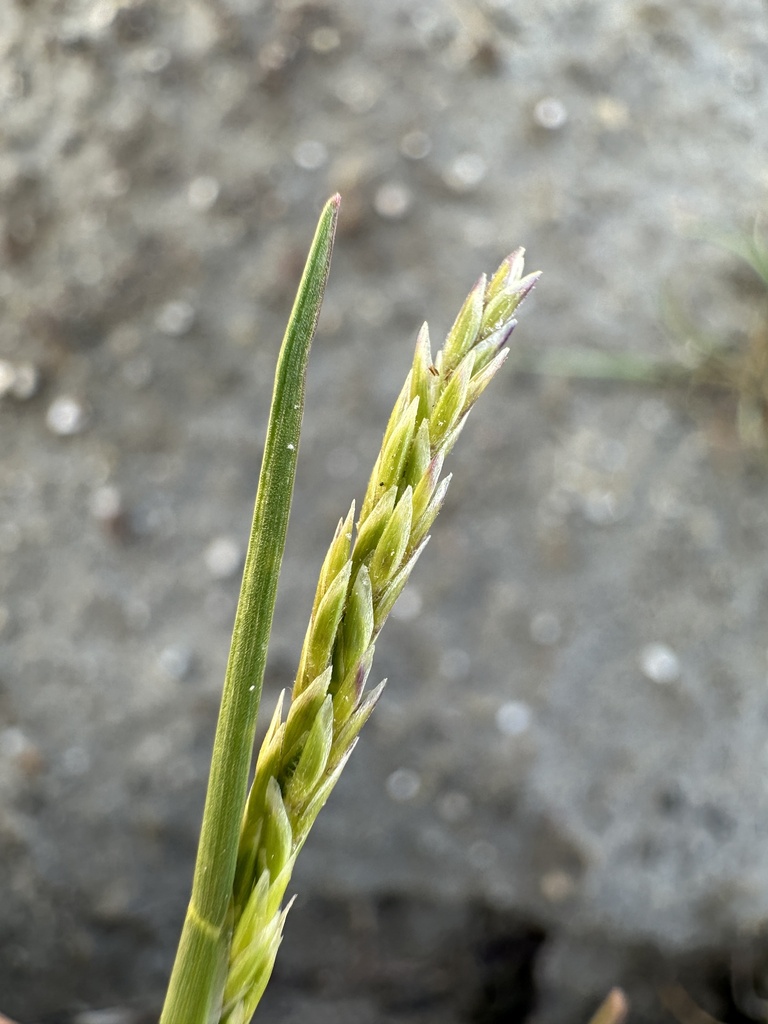
(c) Matt Berger, some rights reserved (CC BY), uploaded by Matt Berger · licence
Family: Poaceae · Type: Grass · Native
Conservation status: CNPS 1B.2
Puccinellia simplex (California alkaligrass) is a native California grass in the Poaceae family, recognized by annual habit and distinctive lemma hairiness.
California alkaligrass is a rare (CNPS 1B.2) native annual found in the San Joaquin Valley, San Francisco Bay Area, western Mojave Desert, and Tehachapi region in saline flats and mineral springs at elevations below 900 meters. Flowering from March to May, this plant produces delicate, pale green to white flowers in narrow, upright inflorescences 1 to 18 centimeters long. Growing with slender stems and fine, thread-like form, it develops thin stems with tightly inrolled leaves less than 2 millimeters wide when flat. Its leaves are narrow and delicate, typically rolled into thin, grass-like blades that adapt to harsh, saline environments. The plant's unique spikelets feature lemmas with soft, sparse hairs and tiny anthers less than half a millimeter long, reflecting its specialized adaptation to alkaline habitats.
Identification and appearance
Key characters: Co-occurs with 3 species; annual habit and distinctive lemma hairiness are diagnostic
Habitat and range
Habitat: Saline flats, mineral springs
Elevation: < 900 m
California counties: Yolo, Lake, Kern, San Bernardino, Napa, Butte, Contra Costa, Merced, Glenn, Alameda, Colusa, Solano, Tulare, Madera, Stanislaus, Kings, Fresno, Lassen, Santa Cruz
Outside California: to Utah
Bloom period
Puccinellia simplex blooms Mar-May.
Conservation status
CNPS 1B.2
How to tell it apart
vs Distichlis: Puccinellia has round stems and tufted growth; Distichlis has strongly flattened stems with leaves in two distinct rows.; vs Bromus: Puccinellia has faint 5-veined lemmas in alkaline sites; Bromus has prominent 5-9 veined lemmas in upland sites.; vs Torreyochloa: Puccinellia is tufted in saline soils; Torreyochloa has rhizomes and grows in high-elevation freshwater.; vs Glyceria: Puccinellia has faintly veined lemmas in alkaline soil; Glyceria has prominent veins and closed leaf sheaths in freshwater.; vs Desmazeria: Puccinellia is perennial in alkaline wetlands; Desmazeria is annual of dry disturbed sites with different spikelet structure.
Frequently asked questions
Is Puccinellia simplex native to California?
Yes. Puccinellia simplex is native to California (recorded as native).
When does Puccinellia simplex bloom?
Puccinellia simplex blooms Mar-May.
Where in California does Puccinellia simplex grow?
Puccinellia simplex occurs in Yolo, Lake, Kern, San Bernardino, Napa, Butte, Contra Costa, Merced and other counties, at elevations of < 900 m.
What plant family does Puccinellia simplex belong to?
Puccinellia simplex is in the Poaceae family, genus Puccinellia.
Is Puccinellia simplex rare or endangered?
Puccinellia simplex carries California Rare Plant Rank 1B.2, state rank S2.
Related species
Other California species in the same genus, family, or bioregion.
- Puccinellia sp. — Alkali grass
- Puccinellia distans — European alkali grass
- Puccinellia howellii — Howell's alkali grass
- Puccinellia lemmonii — Lemmon's alkali grass
- Puccinellia nutkaensis — Alaska alkali grass
- Puccinellia nuttalliana — Nuttall's alkali grass
- Rytidosperma caespitosum — Tufted wallaby grass
- Rytidosperma penicillatum — Hairy oat grass
- Rytidosperma racemosum
Sources: Jepson eFlora · CNPS Rare Plant Inventory · Index of California Plant Names · CalPhotos · CDFW CNDDB
Last updated 2026-10-07
Data from The California Species Project — 14,000+ California species with verified data from CNPS, CDFW, USFWS, Cal-IPC, and more.