Punica granatum
Pomegranate
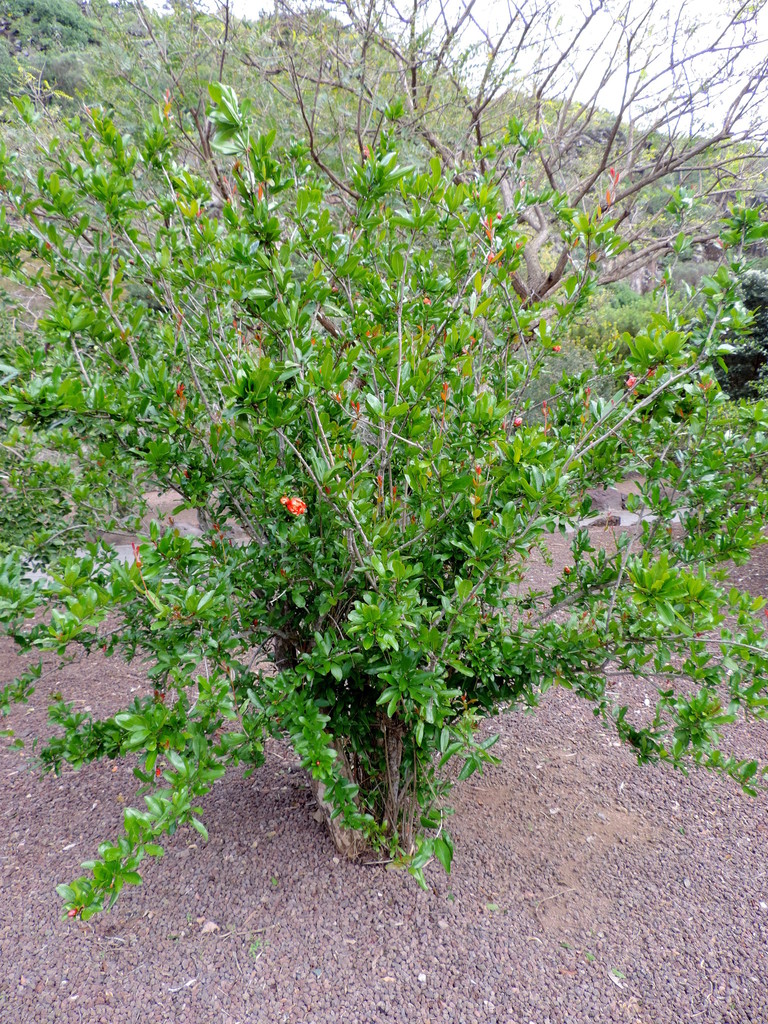
(c) Krzysztof Ziarnek, Kenraiz, some rights reserved (CC BY-SA) · licence
Family: Lythraceae · Type: Shrub / Tree · Not Native
Punica granatum (Pomegranate) is a non-native California shrub / tree in the Lythraceae family, recognized by Only Punica species in CA, occasional escape from cultivation with distinctive large colorful flowers and fruit.
Pomegranate is a naturalized shrub found in southern San Joaquin Valley, southern Coast Ranges, San Gabriel Mountains, and northern Southern California in disturbed ground at elevations below 500 meters. Flowering from April to July, this plant produces bright orange-red to pale yellow flowers 2 to 3 centimeters long with showy petals. Growing up to 5 meters tall with multiple stems, it features glossy, oblong to lance-ovate leaves that are significantly longer than their petioles. Its leaves are shiny on the upper surface and range from 1 to 9 centimeters in length. The fruit is a distinctive red-brown globe 5 to 12 centimeters in diameter, containing red and white seeds.
Identification and appearance
Key characters: Only Punica species in CA, occasional escape from cultivation with distinctive large colorful flowers and fruit
Habitat and range
Habitat: Uncommon. Disturbed ground
Elevation: < 500 m
California counties: Riverside, Los Angeles, Ventura, San Diego, Orange, Marin, Butte, San Mateo, San Luis Obispo, San Bernardino, Alameda, Yolo, Fresno, Santa Clara
Outside California: native southeastern Europe, Asia, to Himalayas
Bloom period
Punica granatum blooms Apr-Jul.
How to tell it apart
vs Gambelia: Pomegranate has thick leathery flowers and woody growth; Gambelia has delicate snapdragon-like flowers on herbaceous plants.; vs Burchellia: Pomegranate flowers have 5-9 sepals and inferior ovaries; Burchellia has tubular flowers with different structure.; vs Chaenomeles: Pomegranate has leathery tubular flowers; flowering quince has flat, open rose-like flowers with many stamens.; vs Hibiscus: Pomegranate has thick tubular flowers with inferior ovary; Hibiscus has flat, open flowers with prominent central column.; vs Prunus: Pomegranate has thick tubular flowers and leathery leaves; Prunus has flat 5-petaled flowers and toothed leaves.
Frequently asked questions
Is Punica granatum native to California?
No. Punica granatum is not native to California (recorded as not native).
When does Punica granatum bloom?
Punica granatum blooms Apr-Jul.
Where in California does Punica granatum grow?
Punica granatum occurs in Riverside, Los Angeles, Ventura, San Diego, Orange, Marin, Butte, San Mateo and other counties, at elevations of < 500 m.
What plant family does Punica granatum belong to?
Punica granatum is in the Lythraceae family, genus Punica.
What habitat does Punica granatum grow in?
Punica granatum grows in Uncommon. Disturbed ground.
Related species
Other California species in the same genus, family, or bioregion.
Sources: Jepson eFlora · Index of California Plant Names · CalPhotos
Last updated 2026-10-07
Data from The California Species Project — 14,000+ California species with verified data from CNPS, CDFW, USFWS, Cal-IPC, and more.