Purshia stansburyana
Cliffrose, Cliffrose
no rights reserved · CC0
Family: Rosaceae · Type: Shrub · Native
Purshia stansburyana (Cliffrose) is a native California shrub in the Rosaceae family, recognized by larger flowers, plumose styles, and leaf morphology.
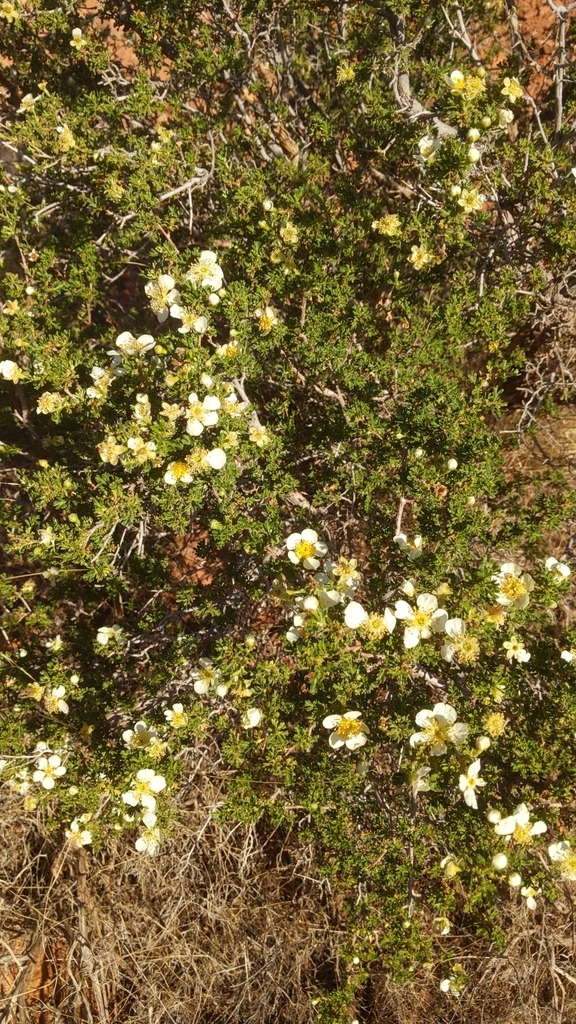
Cliffrose is a California native shrub found in the White and Inyo Mountains and Desert Mountains in Joshua-tree and pinyon/juniper woodland at elevations of 900 to 2,600 meters. Flowering from April to May, this plant produces white to cream-colored flowers with petals 7 to 13 millimeters long, widely ovate in shape. Growing 1 to 4 meters tall with a spreading, multi-branched form, it develops a complex woody structure with intricate branching. Its leaves have 3 to 5 distinct lobes, with central and lateral lobes positioned asymmetrically, creating a delicate, textured appearance. The fruit develops with dramatically long, feathery plumose styles measuring 20 to 60 millimeters, giving the plant a distinctive and elegant silhouette.
Identification and appearance
Key characters: 1 sympatric species; distinguished by larger flowers, plumose styles, and leaf morphology
Habitat and range
Habitat: Joshua-tree, pinyon/juniper woodland
Elevation: 900-2600 m
California counties: San Bernardino, Inyo, Riverside, Los Angeles, San Luis Obispo
Outside California: southwestern United States, northern Mexico
Bloom period
Purshia stansburyana blooms Apr-May(Oct).
How to tell it apart
vs Baccharis: Purshia has lobed leaves with rolled margins; Baccharis has simple, entire or toothed leaves without lobes.; vs Ceanothus: Purshia leaves have 3-9 narrow lobes at the tip; Ceanothus leaves are simple with small teeth along edges.; vs Ribes: Purshia has wedge-shaped leaves lobed only at the tip; currant leaves are broadly lobed from the base.; vs Adenostoma: Purshia has 3-9 lobed leaves; chamise has needle-like, unlobed leaves clustered on short shoots.; vs Artemisia: Purshia has woody stems and large white flowers; sagebrush has inconspicuous flower heads in spikes.
Frequently asked questions
Is Purshia stansburyana native to California?
Yes. Purshia stansburyana is native to California (recorded as native).
When does Purshia stansburyana bloom?
Purshia stansburyana blooms Apr-May(Oct).
Where in California does Purshia stansburyana grow?
Purshia stansburyana occurs in San Bernardino, Inyo, Riverside, Los Angeles, San Luis Obispo, at elevations of 900-2600 m.
What plant family does Purshia stansburyana belong to?
Purshia stansburyana is in the Rosaceae family, genus Purshia.
What habitat does Purshia stansburyana grow in?
Purshia stansburyana grows in Joshua-tree, pinyon/juniper woodland.
Related species
Other California species in the same genus, family, or bioregion.
Sources: Jepson eFlora · Index of California Plant Names · CalPhotos
Last updated 2026-10-06
Data from The California Species Project — 14,000+ California species with verified data from CNPS, CDFW, USFWS, Cal-IPC, and more.