Pyrola picta
White-veined wintergreen
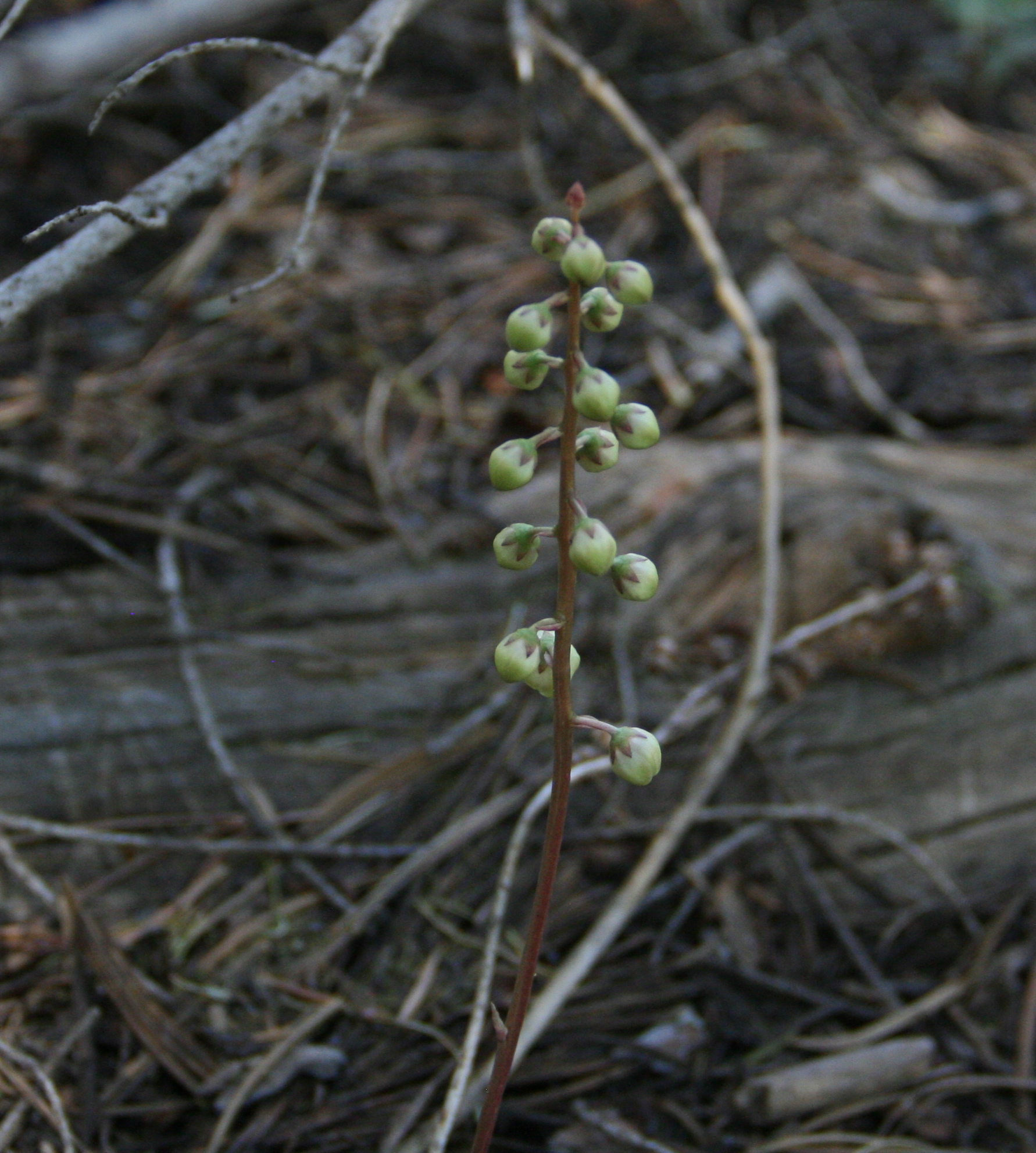
Photo by Chez Brungraber
Family: Ericaceae · Type: Subshrub · Native
Pyrola picta (White-veined wintergreen) is a native California subshrub in the Ericaceae family, recognized by white-veined leaves diagnostic.
White-veined wintergreen is a California native perennial found in northwestern California, the Cascade Range, Sierra Nevada, San Francisco Bay Area, southern Coast Ranges, San Bernardino Mountains, Peninsular Ranges, San Jacinto Mountains, and Modoc Plateau in moist to dry mixed conifer forests, Pinus woodlands, and volcanic areas at elevations of 400 to 2,400 meters. Flowering from June to August, this plant produces delicate cream-white to pink flowers that bloom in clusters of 5 to 25 blossoms. Growing with slender stems up to 35 centimeters tall, it forms distinctive rosettes of leaves. Its leaves are dark green with striking white veining, typically ovate to obovate, measuring 2.5 to 7 centimeters long and occasionally showing purple tones underneath. The flower petals are 5 to 7 millimeters long, creating an elegant and subtle woodland presence.
Identification and appearance
Key characters: 6 sympatric species; white-veined leaves diagnostic
Habitat and range
Habitat: Moist to dry mixed conifer forests, Pinus woodlands, volcanic areas, occasionally on decomposed granite
Elevation: 400-2400 m
California counties: Humboldt, Mariposa, San Bernardino, Siskiyou, Lake, Tuolumne, Fresno, Tulare, Mendocino, Calaveras, Plumas, Alpine, Amador, El Dorado, Sierra, Trinity, Santa Barbara, Los Angeles, Butte, Placer, Kern, Madera, Shasta, Riverside, San Diego, Nevada, Lassen, Modoc, Mono, Sonoma, Tehama, Glenn, Stanislaus, San Mateo, Colusa, Marin, Del Norte, Santa Cruz, Monterey, Napa, Santa Clara, Inyo, Ventura
Outside California: to British Columbia, New Mexico
Bloom period
Pyrola picta blooms Jun-Aug.
How to tell it apart
vs Pterospora: Pyrola has green basal leaves; Pterospora is completely leafless and brownish-pink without chlorophyll.; vs Corallorhiza: Pyrola has basal leaves and radially symmetrical flowers; Corallorhiza is leafless with bilateral orchid flowers.; vs Chimaphila: Pyrola leaves are all basal in a rosette; Chimaphila has thick leaves scattered up the stem.; vs Goodyera: Pyrola flowers are radially symmetrical and arranged all around stem; Goodyera has spiral orchid flowers.; vs Orthilia: Pyrola flowers arranged evenly around stem; Orthilia flowers distinctly one-sided along the stalk.
Frequently asked questions
Is Pyrola picta native to California?
Yes. Pyrola picta is native to California (recorded as native).
When does Pyrola picta bloom?
Pyrola picta blooms Jun-Aug.
Where in California does Pyrola picta grow?
Pyrola picta occurs in Humboldt, Mariposa, San Bernardino, Siskiyou, Lake, Tuolumne, Fresno, Tulare and other counties, at elevations of 400-2400 m.
What plant family does Pyrola picta belong to?
Pyrola picta is in the Ericaceae family, genus Pyrola.
What habitat does Pyrola picta grow in?
Pyrola picta grows in Moist to dry mixed conifer forests, Pinus woodlands, volcanic areas, occasionally on decomposed granite.
Related species
Other California species in the same genus, family, or bioregion.
- Pyrola sp. — Wintergreen
- Pyrola aphylla — Leafless wintergreen
- Pyrola asarifolia — Bog wintergreen
- Pyrola asarifolia subsp. asarifolia — Bog wintergreen
- Pyrola asarifolia subsp. bracteata — Long-bracted wintergreen
- Pyrola crypta — Cryptic wintergreen
- Rhododendron columbianum — Western labrador tea
- Rhododendron macrophyllum — California rhododendron
- Rhododendron occidentale — California azalea
Sources: Jepson eFlora · Index of California Plant Names · CalPhotos
Last updated 2026-10-08
Data from The California Species Project — 14,000+ California species with verified data from CNPS, CDFW, USFWS, Cal-IPC, and more.