Pyrus communis
Common pear
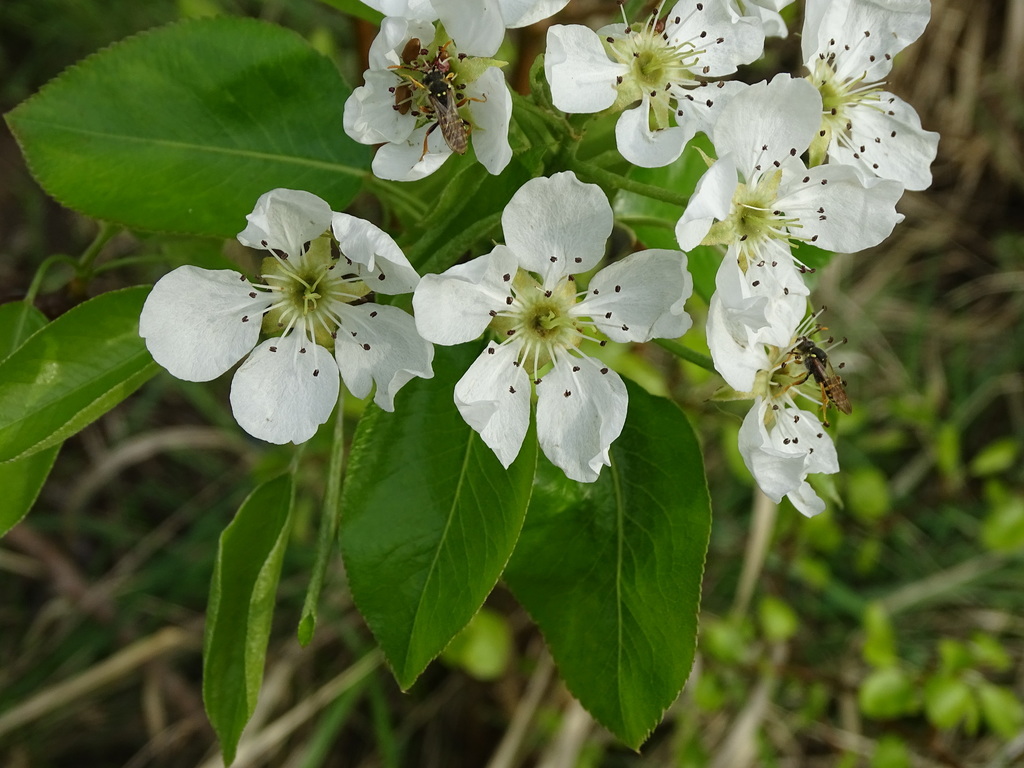
(c) Grzegorz Grzejszczak, some rights reserved (CC BY-SA), uploaded by Grzegorz Grzejszczak · licence
Family: Rosaceae · Type: Tree · Not Native
Pyrus communis (Common pear) is a non-native California tree in the Rosaceae family, recognized by No sympatric species - geographically isolated. Key features include thorny escaped plants with large pear fruits.
Common pear is a naturalized shrub found in northern Sierra Foothills, southern Sacramento Valley, Transverse Ranges, Peninsular Ranges, White and Inyo Mountains, and Desert Mountains in disturbed places at elevations below 1,600 meters. Flowering from February to April, this plant produces white, odorous flowers 10 to 15 millimeters long. Growing with somewhat thorny branches that become smooth with age, the shrub reaches variable sizes with distinctive branching. Its leaves are ovate to wide-ovate, 2 to 7 centimeters long, with rounded teeth and initially hairy surfaces that become glabrous as they mature. The fruit is large, measuring 3 to 15 centimeters in length with a persistent calyx, characteristic of cultivated and escaped pear plants.
Identification and appearance
Key characters: No sympatric species - geographically isolated. Key features include thorny escaped plants with large pear fruits.
Habitat and range
Habitat: Disturbed places
Elevation: < 1600 m
California counties: Los Angeles, San Bernardino, Ventura, Sonoma, Orange, Mono, Sacramento, Butte, El Dorado, Contra Costa, Santa Clara, Trinity, Mendocino, San Diego, Yolo, Mariposa
Outside California: native to Eurasia
Bloom period
Pyrus communis blooms Feb-Apr.
How to tell it apart
vs Populus: Populus has triangular leaves with flattened petioles; Pyrus has oval leaves with round petioles.; vs Prunus: Prunus fruits have a single central pit; Pyrus fruits have a papery core with gritty flesh throughout.; vs Quercus: Quercus has lobed leaves and acorns; Pyrus has unlobed leaves and pear-shaped fruits.; vs Acer: Acer has opposite, palmately lobed leaves; Pyrus has alternate, unlobed leaves.; vs Triadica: Triadica has heart-shaped leaves and dry three-parted capsules; Pyrus has oval leaves and fleshy pear fruits.
Frequently asked questions
Is Pyrus communis native to California?
No. Pyrus communis is not native to California (recorded as not native).
When does Pyrus communis bloom?
Pyrus communis blooms Feb-Apr.
Where in California does Pyrus communis grow?
Pyrus communis occurs in Los Angeles, San Bernardino, Ventura, Sonoma, Orange, Mono, Sacramento, Butte and other counties, at elevations of < 1600 m.
What plant family does Pyrus communis belong to?
Pyrus communis is in the Rosaceae family, genus Pyrus.
What habitat does Pyrus communis grow in?
Pyrus communis grows in Disturbed places.
Related species
Other California species in the same genus, family, or bioregion.
Sources: Jepson eFlora · Index of California Plant Names · CalPhotos
Last updated 2026-10-07
Data from The California Species Project — 14,000+ California species with verified data from CNPS, CDFW, USFWS, Cal-IPC, and more.