Quercus chrysolepis
Maul oak, canyon live oak, Canyon Live Oak
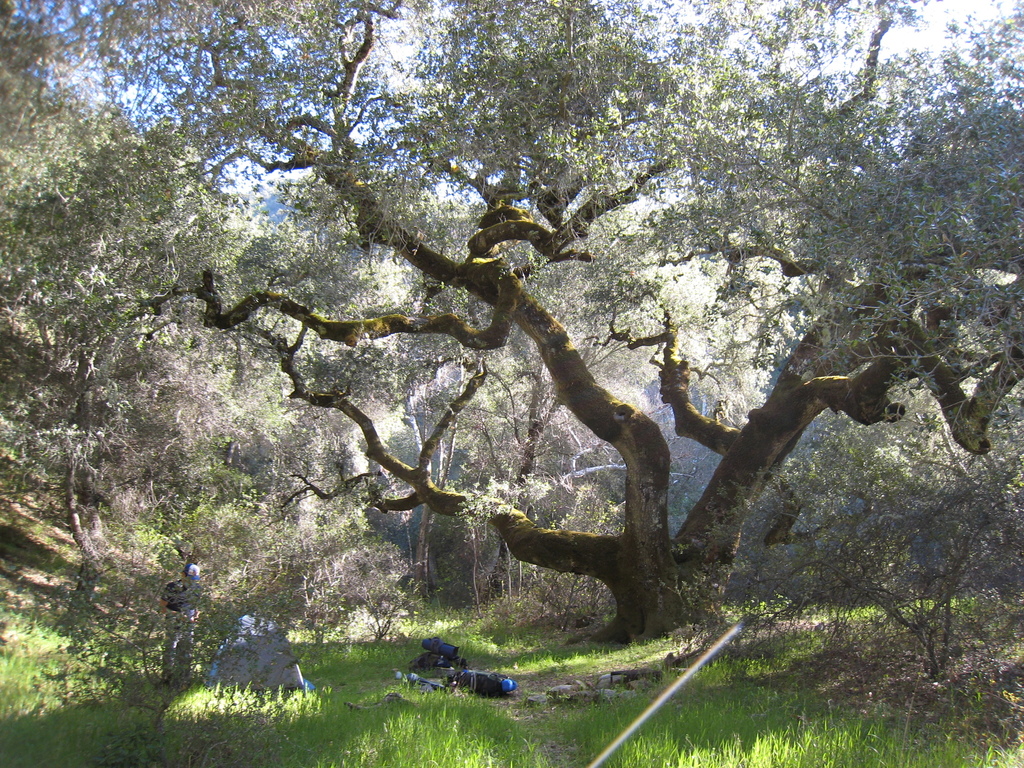
(c) josh jackson, some rights reserved (CC BY) · licence
Family: Fagaceae · Type: Shrub / Tree · Native
Quercus chrysolepis (Maul oak) is a native California shrub / tree in the Fagaceae family, recognized by golden tomentose features and 2-year acorns distinctive.
Maul oak is a California native shrub found in the California Floristic Province and eastern desert mountains in canyons, shaded slopes, chaparral, mixed-evergreen forest, and woodland at elevations of 30 to 2,750 meters. Flowering from April to May, this evergreen shrub produces small, inconspicuous flowers with golden-tomentose twigs that become nearly smooth with age. Growing as a multi-stemmed shrub or small tree up to 35 meters tall, it features a pale gray bark with narrow furrows and scaly texture. Its leathery leaves are oblong to round-ovate, 3 to 6 centimeters long, with a dark green upper surface and golden-puberulent lower surface that becomes grayish and glabrous as the leaf matures. The distinctive acorn cup is 17 to 30 millimeters wide, with thick, golden-tomentose scales, and contains a nut 25 to 30 millimeters long that matures in its second year.
Identification and appearance
Key characters: 36 sympatric species; golden tomentose features and 2-year acorns distinctive
Habitat and range
Habitat: Canyons, shaded slopes, chaparral, mixed-evergreen forest, woodland
Elevation: 30-2750 m
California counties: Humboldt, Los Angeles, Kern, San Bernardino, Mendocino, San Benito, Riverside, Trinity, Shasta, Ventura, Lake, Fresno, Orange, San Diego, Santa Barbara, Monterey, Inyo, Plumas, Butte, Santa Cruz, Marin, Santa Clara, Madera, Sonoma, Glenn, Placer, Del Norte, Siskiyou, Tulare, Nevada, Tuolumne, Napa, Contra Costa, El Dorado, Mariposa, Alameda, San Luis Obispo, Amador, Calaveras, Colusa, San Mateo, Sierra, San Francisco, Tehama, Solano, Alpine, Yolo, Yuba
Outside California: Oregon, Arizona, Baja California
Bloom period
Quercus chrysolepis blooms Apr-May.
How to tell it apart
vs Prunus: Quercus has acorns in cups; cherries/plums have fleshy round fruits.; vs Notholithocarpus: Quercus has drooping catkins; tanoak has upright flower spikes.; vs Rhamnus: Quercus has acorns; buckthorns have berry-like fruits.; vs Ceanothus: Quercus has acorns; California lilacs have small capsule fruits.; vs Platanus: Quercus has acorns; sycamores have hanging ball-shaped seed clusters.
Frequently asked questions
Is Quercus chrysolepis native to California?
Yes. Quercus chrysolepis is native to California (recorded as native).
When does Quercus chrysolepis bloom?
Quercus chrysolepis blooms Apr-May.
Where in California does Quercus chrysolepis grow?
Quercus chrysolepis occurs in Humboldt, Los Angeles, Kern, San Bernardino, Mendocino, San Benito, Riverside, Trinity and other counties, at elevations of 30-2750 m.
What plant family does Quercus chrysolepis belong to?
Quercus chrysolepis is in the Fagaceae family, genus Quercus.
What habitat does Quercus chrysolepis grow in?
Quercus chrysolepis grows in Canyons, shaded slopes, chaparral, mixed-evergreen forest, woodland.
Related species
Other California species in the same genus, family, or bioregion.
Sources: Jepson eFlora · Index of California Plant Names · CalPhotos
Last updated 2026-10-07
Data from The California Species Project — 14,000+ California species with verified data from CNPS, CDFW, USFWS, Cal-IPC, and more.