Quercus lobata
Valley oak, roble, Roble
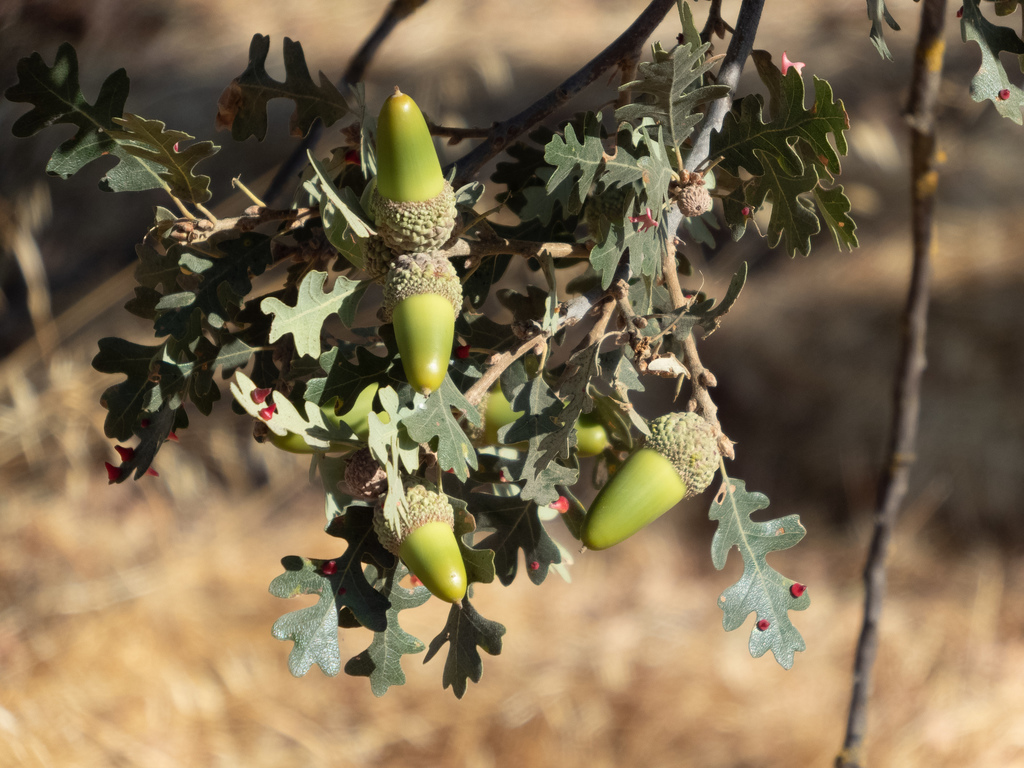
no rights reserved, uploaded by Kyle Nessen · CC0
Family: Fagaceae · Type: Tree · Native
Quercus lobata (Valley oak) is a native California tree in the Fagaceae family, recognized by deeply lobed leaves and large acorns distinctive.
Valley oak is a California native tree found in the Klamath Ranges, northern California Coast Ranges, Sierra Nevada Foothills, Sierra Nevada, Tehachapi Mountains, Central Valley, San Francisco Bay Area, southern California Ranges, northwestern southern California, Channel Islands, western Transverse Ranges, and western San Gabriel Mountains in slopes, valleys, and savanna at elevations below 1,830 meters. Flowering from March to April, this tree produces delicate pale green flowers. Growing up to 35 meters tall with a deciduous habit and thin, scaly light gray bark, it develops a broad spreading canopy. Its large leaves are 5 to 12 centimeters long, obovate with deep lobes, dark green on top and pale green underneath, featuring 6 to 10 obtuse lobes with coarse teeth at the tips. The tree produces large acorns in a hemispheric cup 14 to 30 millimeters wide, with nuts 30 to 50 millimeters long that mature in a single year.
Identification and appearance
Key characters: 33 sympatric species; deeply lobed leaves and large acorns distinctive
Habitat and range
Habitat: Slopes, valleys, savanna
Elevation: < 1830 m
California counties: Kern, Monterey, Tehama, Mendocino, San Luis Obispo, Los Angeles, Santa Barbara, Sacramento, Butte, Napa, Sonoma, Ventura, San Mateo, Santa Clara, Santa Cruz, San Benito, San Joaquin, Tulare, El Dorado, Solano, Alameda, Mariposa, Lake, Tuolumne, Orange, Siskiyou, Stanislaus, San Diego, Riverside, Amador, Colusa, Yolo, Fresno, Sutter, Merced, Nevada, Contra Costa, Marin, Shasta, Calaveras, Placer, Yuba, Kings, Trinity, Glenn, Madera
Bloom period
Quercus lobata blooms Mar-Apr.
How to tell it apart
vs Prunus: Quercus has acorns in cups; cherries/plums have fleshy round fruits.; vs Notholithocarpus: Quercus has drooping catkins; tanoak has upright flower spikes.; vs Rhamnus: Quercus has acorns; buckthorns have berry-like fruits.; vs Ceanothus: Quercus has acorns; California lilacs have small capsule fruits.; vs Platanus: Quercus has acorns; sycamores have hanging ball-shaped seed clusters.
Frequently asked questions
Is Quercus lobata native to California?
Yes. Quercus lobata is native to California (recorded as native).
When does Quercus lobata bloom?
Quercus lobata blooms Mar-Apr.
Where in California does Quercus lobata grow?
Quercus lobata occurs in Kern, Monterey, Tehama, Mendocino, San Luis Obispo, Los Angeles, Santa Barbara, Sacramento and other counties, at elevations of < 1830 m.
What plant family does Quercus lobata belong to?
Quercus lobata is in the Fagaceae family, genus Quercus.
What habitat does Quercus lobata grow in?
Quercus lobata grows in Slopes, valleys, savanna.
Related species
Other California species in the same genus, family, or bioregion.
Sources: Jepson eFlora · Index of California Plant Names · CalPhotos
Last updated 2026-10-07
Data from The California Species Project — 14,000+ California species with verified data from CNPS, CDFW, USFWS, Cal-IPC, and more.