Quincula lobata
Lobed ground-cherry
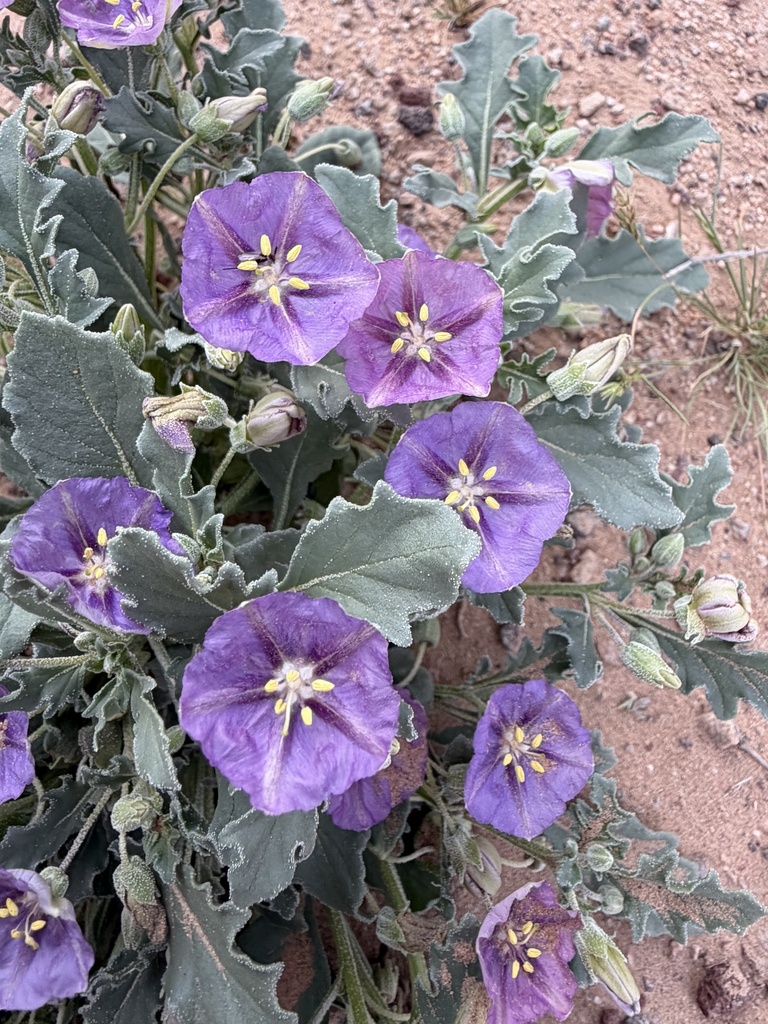
(c) Matt Berger, some rights reserved (CC BY) · licence
Family: Solanaceae · Type: Herb · Native
Conservation status: CNPS 2B.3
Quincula lobata (Lobed ground-cherry) is a native California herb in the Solanaceae family, recognized by Range edge species - genus extends east to Great Plains but only this species reaches California's southeastern deserts.
Lobed ground-cherry is a rare (CNPS 2B.3) California native perennial found in southeastern Mojave Desert and northeastern Colorado Desert regions in desert scrub, woodland, and dry lake bed habitats at elevations of 500 to 1,300 meters. Flowering from March to May and September to November, this plant produces purple or blue flowers approximately 15 to 20 millimeters wide with distinctive white or purple hairy appendages at the base of each corolla lobe. Growing with tufted or spreading stems up to 50 centimeters tall, it has few-branched stems covered in bead-like hairs that dry to scales. Its wing-petioled leaves range from 1 to 7 centimeters long, lanceolate to ovate, with edges that are entire, wavy-dentate, or irregularly lobed. The fruit is a dry berry about 5 to 6 millimeters in diameter, greenish yellow, and completely enclosed by a papery, urn-shaped calyx.
Identification and appearance
Key characters: Range edge species - genus extends east to Great Plains but only this species reaches California's southeastern deserts
Habitat and range
Habitat: Desert scrub, woodland, dry lake beds, silty flats, gravelly soils
Elevation: 500-1300 m
California counties: San Bernardino
Outside California: to Kansas, Oklahoma, Texas, northern Mexico
Bloom period
Quincula lobata blooms Mar-May, Sep--Nov.
Conservation status
CNPS 2B.3
How to tell it apart
vs Physalis: Physalis flowers are yellow to cream, often dark-centered; Quincula flowers are violet to blue-purple, and its herbage carries distinctive bead-like scales rather than simple hairs.; vs Chamaesaracha: Chamaesaracha has cream to greenish flowers and a fruiting calyx that stays snug against the berry; Quincula's calyx swells into an inflated papery bladder.; vs Leucophysalis: Leucophysalis is white to violet-flowered but its calyx only loosely enlarges; Quincula has a fully inflated husk and a purple wheel-shaped corolla.; vs Solanum: Solanum anthers form a projecting yellow cone and the berry is exposed; Quincula has separate anthers and hides its berry inside an inflated calyx.; vs Nicandra: Nicandra also has a bladdery, sharply 5-angled fruiting calyx and blue flowers, but it is a tall coarse annual; Quincula is a low tufted perennial with wavy-lobed leaves and bead-like scaly herbage.
Frequently asked questions
Is Quincula lobata native to California?
Yes. Quincula lobata is native to California (recorded as native).
When does Quincula lobata bloom?
Quincula lobata blooms Mar-May, Sep--Nov.
Where in California does Quincula lobata grow?
Quincula lobata occurs in San Bernardino, at elevations of 500-1300 m.
What plant family does Quincula lobata belong to?
Quincula lobata is in the Solanaceae family, genus Quincula.
Is Quincula lobata rare or endangered?
Quincula lobata carries California Rare Plant Rank 2B.3, state rank S1S2.
Related species
Other California species in the same genus, family, or bioregion.
Sources: Jepson eFlora · CNPS Rare Plant Inventory · Index of California Plant Names · CalPhotos · CDFW CNDDB
Last updated 2026-10-07
Data from The California Species Project — 14,000+ California species with verified data from CNPS, CDFW, USFWS, Cal-IPC, and more.