Ranunculus flammula var. ovalis
Greater creeping spearwort
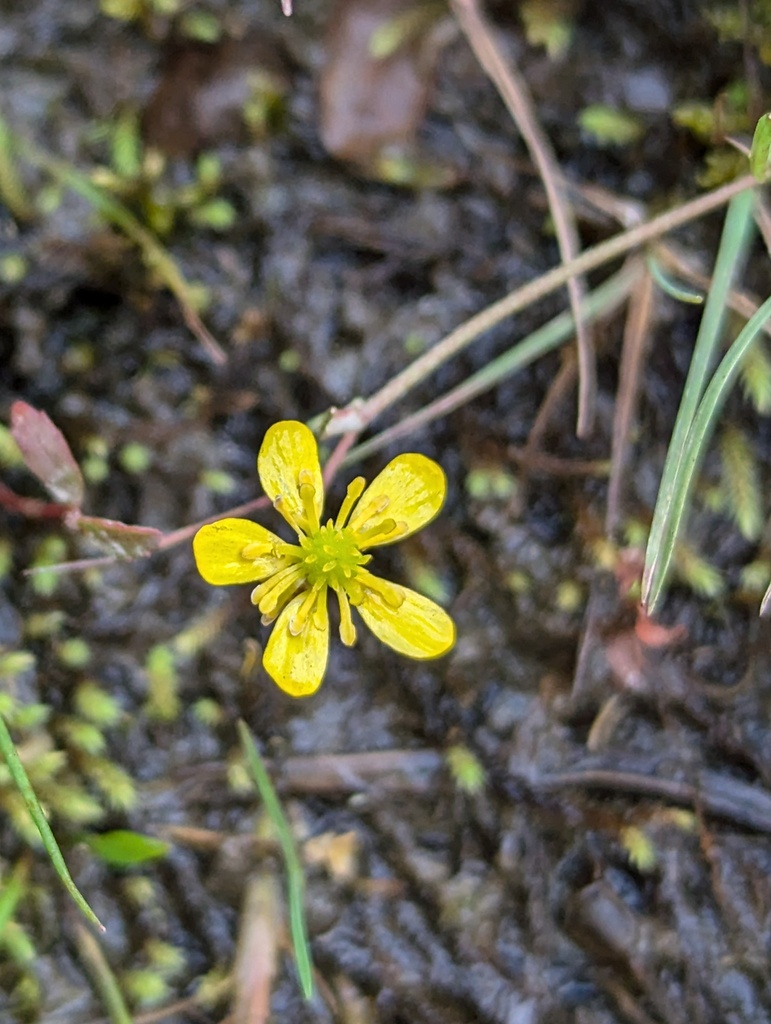
(c) Timothy McNitt, some rights reserved (CC BY), uploaded by Timothy McNitt · licence
Family: Ranunculaceae · Type: Perennial · Native
Ranunculus flammula var. ovalis (Greater creeping spearwort) is a native California perennial in the Ranunculaceae family, recognized by var. flammula by smaller dimensions.
Greater creeping spearwort is a California native perennial found in northwestern California, the Cascade Range, Sierra Nevada, central coastal California, San Bernardino Mountains, and Modoc Plateau in muddy ground and shallow water at elevations below 2,300 meters. Flowering from May to September, this plant produces small white to yellow flowers 3 to 5 millimeters long with delicate, rounded petals. Growing with prostrate or occasionally ascending stems 0.5 to 2 millimeters in diameter, it spreads across wet ground with a low, creeping habit. Its lance-elliptic to lanceolate leaves are narrow, measuring 0.8 to 3.3 centimeters long and 0.2 to 0.8 centimeters wide, creating a delicate ground-hugging appearance. The small flowers are accompanied by sepals 2 to 3 millimeters long, giving the plant a subtle but distinctive presence in wet, marshy environments.
Identification and appearance
Key characters: 56 sympatric species; distinguished from var. flammula by smaller dimensions
Habitat and range
Habitat: Muddy ground, shallow water
Elevation: < 2300 m
California counties: Mendocino, Del Norte, Humboldt, Fresno, Lake, Siskiyou, Tuolumne, Modoc, Butte, Nevada, Placer, Plumas, Amador, Alpine, Sierra, El Dorado, Marin, San Bernardino, Mariposa, Trinity, Tehama, Lassen, Sonoma, Shasta
Outside California: to Alaska, Newfoundland, Massachusetts
Bloom period
Ranunculus flammula var. ovalis blooms May-Sep.
How to tell it apart
vs Lasthenia: Ranunculus has separate petals around a central disk; Lasthenia has many tiny ray flowers around a disk (composite head).; vs Bowlesia: Ranunculus has glossy yellow petals in conspicuous flowers; Bowlesia has tiny white flowers in umbels with divided leaves.; vs Potentilla: Ranunculus has nectaries at petal bases and many pistils; Potentilla has no nectaries and styles attached to ovary sides.; vs Papaver: Ranunculus has 5 petals and many pistils; Papaver has 4 crinkled petals and a single large stigma disk.; vs Oxalis: Ranunculus has glossy separate petals; Oxalis has clover-like leaves and tubular flowers that close at night.
Frequently asked questions
Is Ranunculus flammula var. ovalis native to California?
Yes. Ranunculus flammula var. ovalis is native to California (recorded as native).
When does Ranunculus flammula var. ovalis bloom?
Ranunculus flammula var. ovalis blooms May-Sep.
Where in California does Ranunculus flammula var. ovalis grow?
Ranunculus flammula var. ovalis occurs in Mendocino, Del Norte, Humboldt, Fresno, Lake, Siskiyou, Tuolumne, Modoc and other counties, at elevations of < 2300 m.
What plant family does Ranunculus flammula var. ovalis belong to?
Ranunculus flammula var. ovalis is in the Ranunculaceae family, genus Ranunculus.
What habitat does Ranunculus flammula var. ovalis grow in?
Ranunculus flammula var. ovalis grows in Muddy ground, shallow water.
Related species
Other California species in the same genus, family, or bioregion.
Sources: Jepson eFlora · Index of California Plant Names · CalPhotos
Last updated 2026-10-01
Data from The California Species Project — 14,000+ California species with verified data from CNPS, CDFW, USFWS, Cal-IPC, and more.