Ranunculus sceleratus var. sceleratus
Cursed buttercup
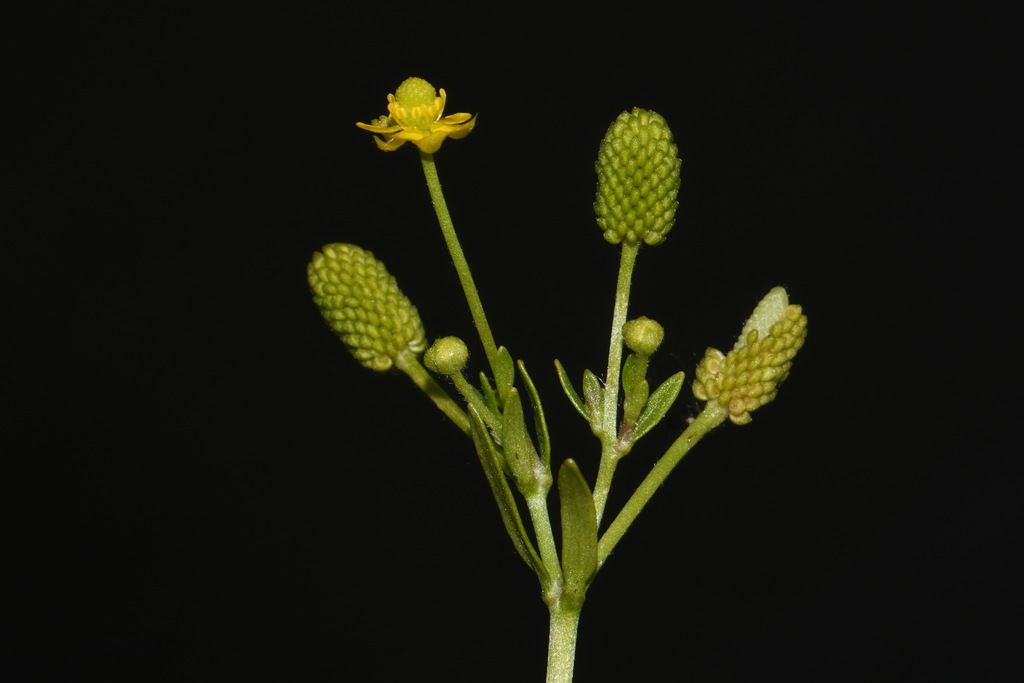
(c) Brian Finzel, some rights reserved (CC BY-SA), uploaded by Brian Finzel · licence
Family: Ranunculaceae · Type: Herb · Native
Ranunculus sceleratus var. sceleratus (Cursed buttercup) is a native California herb in the Ranunculaceae family, recognized by aquatic habit, small petals, and transversely wrinkled fruits.
Cursed buttercup is a native annual found in northern Coast Ranges, northern Sierra Nevada foothills, Central Valley, San Bernarddo Mountains, and Peninsular Ranges in pond and riverbank habitats at elevations below 1,800 meters. Flowering from April to June and again in October, this plant produces small yellow flowers in delicate clusters. Growing with slender, branching stems 10 to 40 centimeters tall, it spreads quickly in wet environments. Its leaves are distinctively lobed with segments that are crenate (scalloped) and can be undivided or further subdivided. The fruits develop with finely textured, transverse wrinkled surfaces that add a unique architectural quality to the plant.
Identification and appearance
Key characters: 36 sympatric species; key features are aquatic habit, small petals, and transversely wrinkled fruits
Habitat and range
Habitat: Ponds, riverbanks
Elevation: < 1800 m
California counties: Riverside, San Diego, Glenn, Butte, Shasta, Modoc, Merced, Santa Barbara
Outside California: to British Columbia, eastern United States, native to Europe
Bloom period
Ranunculus sceleratus var. sceleratus blooms Apr-Jun, Oct.
How to tell it apart
vs Lasthenia: Ranunculus has separate petals around a central disk; Lasthenia has many tiny ray flowers around a disk (composite head).; vs Bowlesia: Ranunculus has glossy yellow petals in conspicuous flowers; Bowlesia has tiny white flowers in umbels with divided leaves.; vs Potentilla: Ranunculus has nectaries at petal bases and many pistils; Potentilla has no nectaries and styles attached to ovary sides.; vs Papaver: Ranunculus has 5 petals and many pistils; Papaver has 4 crinkled petals and a single large stigma disk.; vs Oxalis: Ranunculus has glossy separate petals; Oxalis has clover-like leaves and tubular flowers that close at night.
Frequently asked questions
Is Ranunculus sceleratus var. sceleratus native to California?
Yes. Ranunculus sceleratus var. sceleratus is native to California (recorded as native).
When does Ranunculus sceleratus var. sceleratus bloom?
Ranunculus sceleratus var. sceleratus blooms Apr-Jun, Oct.
Where in California does Ranunculus sceleratus var. sceleratus grow?
Ranunculus sceleratus var. sceleratus occurs in Riverside, San Diego, Glenn, Butte, Shasta, Modoc, Merced, Santa Barbara, at elevations of < 1800 m.
What plant family does Ranunculus sceleratus var. sceleratus belong to?
Ranunculus sceleratus var. sceleratus is in the Ranunculaceae family, genus Ranunculus.
What habitat does Ranunculus sceleratus var. sceleratus grow in?
Ranunculus sceleratus var. sceleratus grows in Ponds, riverbanks.
Related species
Other California species in the same genus, family, or bioregion.
Sources: Jepson eFlora · Index of California Plant Names · CalPhotos
Last updated 2026-10-07
Data from The California Species Project — 14,000+ California species with verified data from CNPS, CDFW, USFWS, Cal-IPC, and more.