Ranunculus uncinatus
Hook seeded buttercup
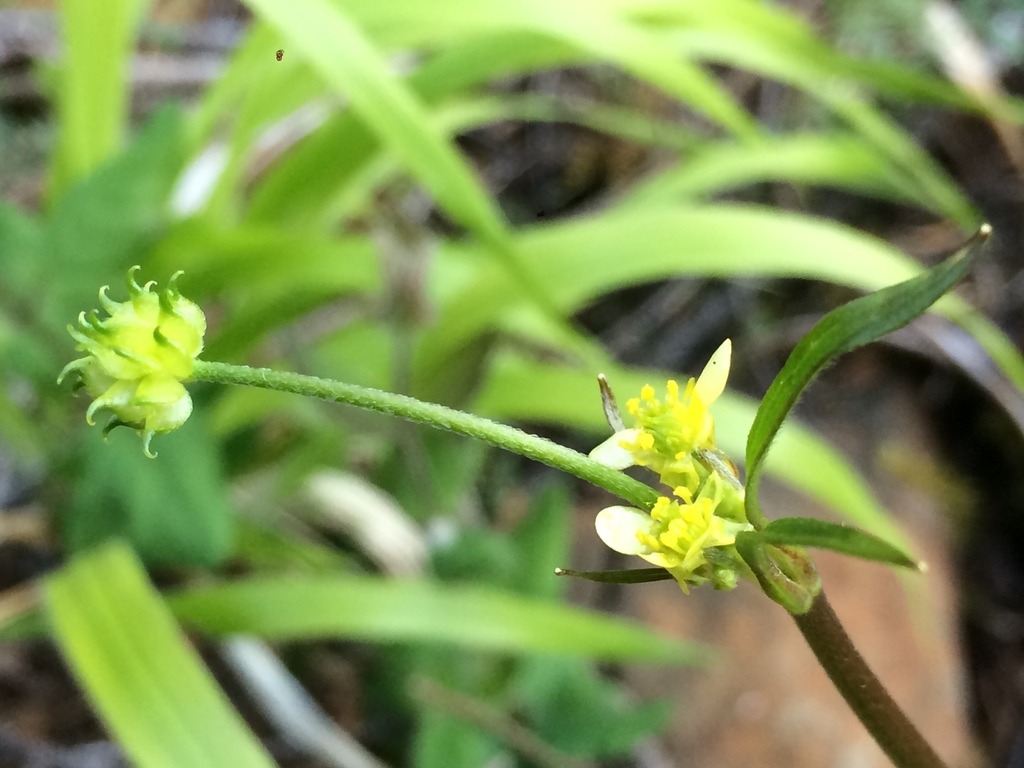
(c) B. Phalan, some rights reserved (CC BY) · licence
Family: Ranunculaceae · Type: Herb · Native
Ranunculus uncinatus (Hook seeded buttercup) is a native California herb in the Ranunculaceae family, recognized by hooked beak on disk-like fruits.
Hook seeded buttercup is a California native perennial found in northwestern California, central coastal California, the Cascade Range, northern and central Sierra Nevada, Modoc Plateau, and San Bernardin Mountains in moist meadows and woodlands, generally along streams at elevations up to 2,800 meters. Flowering from April to July, this plant produces yellow flowers with 5 delicate petals 2 to 4 millimeters long. Growing 15 to 60 centimeters tall with erect stems that do not root at the nodes, it develops from an upright base. Its distinctive leaves are heart-shaped to kidney-shaped, divided into three parts with lobed segments that have elliptic to lance-shaped edges with toothed margins. The fruit features a unique curved, hooked beak that gives the buttercup its distinctive "hook seeded" name.
Identification and appearance
Key characters: 53 sympatric species; key feature is hooked beak on disk-like fruits
Habitat and range
Habitat: Moist meadows or woodland, generally along streams
Elevation: < 2800 m
California counties: Humboldt, Calaveras, Lake, San Bernardino, Tuolumne, Del Norte, Santa Cruz, Modoc, Siskiyou, Inyo, Tulare, Nevada, Fresno, Trinity, Napa, Marin, Lassen, Madera, Butte, Tehama, Mendocino, Placer, Plumas, Glenn, Alpine, San Diego, Shasta, San Mateo, Sonoma, El Dorado, Sierra, Mariposa, Amador, Monterey
Outside California: to Alaska, New Mexico
Bloom period
Ranunculus uncinatus blooms Apr-Jul.
How to tell it apart
vs Lasthenia: Ranunculus has separate petals around a central disk; Lasthenia has many tiny ray flowers around a disk (composite head).; vs Bowlesia: Ranunculus has glossy yellow petals in conspicuous flowers; Bowlesia has tiny white flowers in umbels with divided leaves.; vs Potentilla: Ranunculus has nectaries at petal bases and many pistils; Potentilla has no nectaries and styles attached to ovary sides.; vs Papaver: Ranunculus has 5 petals and many pistils; Papaver has 4 crinkled petals and a single large stigma disk.; vs Oxalis: Ranunculus has glossy separate petals; Oxalis has clover-like leaves and tubular flowers that close at night.
Frequently asked questions
Is Ranunculus uncinatus native to California?
Yes. Ranunculus uncinatus is native to California (recorded as native).
When does Ranunculus uncinatus bloom?
Ranunculus uncinatus blooms Apr-Jul.
Where in California does Ranunculus uncinatus grow?
Ranunculus uncinatus occurs in Humboldt, Calaveras, Lake, San Bernardino, Tuolumne, Del Norte, Santa Cruz, Modoc and other counties, at elevations of < 2800 m.
What plant family does Ranunculus uncinatus belong to?
Ranunculus uncinatus is in the Ranunculaceae family, genus Ranunculus.
What habitat does Ranunculus uncinatus grow in?
Ranunculus uncinatus grows in Moist meadows or woodland, generally along streams.
Related species
Other California species in the same genus, family, or bioregion.
- Ranunculus acris — Acrid buttercup
- Ranunculus alismifolius — Alisma leaved buttercup
- Ranunculus alismifolius var. alismellus — Plantainleaf buttercup
- Ranunculus alismifolius var. alismifolius — Plantainleaf buttercup
- Ranunculus alismifolius var. hartwegii — Common water plantain buttercup
- Ranunculus alismifolius var. lemmonii — Common water plantain buttercup
- Thalictrum alpinum — Arctic meadow-rue
- Thalictrum fendleri — Fendler's meadow rue
- Thalictrum fendleri var. fendleri — Fendler's meadow rue
- Thalictrum fendleri var. polycarpum — Fendler's meadow rue
Sources: Jepson eFlora · Index of California Plant Names · CalPhotos
Last updated 2026-10-07
Data from The California Species Project — 14,000+ California species with verified data from CNPS, CDFW, USFWS, Cal-IPC, and more.