Rapistrum rugosum
Annual bastardcabbage
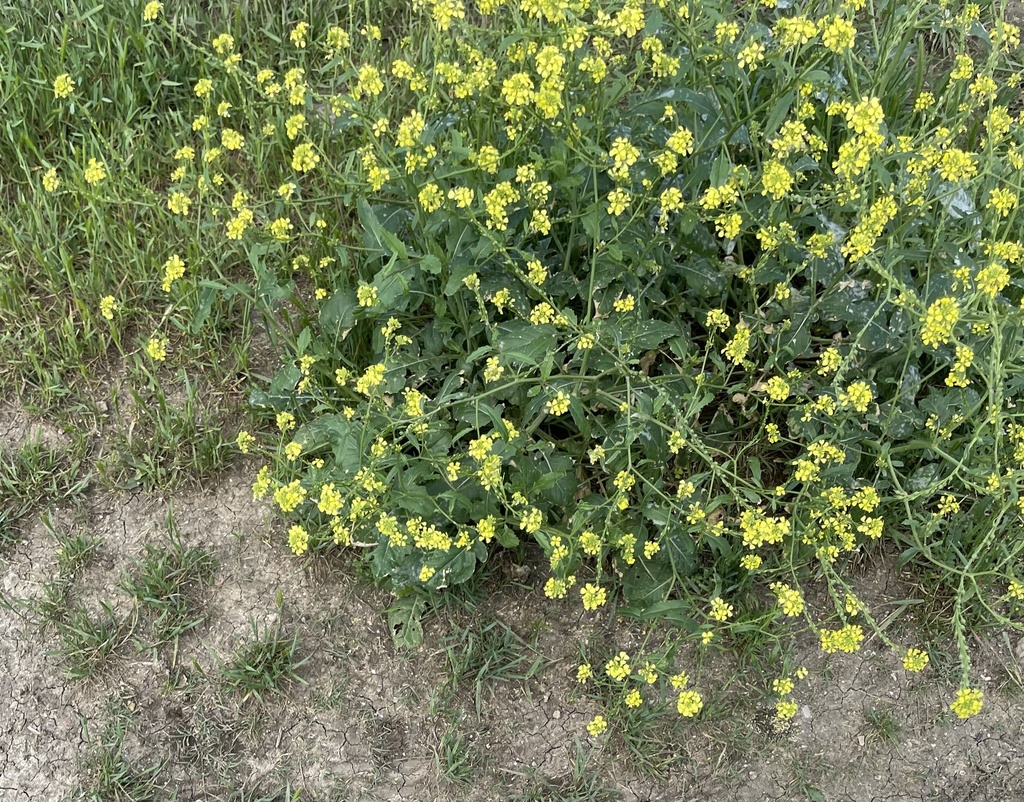
(c) Cliff Tyllick, some rights reserved (CC BY) · licence
Family: Brassicaceae · Type: Herb · Not Native
Rapistrum rugosum (Annual bastardcabbage) is a non-native California herb in the Brassicaceae family, recognized by Only Rapistrum species in CA, European introduction with highly distinctive segmented fruits unlike other Brassicaceae.
Annual bastardcabbage is a naturalized plant found in the Central Coast bioregion in disturbed areas and fields at elevations below 200 meters. Flowering from April to July, this plant produces pale yellow flowers 6 to 11 millimeters long with distinctive petals. Growing with erect stems 30 to 100 centimeters tall that branch extensively in the upper portions, it has a robust and spreading growth habit. Its leaves are basal, oblanceolate to obovate, with one to five pairs of lateral lobes measuring 2 to 25 centimeters long. The fruit is hairy, with a proximal segment 0.7 to 3 millimeters long and a terminal segment that is spheric to ovoid and generally ribbed.
Identification and appearance
Key characters: Only Rapistrum species in CA, European introduction with highly distinctive segmented fruits unlike other Brassicaceae
Habitat and range
Habitat: Disturbed areas, fields
Elevation: < 200 m
Outside California: to Washington, Ontario, eastern United States, Mexico, native to southern Europe
Bloom period
Rapistrum rugosum blooms Apr-Jul.
How to tell it apart
vs Hirschfeldia: Rapistrum has stiff hairs below and a spherical terminal fruit segment, Hirschfeldia is smoother with cylindrical pods.; vs Mutarda: Check the fruit tip - Rapistrum has a distinctive round, bead-like terminal segment containing seeds.; vs Cakile: Rapistrum has stiff hairs and yellow flowers, Cakile is completely smooth with white to lavender flowers.; vs Carrichtera: Rapistrum has yellow petals and upright pods, Carrichtera has dark-veined cream petals and downward-curved pods.; vs Armoracia: Rapistrum is an annual with stiff hairs and beaded fruits, Armoracia is a huge perennial with fleshy roots.
Frequently asked questions
Is Rapistrum rugosum native to California?
No. Rapistrum rugosum is not native to California (recorded as not native).
When does Rapistrum rugosum bloom?
Rapistrum rugosum blooms Apr-Jul.
What plant family does Rapistrum rugosum belong to?
Rapistrum rugosum is in the Brassicaceae family, genus Rapistrum.
What habitat does Rapistrum rugosum grow in?
Rapistrum rugosum grows in Disturbed areas, fields.
Related species
Other California species in the same genus, family, or bioregion.
Sources: Jepson eFlora · CalPhotos
Last updated 2026-10-07
Data from The California Species Project — 14,000+ California species with verified data from CNPS, CDFW, USFWS, Cal-IPC, and more.