Rhamnus crocea
Spiny redberry, Spiny Redberry
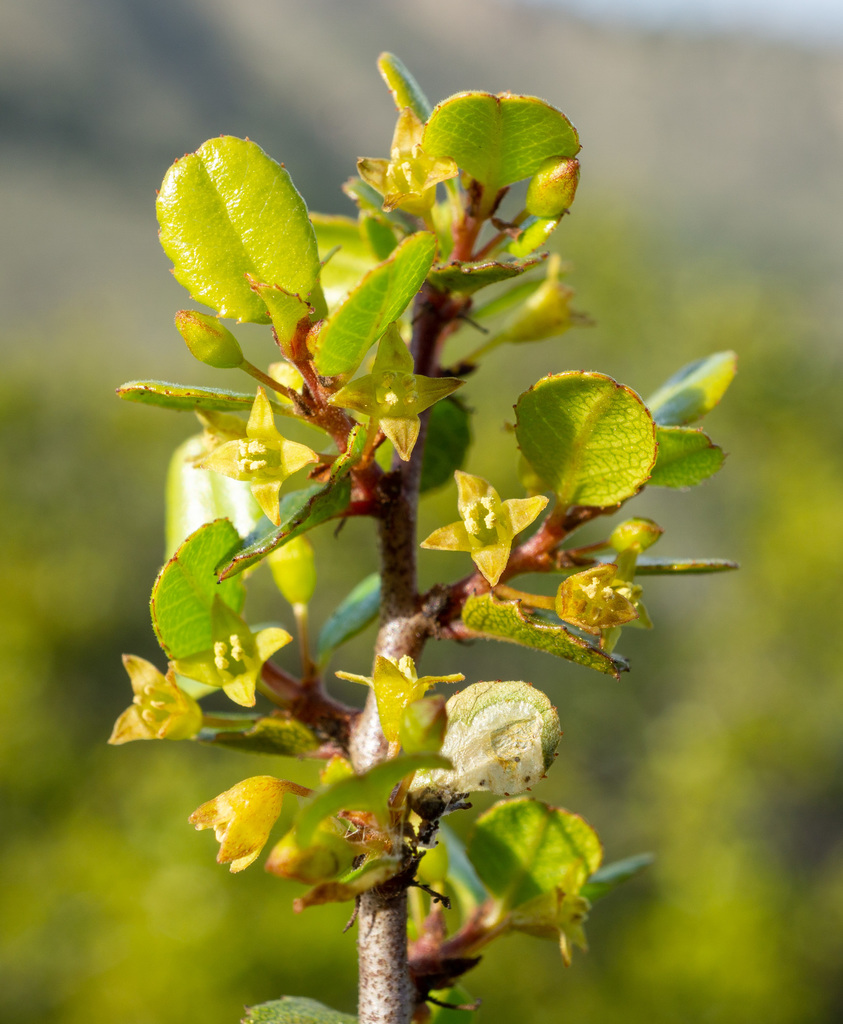
(c) Matt Berger, some rights reserved (CC BY), uploaded by Matt Berger · licence
Family: Rhamnaceae · Type: Shrub / Tree · Native
Rhamnus crocea (Spiny redberry) is a native California shrub / tree in the Rhamnaceae family, recognized by thorn-tipped red twigs, smallest leaves, and spreading rooting habit.
Spiny redberry is a California native shrub found in the Klamath Ranges, northern coastal ranges, southern High Sierra Nevada, central western, and southwestern California in coastal-sage scrub, chaparral, and woodland habitats at elevations below 1,150 meters. Flowering from January to April, this plant produces small, subtle flowers in sparse clusters on glabrous pedicels. Growing as a compact shrub under 2 meters tall, it features many spreading, stiff branches with distinctive red or red-purple twigs that are often thorn-tipped. Its evergreen leaves are thick and elliptic to obovate, 10 to 15 millimeters long, with sharp-toothed or entire margins and a rounded tip. The fruit is a bright red, two-stoned drupe approximately 6 millimeters long, adding ornamental interest to this tough, drought-tolerant shrub.
Identification and appearance
Key characters: 5 sympatric species; distinguished by thorn-tipped red twigs, smallest leaves, and spreading rooting habit
Habitat and range
Habitat: Coastal-sage scrub, chaparral, woodland
Elevation: < 1150 m
California counties: Los Angeles, San Diego, San Bernardino, San Luis Obispo, San Mateo, Riverside, Santa Barbara, Tuolumne, San Francisco, Alameda, Santa Clara, Lake, Ventura, Monterey, Orange, Marin, Tulare, Sacramento, Napa, El Dorado, Sonoma, San Benito, Kern, Solano, Mendocino, Contra Costa, Yuba, Butte, Humboldt, Siskiyou, Shasta, Trinity, Fresno
Outside California: Baja California
Bloom period
Rhamnus crocea blooms Jan-Apr.
How to tell it apart
vs Ceanothus: Rhamnus has tiny inconspicuous flowers; Ceanothus has showy white or blue flower clusters.; vs Quercus: Rhamnus has thin leaves and berry fruits; Quercus has thick leaves and acorns.; vs Prunus: Rhamnus fruits have 2-4 stones inside; Prunus has single large stone (pit).; vs Rhus: Rhamnus has simple leaves and scaly buds; Rhus has compound leaves and hairy fruits.; vs Frangula: Rhamnus buds have protective scales; Frangula buds are completely naked.
Frequently asked questions
Is Rhamnus crocea native to California?
Yes. Rhamnus crocea is native to California (recorded as native).
When does Rhamnus crocea bloom?
Rhamnus crocea blooms Jan-Apr.
Where in California does Rhamnus crocea grow?
Rhamnus crocea occurs in Los Angeles, San Diego, San Bernardino, San Luis Obispo, San Mateo, Riverside, Santa Barbara, Tuolumne and other counties, at elevations of < 1150 m.
What plant family does Rhamnus crocea belong to?
Rhamnus crocea is in the Rhamnaceae family, genus Rhamnus.
What habitat does Rhamnus crocea grow in?
Rhamnus crocea grows in Coastal-sage scrub, chaparral, woodland.
Related species
Other California species in the same genus, family, or bioregion.
Sources: Jepson eFlora · Index of California Plant Names · CalPhotos
Last updated 2026-10-07
Data from The California Species Project — 14,000+ California species with verified data from CNPS, CDFW, USFWS, Cal-IPC, and more.