Rhaponticum repens
Russian knapweed
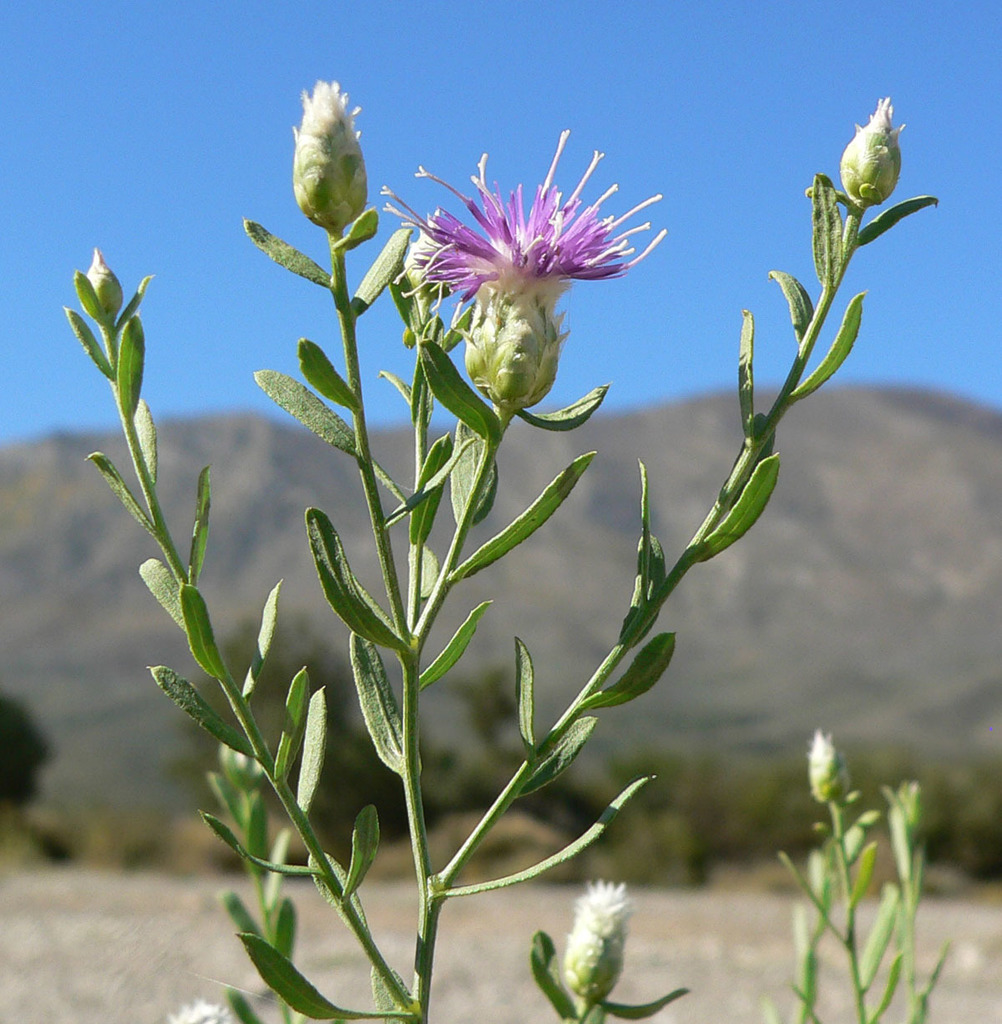
(c) Stan Shebs, some rights reserved (CC BY-SA) · licence
Family: Asteraceae · Type: Herb · Not Native
Conservation status: Cal-IPC Yes
Rhaponticum repens (Russian knapweed) is a non-native California herb in the Asteraceae family, recognized by Central Asian genus naturalized in North America, representing a weedy introduction.
Russian knapweed is a naturalized perennial found in California's interior regions, excluding the wettest northwestern and driest Great Basin areas, in fields and roadsides at elevations below 2,250 meters. Flowering from May to September, this plant produces pale purple to pink flowers in flat-topped or panicle-like clusters with distinctive heads 10 to 14 millimeters wide. Growing with ascending branches 30 to 100 centimeters tall, it initially appears cobwebby-hairy but becomes increasingly glabrous with age. Its lower leaves are 4 to 10 centimeters long, linear to oblanceolate, with 1 to 2 pinnate lobes, while upper leaves become progressively narrower and smaller. The plant produces small fruits with deciduous pappus bristles that are 6 to 10 millimeters long and barbed at the base.
Identification and appearance
Key characters: Central Asian genus naturalized in North America, representing a weedy introduction
Habitat and range
Habitat: Fields, roadsides
Elevation: < 2250 m
Outside California: North America, native to central Asia
Bloom period
Rhaponticum repens blooms May-Sep.
Conservation status
Cal-IPC Yes
How to tell it apart
vs Centaurea: Centaurea phyllaries bear a distinct fringed, comb-like, or spine-tipped appendage; Rhaponticum phyllaries are entire with a rounded, translucent papery tip and no spine.; vs Cirsium: True thistles have spiny-margined leaves and spine-tipped involucres; Rhaponticum has unarmed, softly cobwebby leaves and spineless heads.; vs Carduus: Carduus is spiny with winged stems; Rhaponticum is spineless, spreads by creeping rhizomes into dense colonies, and has papery-tipped phyllaries.; vs Silybum: Milk thistle has huge white-marbled spiny leaves; Rhaponticum has small, gray-green, unarmed leaves and pink discoid heads.; vs Saussurea: Saussurea is a native clumping perennial of high elevations; Rhaponticum is a colonial lowland weed with broad, entire, translucent-tipped phyllaries and deep spreading rhizomes.
Frequently asked questions
Is Rhaponticum repens native to California?
No. Rhaponticum repens is not native to California (recorded as not native).
When does Rhaponticum repens bloom?
Rhaponticum repens blooms May-Sep.
What plant family does Rhaponticum repens belong to?
Rhaponticum repens is in the Asteraceae family, genus Rhaponticum.
Is Rhaponticum repens invasive in California?
Rhaponticum repens is listed by Cal-IPC with an invasiveness rating of Yes.
What habitat does Rhaponticum repens grow in?
Rhaponticum repens grows in Fields, roadsides.
Related species
Other California species in the same genus, family, or bioregion.
Sources: Jepson eFlora · Index of California Plant Names · CalPhotos
Last updated 2026-10-07
Data from The California Species Project — 14,000+ California species with verified data from CNPS, CDFW, USFWS, Cal-IPC, and more.