Rhodiola integrifolia subsp. integrifolia
Western roseroot, Western Roseroot
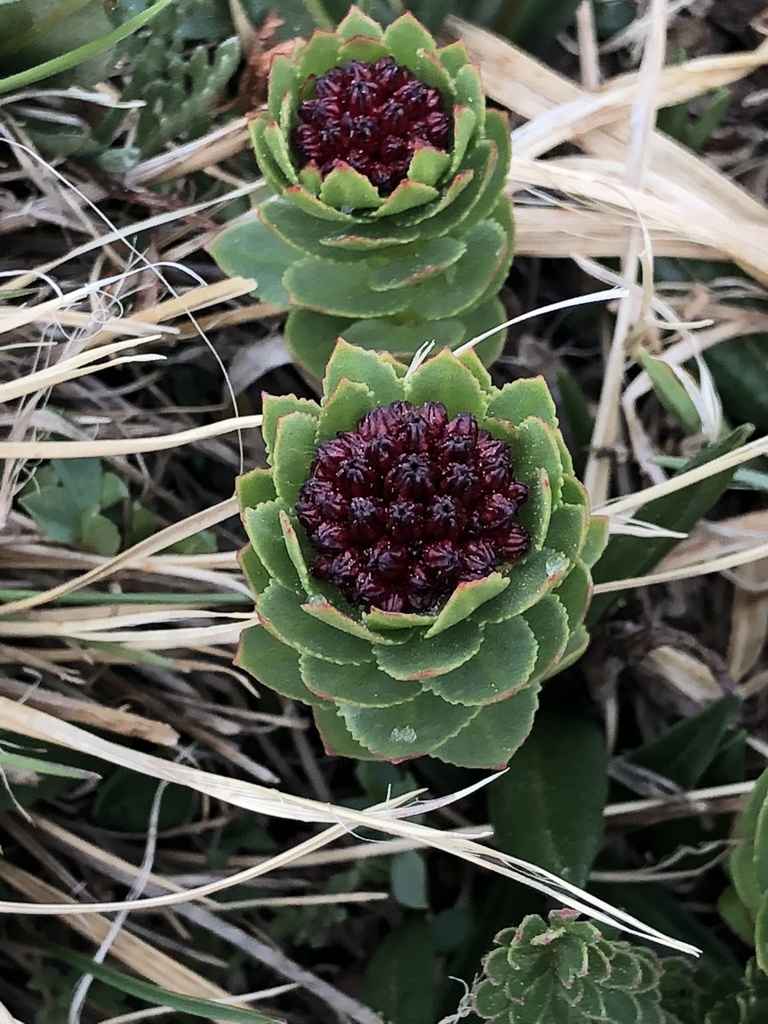
no rights reserved · CC0
Family: Crassulaceae · Type: Herb · Native
Rhodiola integrifolia subsp. integrifolia (Western roseroot) is a native California herb in the Crassulaceae family, recognized by Only member of genus Rhodiola in California, representing the southernmost extent of this circumpolar arctic-alpine genus in western….
Western roseroot is a California native perennial found in the Klamath Ranges, Sierra Nevada, Warner Mountains, and White and Inyo Mountains in alpine habitats on cliffs, talus, and meadow margins at elevations of 1,800 to 4,000 meters. Flowering from May to August, this plant produces dark red to deep red-purple flowers in dense clusters 1 to 3 centimeters long. Growing with a short, thick, fleshy branched caudex and compact stems 3 to 15 centimeters tall, it forms low-growing clusters in harsh alpine environments. Its leaves are oblanceolate to obovate, 5 to 30 millimeters long, with entire or slightly toothed edges and an acute to obtuse tip. The plant produces small fruits 3 to 6 millimeters long, with most individual plants bearing either male or female flowers.
Identification and appearance
Key characters: Only member of genus Rhodiola in California, representing the southernmost extent of this circumpolar arctic-alpine genus in western North America
Habitat and range
Habitat: Cliffs, talus, alpine ridges, margins of meadows, streams
Elevation: 1800-4000 m
California counties: Inyo, Mono, Fresno, Nevada, Siskiyou, Tuolumne, Tulare, Mariposa, Placer, Madera, Alpine, Amador, El Dorado
Outside California: western North America
Bloom period
Rhodiola integrifolia subsp. integrifolia blooms May-Aug.
How to tell it apart
vs Sedum: Rhodiola has unisexual flowers on separate plants; Sedum flowers contain both stamens and pistils.; vs Hylotelephium: Rhodiola grows only in high mountains above 1800m; Hylotelephium is a garden escape at lower elevations.; vs Sedella: Rhodiola is perennial with thick stems; Sedella is a tiny annual with thread-like stems.; vs Crassula: Rhodiola has 4-5 petals per flower; Crassula typically has 3-4 petals.; vs Dudleya: Rhodiola has thin, non-rosette leaves along stems; Dudleya forms distinct basal rosettes.
Frequently asked questions
Is Rhodiola integrifolia subsp. integrifolia native to California?
Yes. Rhodiola integrifolia subsp. integrifolia is native to California (recorded as native).
When does Rhodiola integrifolia subsp. integrifolia bloom?
Rhodiola integrifolia subsp. integrifolia blooms May-Aug.
Where in California does Rhodiola integrifolia subsp. integrifolia grow?
Rhodiola integrifolia subsp. integrifolia occurs in Inyo, Mono, Fresno, Nevada, Siskiyou, Tuolumne, Tulare, Mariposa and other counties, at elevations of 1800-4000 m.
What plant family does Rhodiola integrifolia subsp. integrifolia belong to?
Rhodiola integrifolia subsp. integrifolia is in the Crassulaceae family, genus Rhodiola.
What habitat does Rhodiola integrifolia subsp. integrifolia grow in?
Rhodiola integrifolia subsp. integrifolia grows in Cliffs, talus, alpine ridges, margins of meadows, streams.
Related species
Other California species in the same genus, family, or bioregion.
Sources: Jepson eFlora · Index of California Plant Names · CalPhotos
Last updated 2026-10-07
Data from The California Species Project — 14,000+ California species with verified data from CNPS, CDFW, USFWS, Cal-IPC, and more.