Rhododendron columbianum
Western labrador tea
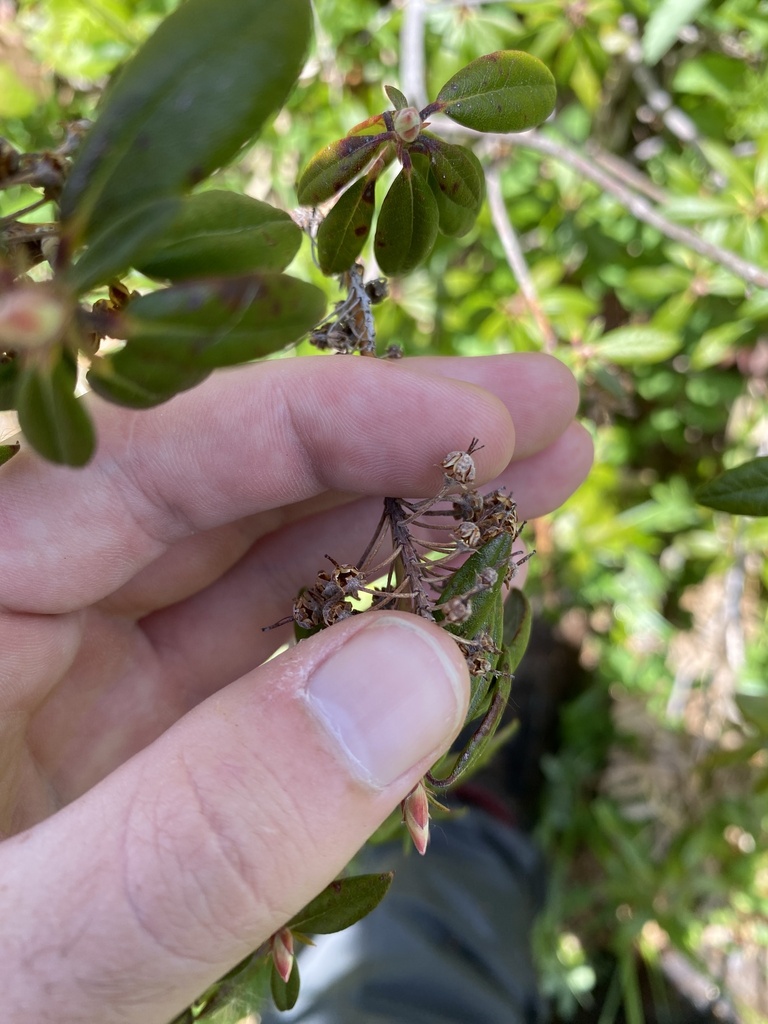
(c) Daniel Kennedy, some rights reserved (CC BY) · licence
Family: Ericaceae · Type: Shrub · Native
Rhododendron columbianum (Western labrador tea) is a native California shrub in the Ericaceae family, recognized by small evergreen leaves with glandular scales vs large smooth evergreen or deciduous leaves.
Western labrador tea is a California native shrub found in coastal regions, the Klamath Ranges, Sierra Nevada, and other mountainous areas in bogs, stream margins, and occasionally well-drained sites at elevations up to 3,630 meters. Flowering from May to August, this plant produces white to cream bell-shaped flowers in rounded clusters. Growing up to 2 meters tall with smooth bark that may peel or shred with age, it has erect stems covered in fine unicellular hairs. Its leathery, evergreen leaves are 1 to 8 centimeters long with margins that are flat or slightly rolled under, featuring sparse glandular scales on their surface. The fruit is a capsule 8 to 10 millimeters wide that dehisces from base to tip.
Identification and appearance
Key characters: 2 sympatric species; key features are small evergreen leaves with glandular scales vs large smooth evergreen or deciduous leaves
Habitat and range
Habitat: Coast, higher elevations inland, bogs, stream margins, occasionally well-drained sites
Elevation: < 3630 m
California counties: Tulare, Mono, El Dorado, Tuolumne, Mariposa, Mendocino, Del Norte, Fresno, Nevada, Inyo, Sierra, Sonoma, Plumas, Calaveras, Marin, Shasta, Madera, Humboldt, Trinity, Lassen, Placer, Siskiyou, Modoc, Santa Cruz, Santa Clara, Tehama, Alpine, Amador, Monterey
Outside California: to British Columbia, Montana, Wyoming, Utah
Bloom period
Rhododendron columbianum blooms May-Aug.
How to tell it apart
vs Rosa: Rhododendron has tubular bell-shaped flowers; Rosa has flat open flowers with separate petals.; vs Nerium: Rhododendron has alternate leaves; Nerium has leaves in whorls of 3-4.; vs Cordia: Rhododendron has fused petals forming tubes; Cordia has separate spreading petals.; vs Hibiscus: Rhododendron has many separate stamens; Hibiscus has stamens fused into a central column.; vs Gardenia: Rhododendron has alternate leaves; Gardenia has opposite or whorled leaves.
Frequently asked questions
Is Rhododendron columbianum native to California?
Yes. Rhododendron columbianum is native to California (recorded as native).
When does Rhododendron columbianum bloom?
Rhododendron columbianum blooms May-Aug.
Where in California does Rhododendron columbianum grow?
Rhododendron columbianum occurs in Tulare, Mono, El Dorado, Tuolumne, Mariposa, Mendocino, Del Norte, Fresno and other counties, at elevations of < 3630 m.
What plant family does Rhododendron columbianum belong to?
Rhododendron columbianum is in the Ericaceae family, genus Rhododendron.
What habitat does Rhododendron columbianum grow in?
Rhododendron columbianum grows in Coast, higher elevations inland, bogs, stream margins, occasionally well-drained sites.
Related species
Other California species in the same genus, family, or bioregion.
Sources: Jepson eFlora · Index of California Plant Names · CalPhotos
Last updated 2026-10-07
Data from The California Species Project — 14,000+ California species with verified data from CNPS, CDFW, USFWS, Cal-IPC, and more.