Rhus aromatica
Skunk bush, Skunk Bush
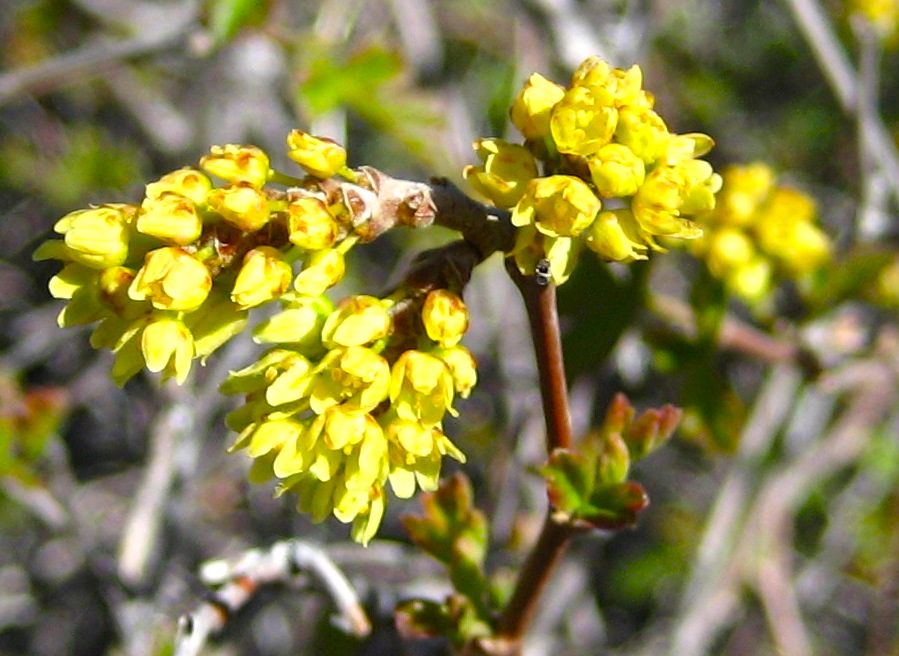
Photo by Chez Brungraber
Family: Anacardiaceae · Type: Shrub · Native
Conservation status: CNPS 2B.3
Rhus aromatica (Skunk bush) is a native California shrub in the Anacardiaceae family, recognized by unique in having compound deciduous leaves vs simple evergreen leaves of congeners.
Skunk bush is a California native shrub found in the California Floristic Province, Mojave Desert (excluding central), and northern Sonoran Desert on slopes, washes, and scrublands at elevations below 2,200 meters. Flowering from March to May, this plant produces yellow petals and yellow-green to reddish sepals in small clusters that emerge before its leaves. Growing as a deciduous shrub 0.5 to 2.5 meters tall with short, stiff branches, it has a distinctive growth form that provides visual interest in arid landscapes. Its leaves are compound with three leaflets, featuring a diamond-shaped terminal leaflet 10 to 35 millimeters long and smaller ovate side leaflets, which are tomentose or slightly hairy on the underside. The fruit is a sticky, bright red-orange drupe approximately 5 to 8 millimeters in diameter, adding further visual appeal to this aromatic shrub.
Identification and appearance
Key characters: 2 sympatric species; unique in having compound deciduous leaves vs simple evergreen leaves of congeners
Habitat and range
Habitat: Slopes, washes, scrub
Elevation: < 2200 m
California counties: San Bernardino, San Luis Obispo, Los Angeles, Riverside, Orange, San Diego, Monterey, Modoc, Butte, Fresno, Glenn, Inyo, Lake, Napa, Mariposa, Santa Barbara, Ventura, Calaveras, Trinity, Colusa, Shasta, Kern, Siskiyou, Madera, Tulare, Yolo, Tehama, Mendocino, Nevada, Tuolumne, El Dorado, Contra Costa, Lassen, Solano, Stanislaus, Sutter, Humboldt
Outside California: to southern Canada, central United States, northern Mexico
Bloom period
Rhus aromatica blooms Mar-May.
Conservation status
CNPS 2B.3
How to tell it apart
vs Malosma: Malosma has simple undivided leaves; Rhus has compound leaves divided into 9+ leaflets.; vs Toxicodendron: Toxicodendron leaflets are shiny-glossy on top; Rhus leaflets are dull and flat-looking.; vs Heteromeles: Heteromeles has simple toothed leaves and smooth red berries; Rhus has compound leaves and fuzzy clustered fruits.; vs Rhamnus: Rhamnus has simple leaves and smooth berries; Rhus has compound leaves and fuzzy red berry clusters.; vs Quercus: Quercus has simple lobed leaves; Rhus has compound leaves divided into multiple leaflets.
Frequently asked questions
Is Rhus aromatica native to California?
Yes. Rhus aromatica is native to California (recorded as native).
When does Rhus aromatica bloom?
Rhus aromatica blooms Mar-May.
Where in California does Rhus aromatica grow?
Rhus aromatica occurs in San Bernardino, San Luis Obispo, Los Angeles, Riverside, Orange, San Diego, Monterey, Modoc and other counties, at elevations of < 2200 m.
What plant family does Rhus aromatica belong to?
Rhus aromatica is in the Anacardiaceae family, genus Rhus.
Is Rhus aromatica rare or endangered?
Rhus aromatica carries California Rare Plant Rank 2B.3, state rank S2.
Related species
Other California species in the same genus, family, or bioregion.
Sources: Jepson eFlora · Index of California Plant Names · CalPhotos · CDFW CNDDB
Last updated 2026-10-07
Data from The California Species Project — 14,000+ California species with verified data from CNPS, CDFW, USFWS, Cal-IPC, and more.